
OASNET: Maximizing Influence via Community-Aware Resource Allocation
Maximizing influence spread in modular social networks by optimal resource allocation q
This paper introduces OASNET (Optimal Allocation in a Social NETwork), a framework that treats Influence Maximization (IM) as a resource allocation problem across modular communities. By utilizing a dynamic programming approach to distribute seed nodes among network clusters, it significantly outperforms traditional degree-based heuristics in Independent Cascade models with high diffusion probabilities.
TL;DR
The Influence Maximization (IM) problem—finding users to trigger the widest possible adoption of an idea—is a staple of viral marketing but remains computationally "heavy." This paper proposes OASNET, which reimagines the problem. Instead of picking nodes from the whole graph, it breaks the network into communities and uses Dynamic Programming to decide exactly how many "seed" nodes each community deserves. When diffusion probabilities are high, this "divide-and-conquer" allocation beats standard degree-based methods significantly.
Background: The Scalability Wall
Since Kempe et al. (2003) proved that IM is NP-hard, the community has struggled with two issues:
- Complexity: The standard Greedy approach is too slow for millions of nodes.
- Topological Blindness: Heuristics like "High Degree" often overlap their influence, wasting seeds in the same dense cluster while ignoring other influential pockets of the network.
The Core Insight: Modularity as an Asset
Most social networks are modular—dense clusters (communities) connected by sparse "weak ties." The authors argue that we shouldn't treat a network as a monolithic entity. Instead, we should view initial active nodes as a limited resource to be allocated among different communities.
1. The Growth Function
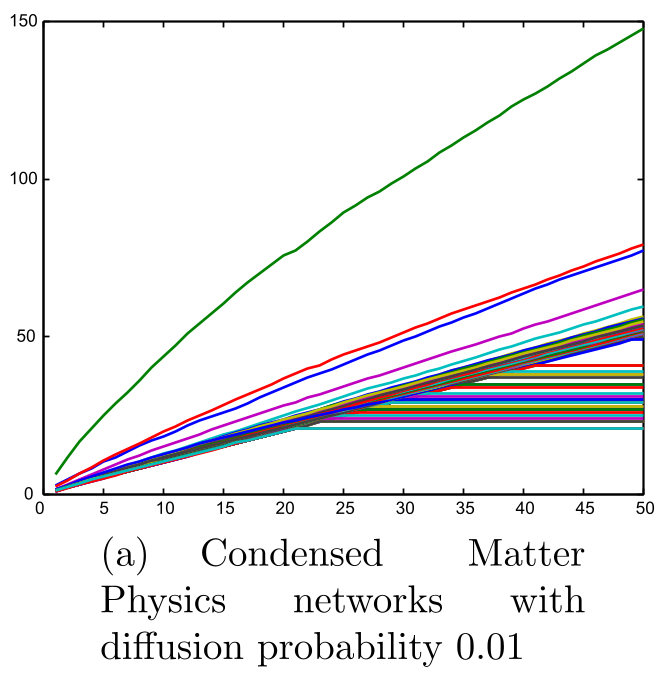
The authors define as the expected number of active nodes given seeds in graph under model and strategy . This function captures the "return on investment" for each seed placed in a specific community.
2. Optimal Allocation via Dynamic Programming
Assuming communities are disconnected (a simplification later relaxed), the total influence is just the sum of local influences. The goal is to maximize: subject to . This is a classic resource allocation problem that can be solved efficiently using DP in time.
Why Does It Work? The Percolation Effect
The most profound insight in the paper relates to Bond Percolation. In the Independent Cascade model, there is a "phase transition" probability.
- Below the threshold: Growth functions are smooth; OASNET performs similarly to standard heuristics.
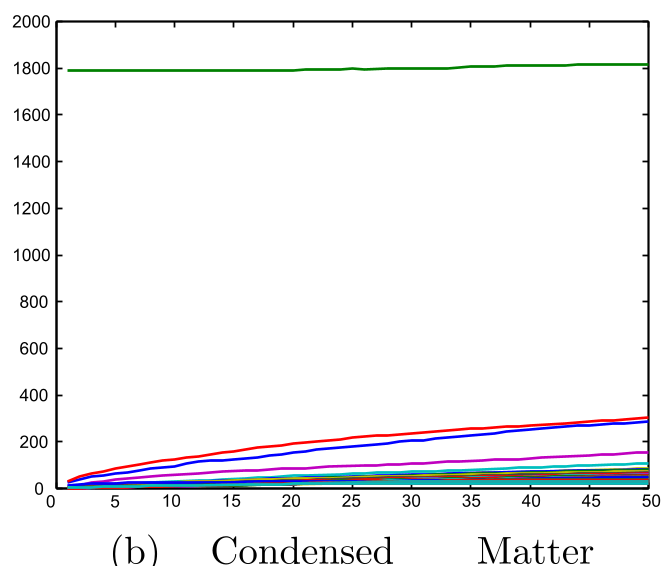
- Above the threshold: The "Largest Community" reaches a percolation stage where one seed might activate a massive portion of the cluster, causing the growth function to "hop" or saturate quickly.
By identifying these "steep" growth phases in local communities, OASNET avoids over-investing seeds in communities that are already saturated and redirects them to clusters where they can trigger new local cascades.
Experimental Validation
The authors tested OASNET on three real-world co-authorship networks (CondMat, NetHEPT, NetPHY).
Key Findings:
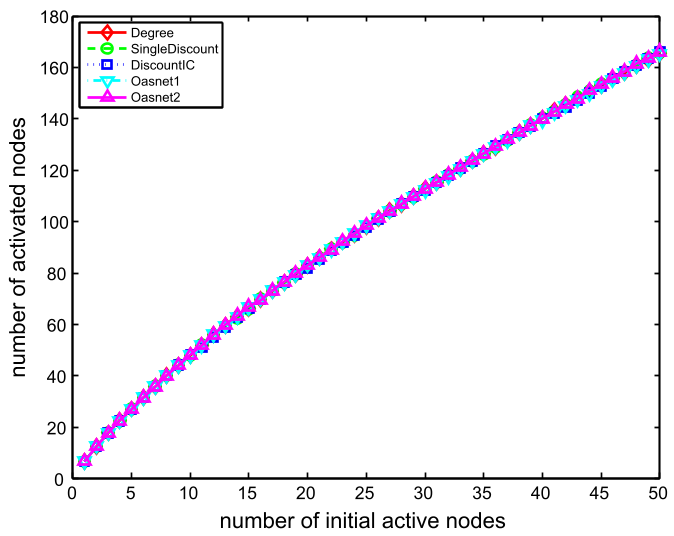
- Performance Boost: On the Independent Cascade model with , OASNET consistently outperformed "Degree Discount" and "High Degree" heuristics.
- Threshold Sensitivity: The advantage of OASNET is most pronounced when the diffusion probability is high enough to differentiate the growth patterns of different-sized communities.
- Linear Threshold Model: Performance was comparable to existing heuristics, as the LT model often results in smoother growth functions that don't trigger the DP's optimization advantages as sharply as the IC model.
Critical Analysis & Conclusion
Takeaway
OASNET effectively bridges the gap between high-quality greedy selection and high-speed heuristics. By using modularity, it enforces a "diversity" in seed selection that simple degree-based methods lack.
Limitations
The model assumes communities are largely disconnected. While the authors introduced "dummy nodes" to handle cross-community edges, in hyper-connected networks, the "leakage" of influence between clusters might violate the independence required for the DP approach.
Future Work
The authors suggest extending this to temporal networks—how should we allocate resources when the social structure changes tomorrow? This remains a vital question for real-world viral marketing campaigns.