
PALU: Breaking the Unlearning Trade-off via Dual-Sparsity Localized Entropy
Maximizing Local Entropy Where It Matters: Prefix-Aware Localized LLM Unlearning
This paper introduces PALU (Prefix-Aware Localized Unlearning), a framework designed to remove sensitive knowledge from LLMs by maximizing local entropy across temporal and vocabulary dimensions. PALU achieves state-of-the-art forgetting efficacy on benchmarks like TOFU and MUSE while maintaining near-perfect model utility.
TL;DR
Unlearning sensitive data in Large Language Models (LLMs) usually feels like a zero-sum game: you either forget too little or you break the model’s general intelligence. PALU (Prefix-Aware Localized Unlearning) shifts this paradigm. By discovering that we only need to disrupt the "initiating" tokens and flatten the "top-tier" vocabulary logits, PALU achieves surgical-grade erasure with minimal collateral damage to the model's original performance.
The Problem: The "Over-Correction" Trap
Traditional unlearning methods rely on Negated Cross-Entropy (-CE). If the model knows "The secret key is 1234," -CE tries to push the probability of "1234" to zero. However, this has two fatal flaws:
- Semantic Redundancy: If you suppress "1234," the model might just pivot to a synonym or a similar representation, failing to truly "forget" the concept.
- Global Damage: These methods apply gradients to every token in the sentence (including "The", "is", "a"), which eventually degrades the model’s ability to speak fluently (the "gibberish" problem).
The Methodology: Precision over Force
PALU is built on a "Dual-Sparsity" insight that treats unlearning as a targeted intervention rather than a global reconstruction.
1. Temporal Sparsity (Prefix Awareness)
The authors found that sensitive generation is a causal chain. If you disrupt the prefix (the first few pivotal tokens), the rest of the sensitive sequence naturally collapses. PALU identifies sensitive spans and only optimizes the first tokens (typically ).
2. Vocabulary Sparsity (Local Entropy Maximization)
Instead of suppressing a single token, PALU aims for Maximum Entropy. It makes the model "confused" by flattening the distribution. However, doing this for 50,000+ tokens is slow. PALU only flattens the Top-K logits (the decoding-critical subspace). By pulling these top logits down to a "global mean," the sensitive signal is effectively buried in the background noise.
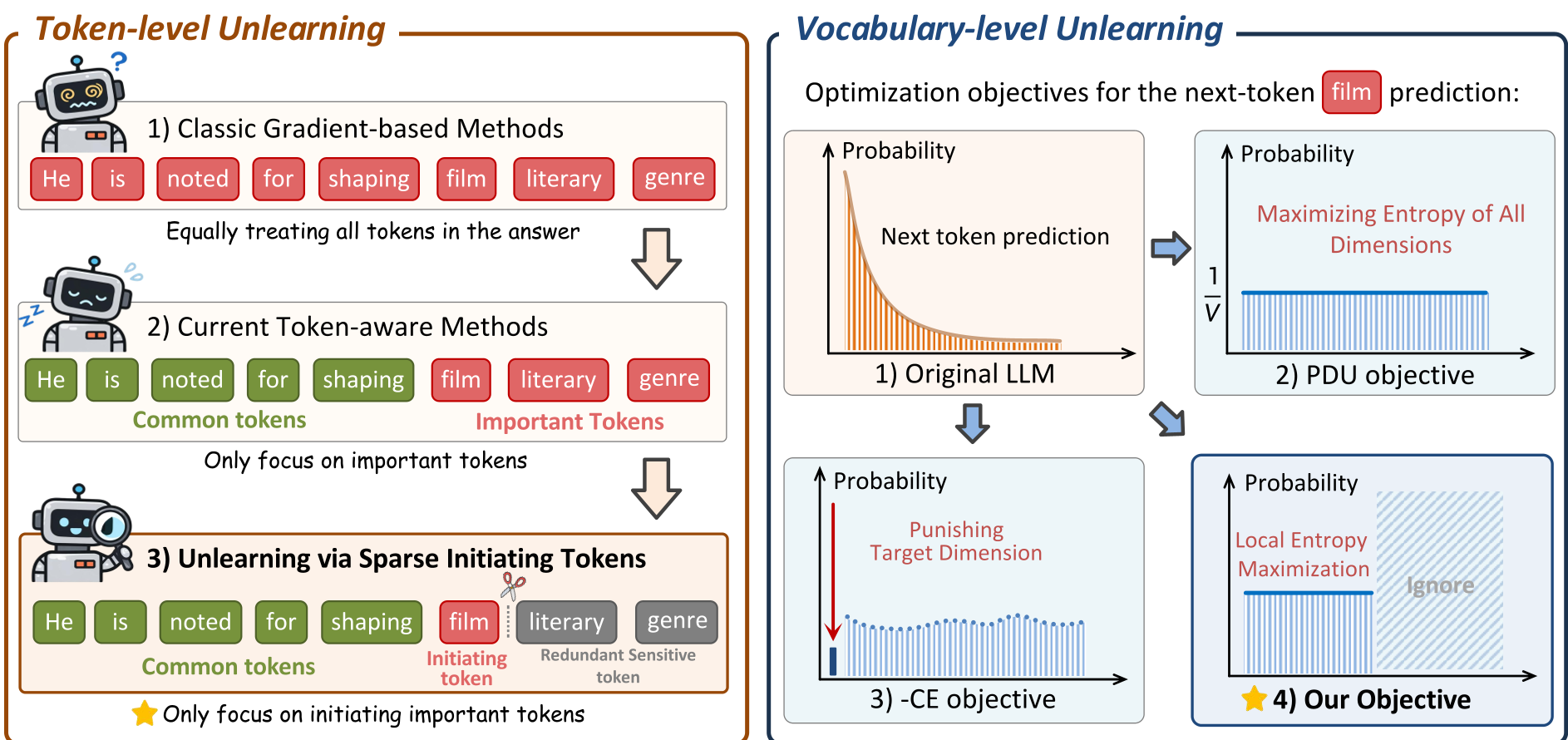 Figure 1: PALU localizes optimization to the sensitive prefix and the top-K vocabulary candidates.
Experimental Results: SOTA Efficiency
In tests on the TOFU and MUSE benchmarks, PALU consistently outclassed baselines like NPO and TPO.
- Utility Preservation: On Llama-2-7B, PALU maintained a Model Utility (MU) of 0.6238, nearly identical to the theoretical upper bound (Retain model) of 0.6266.
- Privacy Defense: PALU reduced Membership Inference Attack (MIA) metrics more effectively than even the Retain model, suggesting that active logit flattening is more robust than simply excluding data from training.
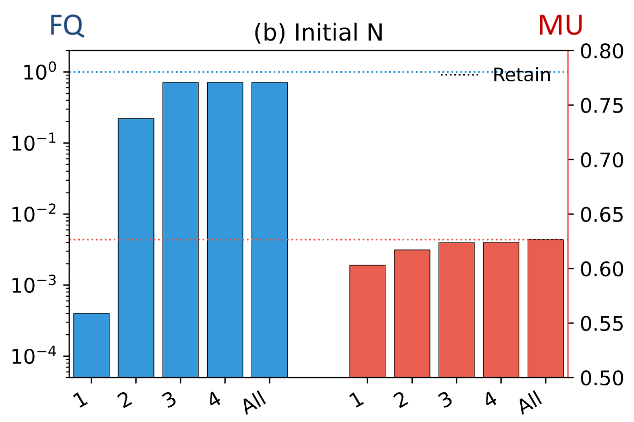 Figure 2: PALU achieves the best balance between Forget Quality and Model Utility across different models and forget ratios.
Ablation Insights
The ablation study (Figure 4 in the paper) reveals a "Threshold Effect":
- K-size: Once reaches 5,000, unlearning performance saturates. Optimizing the remaining 27,000+ tokens in the Llama vocabulary is a waste of compute.
- N-size: Optimizing just the first 3 tokens of a sensitive span is sufficient. Any more provides diminishing returns.
Critical Analysis & Conclusion
PALU represents a shift from "brute force suppression" to "informed confusion." It acknowledges that the internal manifold of an LLM is sparse—only certain tokens and certain logit dimensions drive the recovery of sensitive facts.
Limitations: Currently, PALU relies on identifying sensitive spans (using tools like DistilBERT or GPT-4). If the "sensitivity mask" is inaccurate, the unlearning quality drops. Furthermore, extending this to multimodal models (images/audio) remains an open challenge.
Takeaway: For developers and researchers looking to comply with "the right to be forgotten" (GDPR), PALU offers a blueprint for efficient, stable, and highly effective knowledge erasure that doesn't sacrifice the model's core intelligence.