
LT-A Model: Cracking the Code of Positive Influence in Polarized Social Networks
Maximizing Positive Influence in Signed Social Networks
This paper introduces the Positive Influence Maximization (PIM) problem within signed social networks, proposing the Linear Threshold model with Attitude (LT-A). By incorporating node attitudes and signed relationships (trust/distrust), the authors achieve more realistic influence simulations and validate their approach using a greedy algorithm with CELF optimization.
TL;DR
Information doesn't just spread; it transforms. While traditional models assume every connection is a "friend" who helps spread a message, real social networks are "signed"—containing both trust and distrust. This paper introduces LT-A (Linear Threshold with Attitude), a model that incorporates user attitudes and signed relationships to maximize positive influence, proving that recognizing your enemies is just as important as identifying your friends in viral marketing.
Problem & Motivation: The "Trust Gap" in Social Modeling
Most Influence Maximization (IM) research operates under a simplistic assumption: if User A is active, they will try to activate User B. But what if User B dislikes User A? In a signed network, a negative relationship () means User B might specifically adopt the opposite opinion.
The authors identify three fatal flaws in prior work:
- Opinion Blindness: Treating activation as a binary state rather than a spectrum of positive/negative attitudes.
- Negativity Bias: Failing to account for the psychological fact that negative information often carries more weight than positive information.
- Static Attitudes: Assuming users never change their minds once influenced.
Methodology: The LT-A (Linear Threshold with Attitude) Model
The core innovation is the introduction of the attitude weight and relationship weight .
1. The Mathematical Intuition
In the LT-A model, a node becomes active when the sum of weights from its active neighbors exceeds a random threshold . However, the nature of that activation (positive or negative) is determined by the attitude function:
Where:
- : The attitude of the neighbor.
- : The sign of the relationship (1 for trust, -1 for distrust).
- : The influence strength.
2. Architecture and Propagation
The process begins with a seed set having a forced positive attitude (). As the influence ripples through the network, the signs on the edges can "flip" the attitude. If a positive seed influences a neighbor through a "distrust" edge, that neighbor may become active with a negative attitude, potentially hindering the marketing campaign.
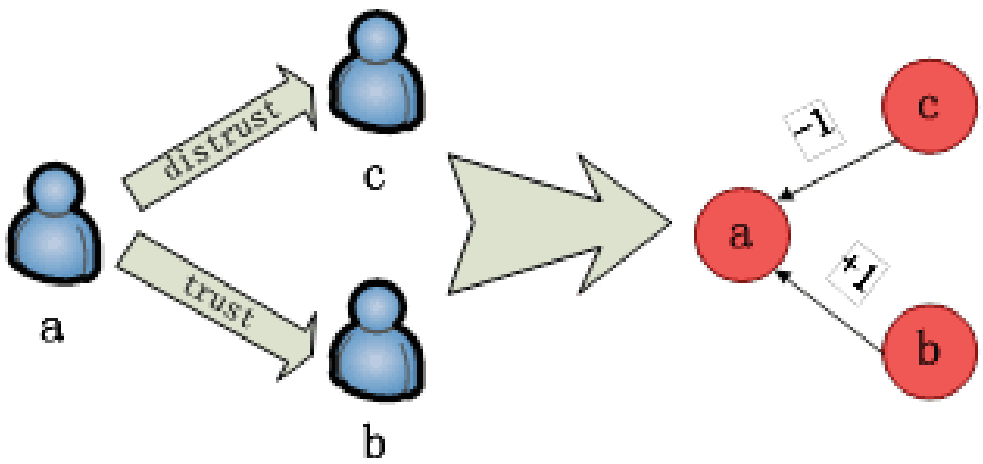 Figure 1: Illustration of asymmetric relationships in signed social networks.
Experiments & Results: Outperforming the Classics
The authors proved that the influence function under LT-A remains monotonous and submodular, allowing the use of a Greedy algorithm with a approximation guarantee. To handle large-scale data, they employed CELF (Cost-Effective Lazy Forward) optimization.
Performance on Real-World Data
Testing across the Epinions and Slashdot datasets (known for having explicit friend/foe labels), the LT-A Greedy algorithm consistently found more effective seed sets than standard LT models or heuristic approaches like "Positive Out-Degree."
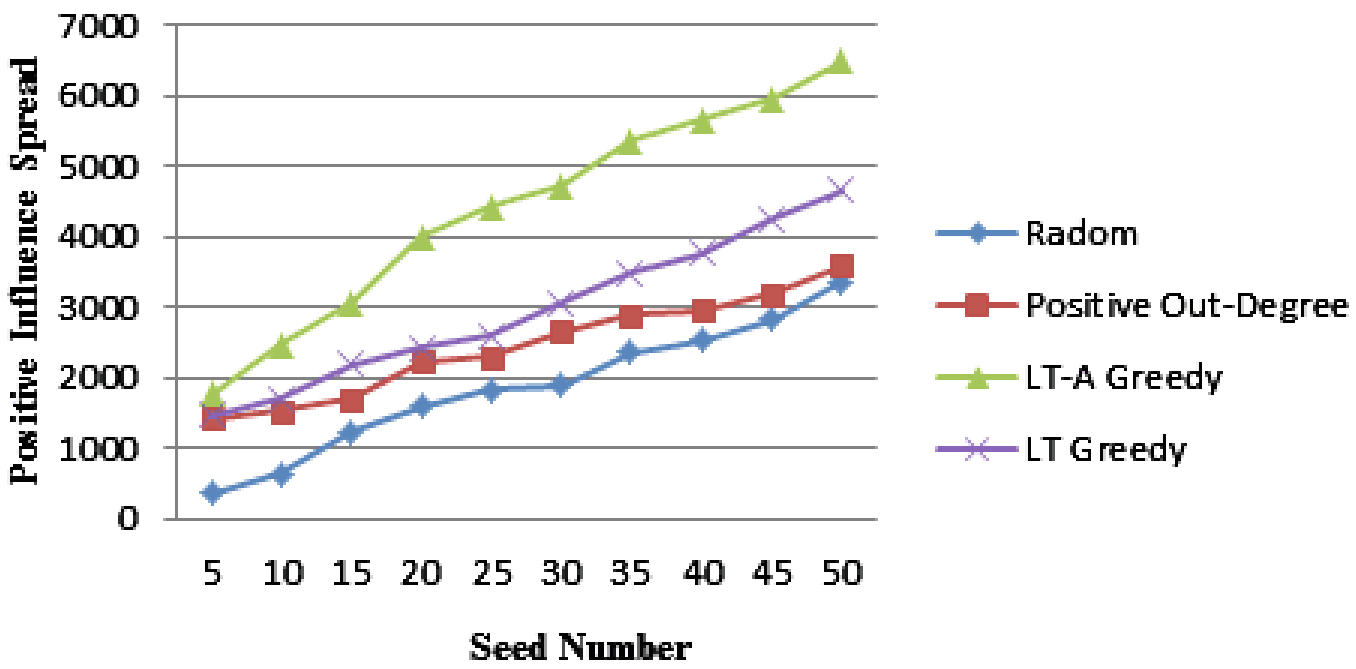 Figure 2: Positive influence spread comparison on the Epinions dataset.
Key Benchmarks:
- Epinions: The LT-A model achieved a 39.2% improvement in positive influence spread over the standard LT Greedy algorithm.
- Slashdot: The gap widened further, demonstrating that in highly polarized environments (like technology news sites), accounting for signed relationships is the only way to reliably predict influence.
Critical Analysis & Conclusion
Takeaway
The LT-A model successfully bridges social psychology (negativity bias) and discrete optimization. It reveals that the "best" influencers aren't necessarily those with the most followers, but those whose influence won't be "flipped" by negative edges in the network graph.
Limitations & Future Work
- Threshold Sensitivity: The model relies on a random threshold , which may not capture the nuanced resistance humans have to changing deep-seated beliefs.
- Computational Cost: While CELF helps, greedy approaches are still computationally expensive for networks with millions of nodes. Applying this logic to Scalable Heuristics or State Space Models would be a logical next step.
In conclusion, as social platforms become increasingly polarized, the LT-A model provides a robust framework for marketers and sociologists to understand the delicate balance of trust and distrust in digital communication.