
Beyond Awareness: Maximizing Positive Influence via the OC Model
Maximizing the Spread of Positive Influence in Online Social Networks
This paper introduces the Opinion-based Cascading (OC) model to solve the Maximizing Influenced-users Opinions (MIO) problem in social networks. The authors propose the OVM algorithm, which integrates CELF heuristics and a novel "Potential Candidate Selection" method to achieve scalability on graphs with millions of nodes.
TL;DR
Most viral marketing research operates on a flawed assumption: that if you reach a user, they will like your product. This paper challenges that "all influence is positive" dogma. By introducing the Opinion-based Cascading (OC) model, the authors provide a framework to distinguish between brand awareness and true brand affinity. They propose the OVM algorithm, which manages to scale to millions of users while maximizing the sum of positive opinions rather than just the raw count of influenced nodes.
The "Liking" vs. "Knowing" Gap
Traditional models like the Independent Cascade (IC) or Linear Threshold (LT) treat influence as a binary state—either you are "activated" (informed) or you are not. However, real-world data from platforms like Facebook or Amplicate shows a starkly different reality: a product like the iPhone can have hundreds of thousands of "hate" opinions alongside its "love" opinions.
The core insight of this paper is that negative opinions propagate too. If your marketing campaign reaches a million people but 70% of them end up with a negative opinion due to peer influence or bad product fit, the campaign is a failure. Yet, traditional algorithms would rank this as a massive success.
Methodology: The Two-Phase OC Model
The authors propose a two-phase transition for every node in the network:
- Activation Phase: Similar to the LT model, a node becomes "aware" when the sum of influence weights from its neighbors exceeds a threshold .
- Opinion Reforming Phase: This is where the magic happens. Once activated, the node's initial opinion is modified by the opinions of its active neighbors: The final opinion is capped between [-1, 1]. This captures the "word-of-mouth" effect where your friends' opinions can flip your own perspective from positive to negative.
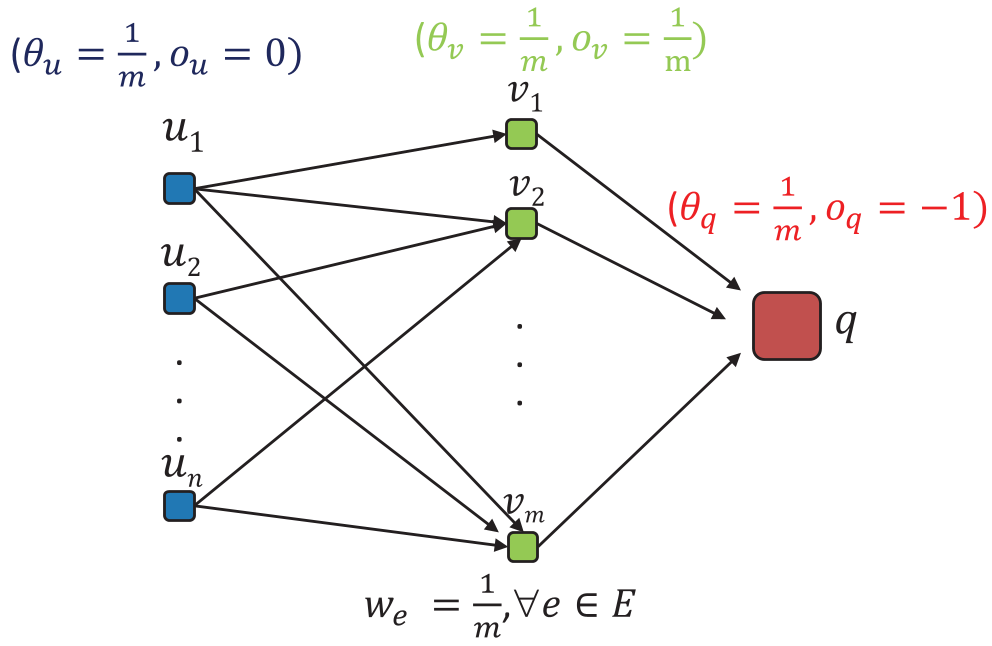 Fig 1. The authors prove that the MIO problem is not only NP-hard but also lacks a finite approximation ratio unless P=NP, complicating the search for an optimal seed set.
Engineering Scalability: The OVM Algorithm
Because the objective function (Total Opinion) is neither submodular nor monotone, standard greedy guarantees vanish. To solve this, the authors developed OVM (Opinion-based Viral Marketing), featuring:
- Potential Candidate Selection: Instead of evaluating all nodes, OVM pre-filters the top candidates based on a "Potentiality" score , which estimates both a node's personal opinion and its ability to influence neighbors.
- Fast Updates: By incrementally updating activation rounds and only recalculating opinions for reachable nodes, they avoid redundant BFS traversals.
Experimental Validation
The paper tests OVM against four major datasets: NetHEPT, Wiki-Vote, Facebook, and Flixster.
1. Performance vs. Opinion Spread
OVM consistently matches the quality of the "Natural Greedy" algorithm while being orders of magnitude faster.
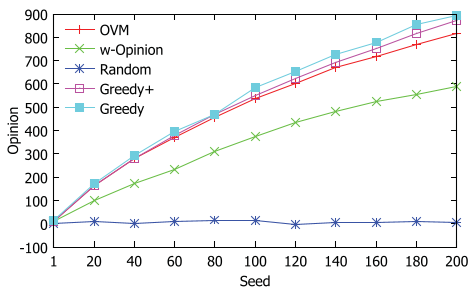 Fig 2. OVM (red) tracks closely with the greedy approach, significantly outperforming Max-Degree or Random heuristics.
2. The Fallacy of Max-Influence
The most striking result is the comparison between OVM and the standard Max-Influence algorithm. On the Facebook dataset, Max-Influence reached ~3,000 people, but the net positive opinion was nearly zero. OVM reached only ~1,000 people but achieved a total positive opinion score over 80 times higher.
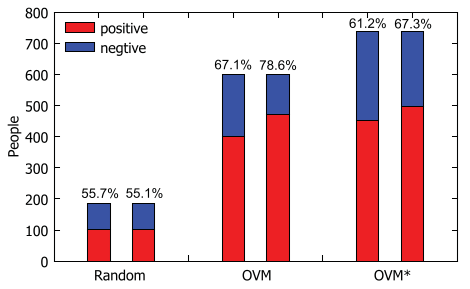 Fig 3. More reached users do not translate to higher positive influence.
Conclusion and Deep Insight
The OC model proves that in social networks, quantity quality. This research reframes Influence Maximization as an opinion-centric task. The OVM algorithm's ability to process a 2.5-million-node graph (Flixster) in roughly 10 minutes suggests that this method is ready for industrial-scale deployment.
Future Outlook: The next logical step is to incorporate dynamic opinions that change over time (beyond a single update) and to model "attacker" nodes that intentionally spread negative sentiment—shifting from marketing to social network defense.