
QTFM: Maximizing Organizational Efficiency Through Social Synergy
Maximizing the number of qualified work teams based on social network relationships
This paper addresses the "Maximum Qualified Teams Problem," aimed at partitioning a workforce into sub-teams to maximize the count of groups exceeding a performance threshold. It introduces the Qualified Team First Method (QTFM), which leverages both personal capabilities and social network relationships to optimize team formation.
TL;DR
In modern project management, the difference between success and failure often lies in how teams are assembled. This paper investigates the Maximum Qualified Teams Problem, proving it is NP-Complete and introducing the Qualified Team First Method (QTFM). By integrating personal capability with social network synergy, QTFM significantly increases the number of teams that meet specific performance thresholds compared to traditional HR approaches.
Background: Beyond the "Dream Team" Fallacy
The traditional intuition in human resources is to either create a single "Dream Team" of top performers or to distribute talent evenly (Round-Robin). However, these approaches overlook two critical factors:
- Synergy: Two brilliant individuals might fail if they cannot collaborate.
- Thresholds: In many industries, a team only needs to be "good enough" (qualified) to complete a sub-task. Over-investing talent in one team at the expense of others can lead to a lower total project success rate.
Problem & Motivation: The Complexity of Cooperation
The author identifies the core pain point: existing graph partitioning or set packing methods do not specifically target the number of qualified units in a constrained environment where every member must be assigned. The research recognizes that a team's performance () is a weighted sum of Personal Capability () and Teamwork Capability ():
The goal is to maximize the count of such that (the passing value).
Methodology: The Qualified Team First Method (QTFM)
The paper proves the problem's complexity by reducing it to the Partition Into Triangles Problem, a known NP-Complete challenge. To solve this efficiently, the author proposes QTFM.
How QTFM Works:
Unlike the Bi-directional Round-Robin (RR) which balances talent, or the Best Team First Method (BTFM) which exhausts top talent early, QTFM uses a "threshold-aware" greedy approach:
- Phase A: If the team is currently below the passing value , it recruits the member who provides the maximum performance boost.
- Phase B: Once the team hits the "Qualified" status (), it pivots to recruit members who provide the minimum boost.
This strategic "pivot" preserves high-synergy pairs for the next team, ensuring that resources aren't wasted on "over-qualifying" a single group.
 The mathematical objective function designed to maximize the indicator variable .
Experiments & Results: Crushing the Baseline
The simulation compared QTFM against Random, RR, and BTFM methods using a pool of 500 members.
Key Findings:
- Superior Scalability: As the difficulty (passing value ) increases, QTFM maintains a much higher success rate than traditional methods, which quickly converge toward random performance.
- The Small Team Advantage: The research found that the percentage of qualified teams () decreases as team size () increases. This suggests that larger teams are exponentially harder to "guarantee" performance for, as they require more internal connections to maintain synergy.
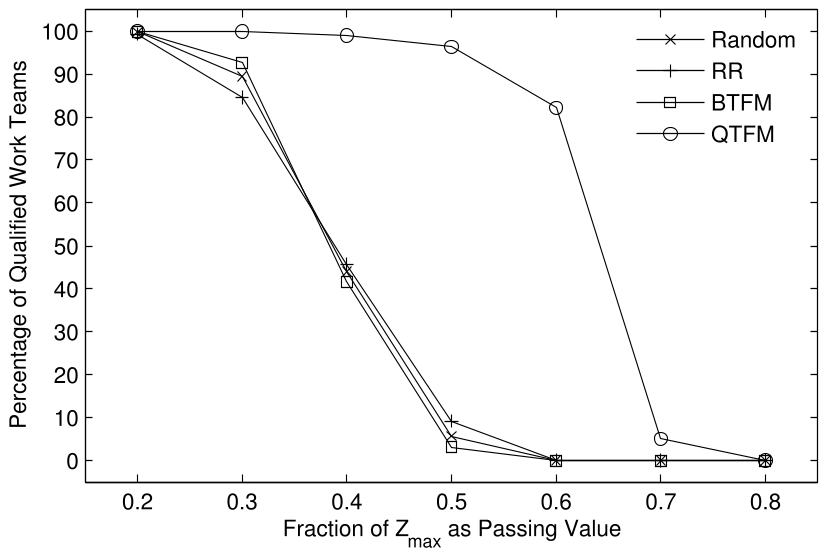 Fig 1. Analysis of Qualified Team Percentages across different performance thresholds (Z).
Critical Analysis & Conclusion
Takeaway
The shift from "maximizing total performance" to "maximizing the number of qualified units" is a vital paradigm shift for large-scale operations. QTFM proves that by being "stingy" with talent once a threshold is met, we can elevate the entire organization.
Limitations
- Static Capabilities: The model assumes personal and teamwork capabilities are fixed constants, ignoring that people learn and adapt over time.
- Single-attribute Synergy: Social relationship is treated as a single scalar value, whereas real-world synergy involves multi-dimensional traits (e.g., leadership, technical expertise, communication).
Future Outlook
This work lays the groundwork for AI-driven HR platforms. Future iterations could integrate dynamic social data from Slack or GitHub to automatically suggest team re-shuffles that maximize the probability of project success across an entire department.