
TIM: Precision Strike in Social Influence Maximization
Maximizing Social Influence on Target Users
This paper introduces the Target Influence Maximization (TIM) problem, focusing on activating a specific subset of users rather than the entire network. The authors propose a Probabilistic Social Influence (PSI) model based on real-world action logs and a cluster-based greedy framework to achieve a (1-1/e) approximation with significantly lower latency.
TL;DR
In the world of social networks, being "globally influential" isn't always enough. Whether you are running a political campaign or a niche product launch, you need to reach a specific target set of users. This paper formulates the Target Influence Maximization (TIM) problem and introduces a data-driven probabilistic model (PSI) combined with a cluster-based indexing structure to find the optimal seed nodes with high efficiency and (1-1/e) theoretical guarantees.
Problem & Motivation: The Fallacy of Global Influence
Most classic influence maximization research focuses on the "In-Degree" or "Global Center" of a graph. However, the authors argue that the nodes that maximize network-wide spread are often suboptimal for targeting specific groups.
Consider a travel agency targeting users who clicked a specific ad. The global "celebrity" nodes in the network might not have any meaningful connection to this group. The challenge is two-fold:
- Hidden Weights: How do we know how much user A actually influences user B? Constant values or random weights are just guesses.
- Search Complexity: Iterating through millions of nodes to check their influence on a specific subset is computationally prohibitive for real-time applications.
Methodology - The Core
1. Probabilistic Social Influence (PSI) Model
The authors move away from heuristic edge weights. Instead, they use action logs (likes, check-ins, purchases).
- Time Decay: Influence is modeled with an exponential decay: the longer the gap between user A's action and user B's subsequent action, the weaker the perceived influence.
- User Influenceability: The model normalizes weights based on how many neighbors performed an action before the user, capturing how "easily swayed" a specific individual is.
2. Cluster-Based Assembling Framework
To solve the efficiency problem, the paper introduces a hierarchical clustering approach.
- Candidate Filtering: By calculating "Influencer Sets" () and "Follower Sets" () with a threshold , they prune nodes that have negligible impact on the target set.
- Tree Structure: Users with similar influence behaviors are grouped into a Hierarchical Tree.
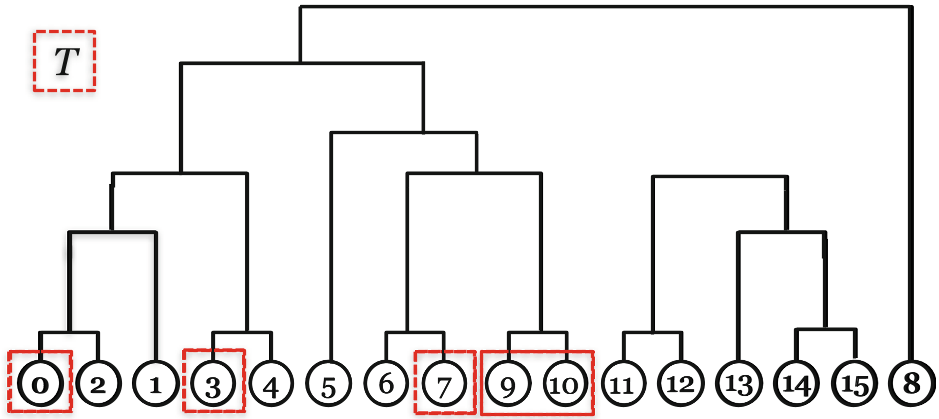 Figure 1: The tree structure allows for the precomputation of union influencer sets, enabling a faster greedy Search through specialized indices.
Experiments & Results: Precision Pays Off
The authors tested their approach on three massive datasets: Amazon (product reviews), Gowalla (check-ins), and Facebook (crawled social data).
Spread Achievement
When the target set is small relative to the whole graph , traditional global models (IC/LT) perform poorly because they waste "influence budget" on nodes outside the target set. TIM consistently maintains a higher spread within the designated group.
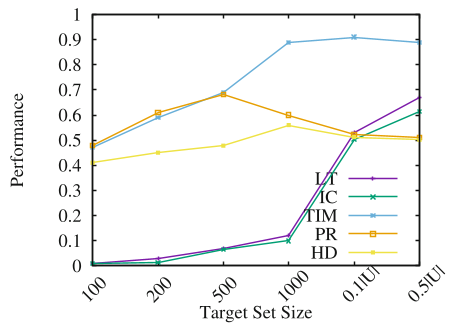 Figure 2: Influence spread comparison. TIM shows a clear advantage over High Degree, PageRank, and global IC/LT models.
Computational Efficiency
By utilizing the Node-Influencer and Influencer-Node indices, the proposed greedy algorithm achieves near-instant response times for small set queries, drastically outperforming the previous gold-standard optimization, CELF++.
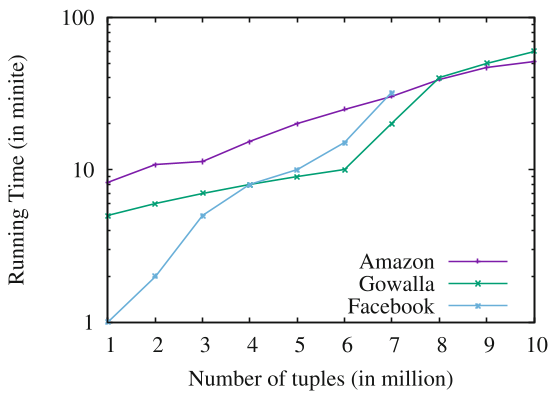 Figure 3: Runtime across different action log sizes. The indexing strategy allows TIM to scale linearly and handle millions of records efficiently.
Critical Insight & Conclusion
The true value of this paper lies in its data-centric philosophy. Instead of treating an influence graph as a static mathematical object, it treats it as a dynamic history of human interactions.
Takeaways for Practitioners:
- Pruning is Power: In targeted tasks, 99% of the graph is usually "noise." Effective indexing of influence paths is the only way to achieve real-time performance.
- Temporal Matters: The introduction of time-decay in the PSI model aligns better with physical reality than the classic Independent Cascade model.
Limitations: While the PSI model is grounded in data, it assumes future influence patterns will strictly mirror historical logs. It may struggle with "cold-start" scenarios where new users or products have no prior action history.