
MESLiN: Merging Reservoir Computing and Density Estimation for Advanced Emotion Recognition
Maximum Echo-State-Likelihood Networks for Emotion Recognition
The paper introduces the Maximum Echo-State-Likelihood Network (MESLiN), a hybrid architecture combining Echo State Networks (ESN) with Radial Basis Function (RBF) networks for sequence classification. Applied to speech-based emotion recognition, it achieves a State-of-the-Art (SOTA) accuracy of 86.39% on the WaSePc dataset.
TL;DR
The Maximum Echo-State-Likelihood Network (MESLiN) is a novel architecture that solves the problem of modeling dynamic temporal sequences (like speech) by combining the stable "memory" of an Echo State Network (ESN) with the probabilistic precision of a Radial Basis Function (RBF) network. It achieved a staggering 86.39% accuracy in emotion recognition, outperforming both traditional machine learning models and human listeners.
Problem & Motivation: The Complexity of Temporal Emotions
Recognizing emotions from speech is notoriously difficult because:
- Temporal Variability: The same word spoken in "Anger" vs "Sadness" has a different temporal profile and duration.
- Training Instability: Standard RNNs trained via Backpropagation Through Time (BPTT) often suffer from vanishing gradients.
- Lack of Likelihood: Most classifiers provide a class label but don't inherently model the underlying probability density of the emotional "space."
The authors' insight was to separate Encoding from Estimation. Use a reservoir (ESN) to capture the temporal "echo" of the speech, then use a statistical model (RBF) to calculate the likelihood of that echo belonging to a specific emotion.
Methodology: The MESLiN Architecture
The system follows a two-block connectionist pipeline:
- The Reservoir Encoder: An ESN with a sparsely connected reservoir (10% connectivity) processes the RASTA-PLP features of the audio. It converts a variable-length sequence into a fixed-length vector , representing the final state of the neurons.
- The Density Estimator: This vector is fed into a constrained RBF-like network. Unlike standard RBFs used for classification, this one is constrained to act as a Probability Density Function (PDF), ensuring the output is a valid likelihood.
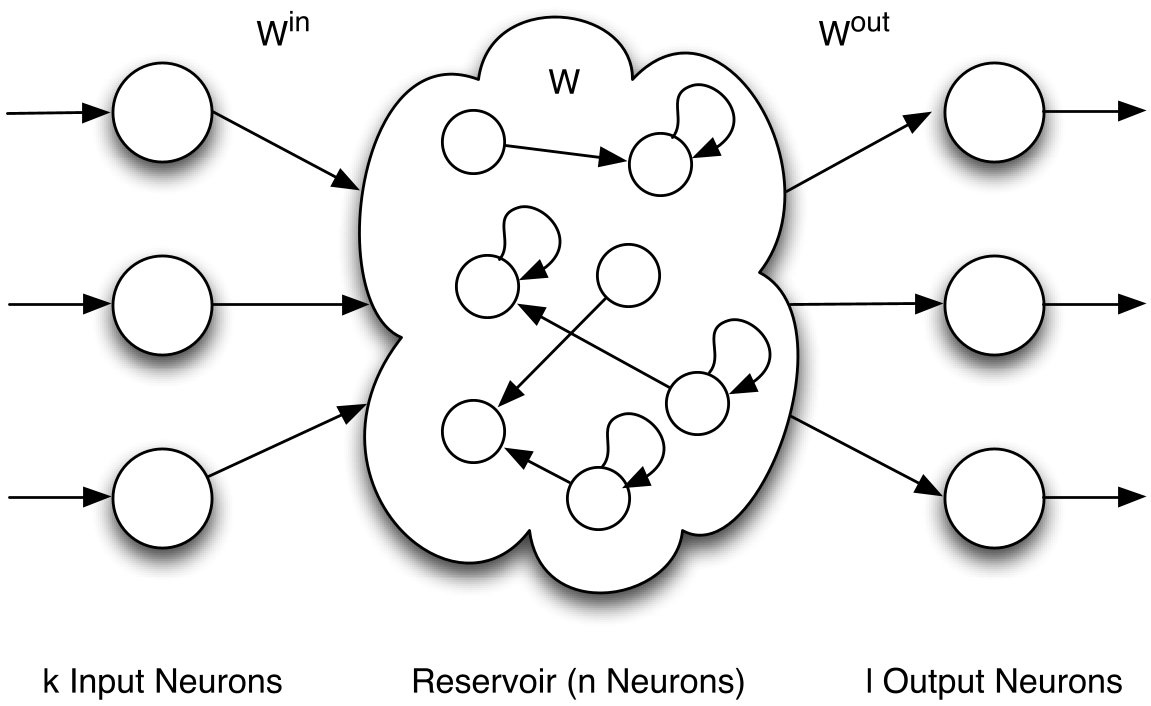 Fig 1. Schematic of the Hybrid ESN-RBF Architecture.
The training uses a Maximum Likelihood (ML) framework. For each emotion (Joy, Anger, etc.), a separate MESLiN is trained to "specialize" in that emotion's distribution. During testing, the sequence is assigned to the class whose MESLiN yields the highest likelihood (Bayesian Maximum-a-Posteriori).
Experiments & Results
The model was tested on the WaSePc dataset (German pseudo-words). The performance leap was massive:
| Method | Average Accuracy (%) |
|---|---|
| Nearest Neighbor | 33.90 |
| MLP | 39.32 |
| SVM | 48.01 |
| MESLiN (Proposed) | 86.39 |
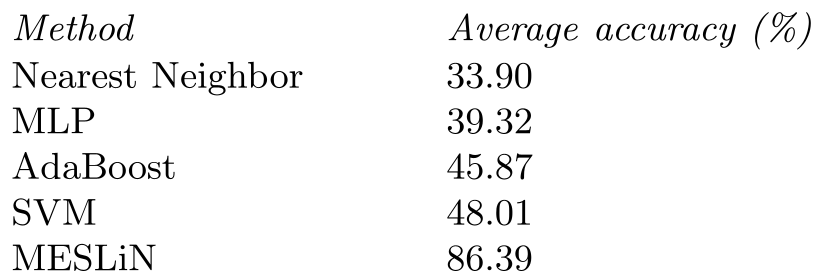 Table 1. MESLiN's dominance over traditional frame-based classifiers.
Why did it beat humans?
Humans averaged ~78% accuracy. The authors suggest that because the dataset used acted emotions, the actors might have subtle, repetitive stylistic biases. While humans rely on subjective general knowledge, the MESLiN model "learned" the specific acoustic signatures utilized by the actors, allowing it to surpass human performance in this specific controlled environment.
Critical Analysis & Conclusion
Takeaway
MESLiN proves that we don't always need complex, fully-differentiable end-to-end deep learning. By using a fixed reservoir for encoding and a statistically sound RBF for density estimation, we can achieve SOTA results with higher stability and less training overhead.
Limitations
- Acted Data: The high performance may be slightly inflated due to the "actor bias" mentioned by the authors. Real-world, spontaneous emotional speech is significantly messier.
- Scalability: Training a separate MESLiN for every single class might become computationally expensive as the number of categories grows.
Future Work
The authors propose moving toward a fully unsupervised cluster discovery approach, where the model discovers its own "emotional clusters" in the reservoir space without needing pre-defined labels. This could revolutionize how we discover "micro-emotions" that humans might not have names for.