
MAX-EXP-AN: Bridging the Gap Between Statistical Precision and Hierarchical Efficiency in Cultural Data Mining
Maximum-expectation integrated agglomerative nesting data mining model for cultural datasets
The paper introduces MAX-EXP-AN, a hybrid data mining model combining Maximum-Expectation (MAX-EXP) statistical estimation with Agglomerative Nesting (AN) clustering. It is specifically designed for Cultural Geo-Information Systems (CGIS) to identify the location and dating of archeological objects with high precision and low computational overhead.
TL;DR
Researchers have developed a new hybrid model called MAX-EXP-AN (Maximum-Expectation Integrated Agglomerative Nesting) designed to revolutionize Cultural Geo-Information Systems (CGIS). By combining statistical optimization with hierarchical clustering, the model slashes time complexity and reduces cluster cohesion, making it significantly more effective at identifying and dating archeological objects than traditional methods like K-means or BIRCH.
Academic Context: This work addresses the scalability and error-rate bottlenecks in unsupervised learning for high-dimensional cultural datasets, positioning itself as a superior alternative to density-based and grid-based partitioning methods.
The Problem: The Cohesion and Complexity Trap
In the realm of Cultural Geo-Information Systems (CGIS), data is not just numbers; it is a complex web of locations, dates, and historical contexts. Existing data mining approaches face two primary hurdles:
- High Cohesion: Data points within clusters are often insufficiently related or overlap poorly, leading to "noisy" patterns.
- Time Complexity: As cultural databases grow, the computational cost of identifying objects in various geo-locations skyrockets.
Traditional algorithms like DENCLUE or OptiGrid often fail to capture the progressive, multi-level structure inherent in archeological data, leading to a loss of pattern quality.
Methodology: The Logic of MAX-EXP-AN
The authors solve this by fusing two powerful concepts: Statistical Expectation and Hierarchical Nesting.
1. The MAX-EXP Phase (Reducing Cohesion)
The model starts by treating clustering as a statistical estimation problem. Using the Maximum Likelihood (ML) function, it iterates through an Expectation step (estimating the distribution of unobserved values) and a Maximization step (optimizing parameters to reduce variation).
- Insight: It uses Kullback–Leibler divergence to measure and minimize the "distance" between probability distributions, ensuring that clusters are as cohesive and pure as possible.
2. The AN Phase (Optimizing Speed)
Once the statistical foundation is set, Agglomerative Nesting (AN) builds a dendrogram (a tree-like structure).
- Architecture: It adopts a bottom-up approach, gathering all sample data points into a single root.
- Optimization: To avoid the traps of some hierarchical methods, the authors use polynomial-based inter-cluster generation. This allows the Cluster Head (CH) to broadcast factored polynomials to members, drastically reducing the time needed for membership join/leave events.
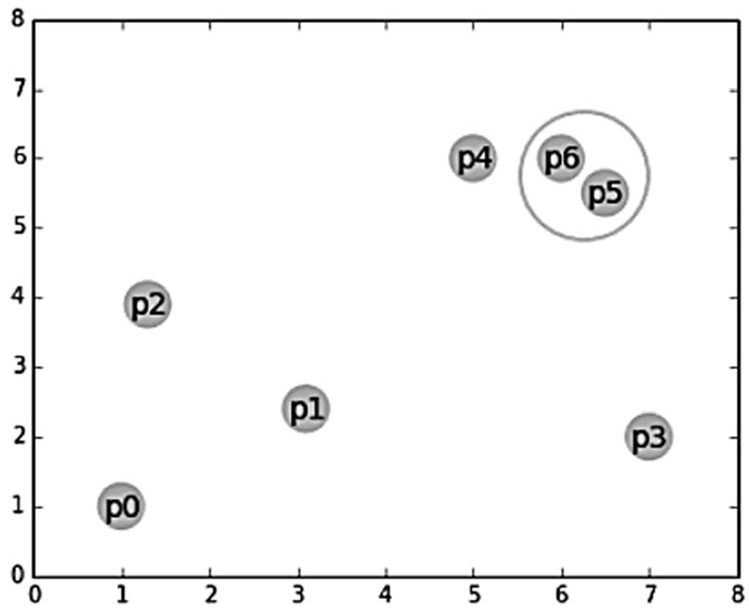 Figure: The Dendrogram graph shows the progressive bottom-up grouping of cultural data points.
Experimental Results: Proving the Superiority
The model was put to the test in an NS2 simulation environment with a transmission range of 500m and varying cluster counts (10 to 50).
- Precision and Accuracy: Using the Rand Coefficient (RC) and Jaccard Coefficient (JC), the model showed a marked improvement in matching observed clusters to ideal labels compared to K-means and BIRCH.
- Error Reduction: The Sum of Squared Errors (SSE) analysis revealed that MAX-EXP-AN maintains a much lower error rate as the volume of data increases, thanks to its optimized pairwise distance measurements.
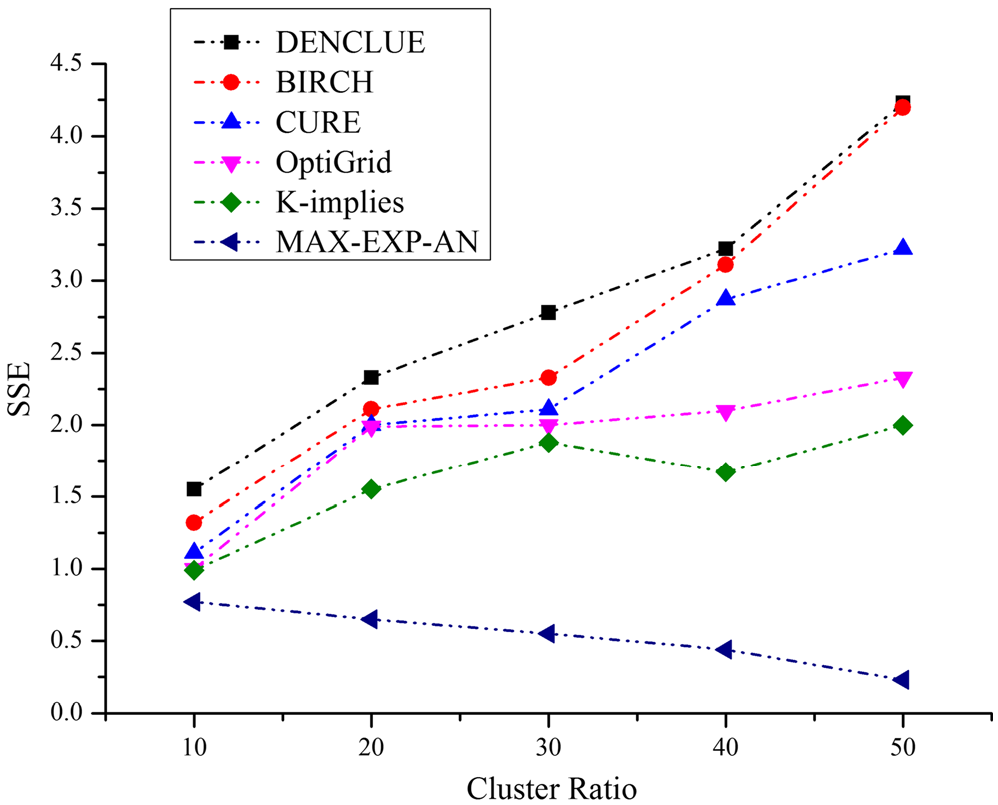 Figure: SSE comparison showing that MAX-EXP-AN maintains higher quality clusters with fewer errors than conventional methods.
Critical Insight & Future Outlook
The brilliance of MAX-EXP-AN lies in its Inductive Bias—the assumption that cultural data is naturally hierarchical and can be modeled through probability densities. By moving away from rigid partitions and towards a dynamic, statistical-hierarchical hybrid, the researchers have created a tool that is both robust to noise and computationally lean ().
Future Directions: The authors suggest integrating Intelligent Internet of Things (IoT) sensors into the CGIS system. This would allow for real-time archeological data mining directly from excavation sites, potentially automating the initial dating and categorization of finds.
Final Takeaway
For practitioners in data mining and GIS, this paper provides a clear blueprint: stop choosing between statistical rigor and hierarchical structure. Use both.