
Voting as Inference: Why Your Social Network Changes the "Truth"
The Maximum Likelihood Approach to Voting on Social Networks.
The paper investigates voting rules through the lens of Maximum Likelihood Estimation (MLE) within social networks. It introduces the "Independent Conversations Model," where votes are determined by majority outcomes of local pairwise interactions, challenging the notion that network topology can be ignored in optimal rule design.
TL;DR
Is voting just a way to compromise, or is it a tool to uncover an objective truth? This paper treats voting as a Maximum Likelihood Estimation (MLE) problem. It moves beyond the naive assumption that voters are independent, proposing a model where social "conversations" dictate votes. The catch? Calculating the most likely winner in such a network is #P-hard, though approximating it via "hidden variable" estimation remains computationally efficient.
Problem & Motivation: The Independent Voter Myth
Classical social choice theory often assumes voters are independent sensors. If 60% of people are likely to be right, the majority rule is the best way to find the truth. But humans aren't islands; we talk, argue, and influence our neighbors.
Previous research suggested that if social influence is independent of the "truth" (a specific mathematical factorization), the social network actually doesn't matter—you still just count the votes. Vincent Conitzer argues this is too simplistic. If the very process of forming a vote is tied to interactions that are also noisy estimates of the truth, the network structure becomes a critical variable that can flip the election outcome.
Methodology: The Independent Conversations Model
The author introduces a clever local interaction model:
- Edges as Signals: Every edge in a social network represents a "conversation." This conversation reaches a "correct" conclusion with probability .
- Majority Rule at the Node: Each voter participates in conversations with all their neighbors. Their final vote is simply the majority of the outcomes of these conversations.
Architecture of the Noise Model
Unlike independent models, the "truth" here is mediated through the edges. To find the probability of a vote profile, we must sum over all possible edge configurations that could have led to those votes.
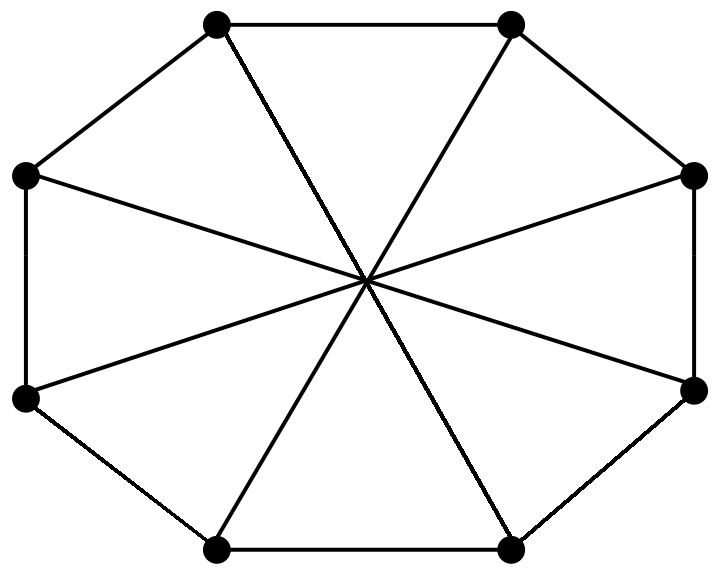 In Fig 1, we see how a single set of votes (voter nodes) can be explained by specific underlying edge "conversations."
The Complexity Wall: #P-Hardness
The paper delivers a sobering theoretical result: Theorem 1. Calculating the likelihood of the truth given the votes is #P-hard. The proof maps the problem of counting perfect matchings in a bipartite graph—a famously difficult counting problem—to the problem of calculating vote probabilities in this network model.
The Intuition: To know how likely a result is, you have to count all the "hidden" ways the network edges could have been labeled to produce the observed votes. In complex topologies, this counting is intractable.
A Path Forward: Joint Estimation
If we can't sum over all hidden variables, can we just find the best one? Theorem 2 proves that if we try to estimate the truth and the state of every conversation (the edges) simultaneously, the problem becomes easy. By transforming the network into a weighted b-matching problem, we can use polynomial-time optimization to find the most likely "story" for the entire network.
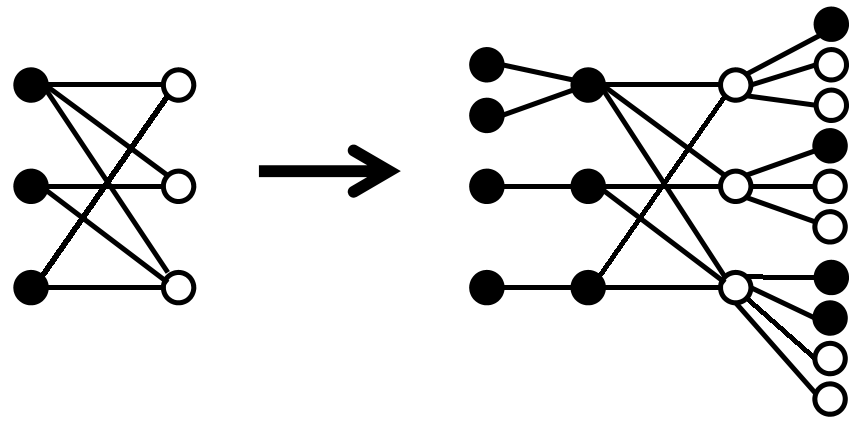 Fig 4 illustrates the reduction used to prove that counting these configurations is as hard as finding perfect matchings.
Critical Analysis & Conclusion
Takeaway
This work bridges the gap between Social Choice and Probabilistic Graphical Models. It proves that the "Independent Voter" assumption isn't just a simplification—it's a potential error. In networks with specific structures (like the cliques vs. wheels discussed in the paper), the "correct" winner might change based on who talks to whom.
Limitations
- Static Nature: The model is a snapshot. It doesn't capture the "echo chamber" effect where opinions evolve over multiple rounds of conversation.
- Binary Choice: The proof focuses on two alternatives; extending the social network MLE to rankings (Kemeny-style) would likely introduce even higher complexity.
Future Outlook
The next frontier is integrating DeGroot models (iterative opinion pooling) with this MLE framework. If we can model how truth propagates through time on a graph, we might finally design voting systems that are robust to the "noise" of social media and interpersonal influence.