
MMC-Net: Revitalizing Maximum Margin Criterion for Adaptive Deep Learning
A Family of Maximum Margin Criterion for Adaptive Learning
The paper introduces a comprehensive framework for adaptive learning based on the Maximum Margin Criterion (MMC). It proposes several variants—Random MMC, Layered MMC, and 2D^2 MMC—and culminates in the "MMC Network," a simple deep architecture that achieves SOTA-level discrimination in high-dimensional image classification tasks.
TL;DR
The paper introduces a modernized family of Maximum Margin Criterion (MMC) methods designed to bridge the gap between classical statistical learning and deep feature extraction. By solving the high-dimensionality and large-scale data bottlenecks, the authors propose MMC-Net, a deep architecture that uses MMC-based filter banks to outperform traditional benchmarks like PCA-Net and LDA-Net.
Academic Positioning: This work is a "Structural Evolution" of discriminant analysis, moving from simple linear projections to adaptive, multi-layered, and bi-directional learning frameworks suitable for the Big Data era.
Problem & Motivation: The Limits of Traditional Discriminant Analysis
In the world of feature extraction, Linear Discriminant Analysis (LDA) has long been the gold standard. However, it faces a mathematical wall known as the "Small Sample Size" problem: when the data dimensionality () exceeds the number of samples (), the within-class scatter matrix becomes singular, causing the ratio-based optimization to fail.
The MMC Alternative: Maximum Margin Criterion (MMC) avoids this by using a subtraction-based objective: . While robust, it still faces two major hurdles:
- Memory Overflow: Large leads to massive covariance matrices.
- Scalability: Large makes eigen-decomposition computationally prohibitive.
The authors' insight is to apply a "Direct Solution" via kernel-view transformations, shifting the computational complexity from the feature space () to the sample space (), and then using random sampling to handle the cases where is still too large.
Methodology: The Family of MMC Variants
1. Direct and Random MMC (RMMC)
The core innovation starts with transforming the MMC problem into a kernelized space. Instead of decomposing a matrix, they decompose a matrix , where is the sample kernel.
- Inductive Bias: If (where is a subset), RMMC selects representative samples to approximate the scatter, reducing complexity to .
2. 2D^2 MMC
For images, vectorization loses spatial structure. 2D^2 MMC learns bi-directional projections () directly on the image matrix. This preserves the row and column correlations while dramatically reducing the dimensionality of high-resolution inputs.
3. The MMC-Net Architecture
Inspired by PCANet, the authors propose MMC-Net. It replaces unsupervised PCA filters with supervised MMC filters.
- Stage 1 & 2: Learning filter banks by calculating and on local image patches.
- Stage 3: Hashing and Histogramming to aggregate the refined features.
 Figure 1: The logical flow of the direct MMC algorithm applied to high-dimensional data.
Experiments & Results
The authors tested their methods on diverse datasets, including MNIST (digits), SUN (scenes), and STL-10 (objects).
Key Findings:
- Superiority over PCA: On the SUN database, PCA failed to learn discriminative information, whereas MMC variants provided stable, high-accuracy results.
- Efficiency: RMMC achieved near-identical accuracy to full MMC on the MNIST dataset but with a fraction of the memory and time.
- Competitive Deep Learning: In head-to-head tests of "Simplified Deep Networks," MMC-Net consistently performed on par with or better than LDANet, especially as patch sizes varied.
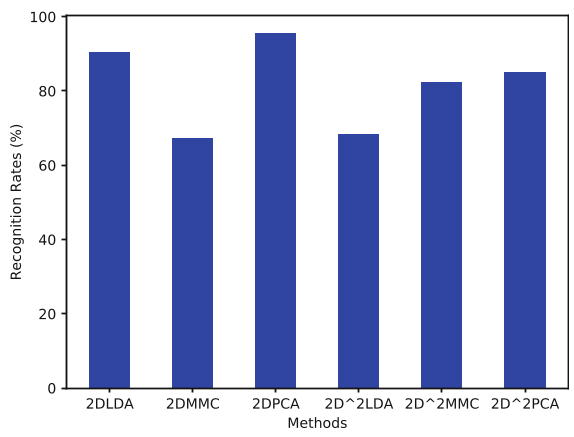 Figure 2: Recognition rates across different dimensionality reduction methods. Note the stability of MMC-based methods across datasets.
Critical Analysis & Conclusion
Takeaway
The "Family of MMC" provides a scalable toolkit for feature extraction. By decoupling the optimization from the raw feature dimension , the authors have made discriminant analysis viable for modern deep-coded features (like VGG-16 outputs) which are often high-dimensional.
Limitations
- Parameter Sensitivity: The trade-off parameter (balancing and ) still requires manual tuning or cross-validation.
- Linear Constraint: While "Layered MMC" introduces non-linearity, the core filter learning is still linear within each layer.
Future Work
The logical next step is the integration of these adaptive MMC filters into an end-to-end trainable Backpropagation framework, potentially replacing standard convolutional layers with "Discriminant Layers" that optimize class separation explicitly.
Author Note: This study proves that classical statistical "margins" remain a powerful inductive bias in the age of Deep Learning.