
SAW-ASA: Bridging Multi-Criteria Decision Making and Adaptive Search for Influence Maximization
An MCDM integrated adaptive simulated annealing approach for influence maximization in social networks
This paper introduces SAW-ASA, a hybrid framework that integrates Simple Additive Weighting (SAW) with Adaptive Simulated Annealing to solve the Influence Maximization (IM) problem. By combining four centrality measures to filter candidate nodes and employing a self-adaptive meta-heuristic, it achieves a superior trade-off between influence spread and computational efficiency.
TL;DR
To solve the NP-hard Influence Maximization (IM) problem, this paper proposes SAW-ASA. It moves beyond simple degree-count heuristics by using a Multi-Criteria Decision Making (MCDM) approach to rank nodes and an Adaptive Simulated Annealing algorithm to refine the seed set. The result is a high-performance framework that matches the accuracy of simulation-based methods at a fraction of the temporal cost.
Problem & Motivation
Identifying "super-spreaders" in social networks is critical for viral marketing and rumor control. However, the IM problem is a computational nightmare.
- The Scalability-Accuracy Dilemma: Greedy algorithms with Monte-Carlo Simulations (MCS) provide high accuracy but are too slow for large networks.
- Heuristic Limitations: Common metrics like Degree Centrality often ignore "overlapping influence"—where two high-degree nodes share the same neighbors, rendering one redundant.
- The Sparsity of Activity: Research shows only ~5% of nodes contribute to 80% of network activity. Identifying this tiny slice is the key to efficiency.
Methodology: The Two-Stage Filter
The authors propose a logic that filters the "noise" before performing the expensive optimization.
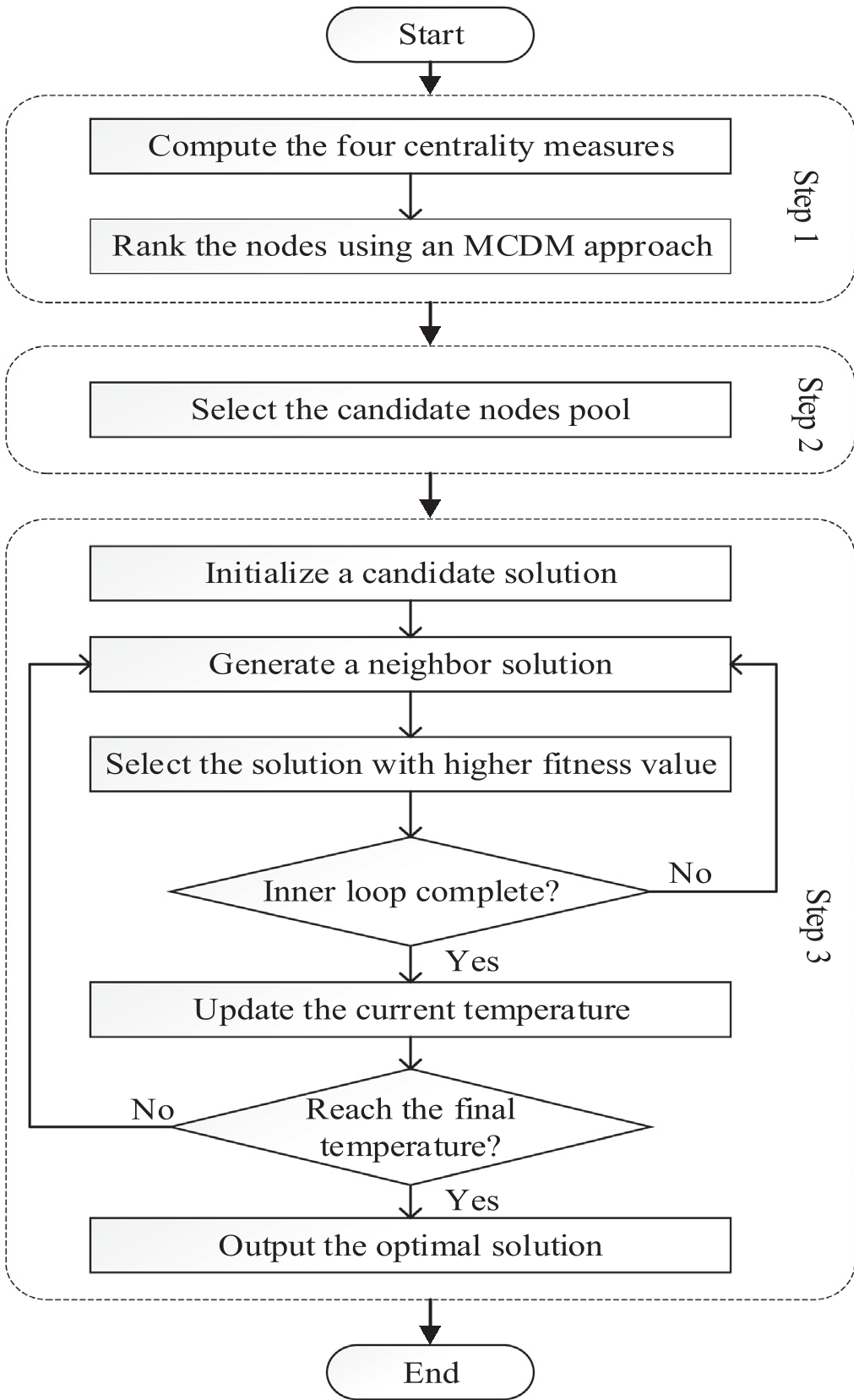
1. Multi-Criteria Node Ranking (SAW)
Instead of relying on one metric, the paper uses Simple Additive Weighting (SAW) to combine:
- Degree: Direct reach.
- Betweenness: "Brokerage" power.
- Closeness: Speed of access to the whole network.
- Eigenvector: Connection to other well-connected nodes.
2. Candidate Pool Selection
They introduce a clever non-linear equation to determine the number of candidates (): This ensures that the search space is proportional to the network size and the desired seed set size, controlled by a diversity index ().
3. Adaptive Simulated Annealing (ASA)
Once the candidates are selected, ASA searches for the optimal subset. Unlike standard SA, this version is "Adaptive":
- Self-Adaptive Temperature: If the search finds improvements, it slows down cooling to explore more. If it fails (stagnation), it cools faster to save time.
- Greedy Hill-Climbing: It prioritizes moves that immediately improve influence spread to accelerate convergence.
Experiments & Results
The authors tested SAW-ASA against six baselines (including CELF, PageRank, and DDSE) across networks ranging from small co-authorship graphs to the large Slashdot network (>77k nodes).
Influence Performance
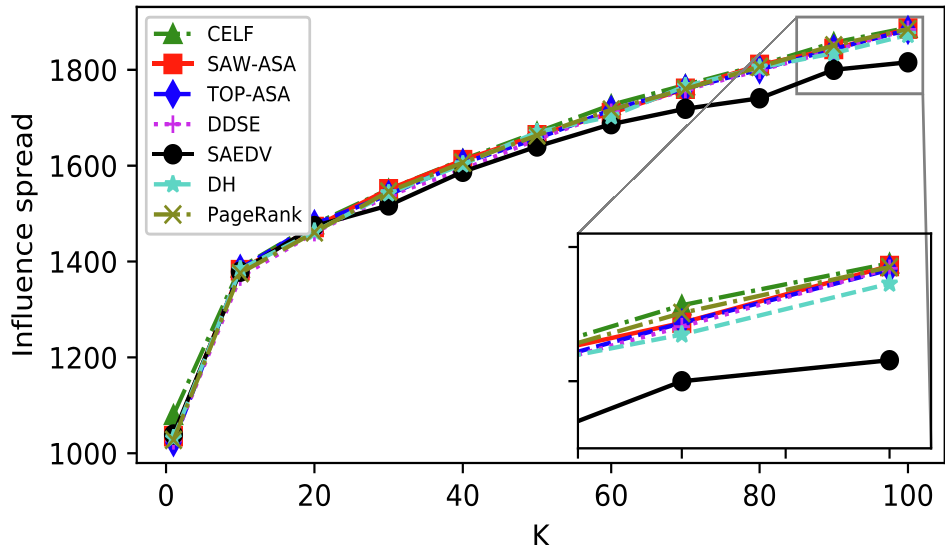
In terms of Influence Spread, SAW-ASA consistently matched the "Gold Standard" CELF and outperformed other meta-heuristics like SAEDV, which tends to get trapped in local optima as network size increases.
Computational Efficiency
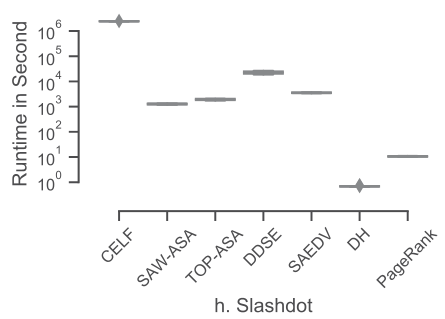
The real triumph was in Runtime. SAW-ASA is significantly more efficient than previous meta-heuristics. Because it uses the Expected Diffusion Value (EDV) instead of repeated Monte-Carlo simulations, it maintains a constant speed regardless of the diffusion probability ().
Critical Analysis & Conclusion
The "Why" it Works: The synergy between MCDM and ASA is the secret sauce. By using SAW, the model starts its search with the most "talented" individuals. The ASA then acts as the "team builder," removing nodes with redundant (overlapping) influence and replacing them with nodes that expand the total reach.
Limitations & Future Work
- Weight Sensitivity: The paper uses equal weights for centralities. In specialized networks (e.g., hidden criminal networks), "Betweenness" might be far more important than "Degree."
- Static Assumption: The model assumes a static network. Future work should address Dynamic IM, where edges appear and disappear over time.
Final Takeaway: SAW-ASA provides a robust, scalable, and highly customizable solution for the IM problem, offering a significant leap for real-world applications in billion-scale digital social ecosystems.