
Beyond Supervised Learning: Unmasking Facebook Spammers via Markov Clustering
An MCL-Based Approach for Spam Profile Detection in Online Social Networks
This paper presents a graph-based spam profile detection approach for Facebook using Markov Clustering (MCL). By modeling user interactions—active friends, page likes, and shared URLs—as weighted edges, the method successfully segments benign and spam accounts, achieving a SOTA of 0.88 and of 0.79 through a majority voting refinement.
TL;DR
Social spammers exploit the "network of trust" to bypass traditional filters. This paper moves away from rigid supervised classifiers, proposing a Markov Clustering (MCL) approach that models Facebook interactions as a weighted graph. By analyzing shared URLs, active friend intersections, and fan-page likes, the system can group spam accounts into campaigns with high precision ().
Background: The Facebook Vulnerability
While much academic attention focuses on Twitter spam, Facebook presents a different challenge. Its ecosystem relies on Fan Pages and Tagging, features that spammers use to amplify their reach beyond their immediate friend circles. The core problem is that supervised models (like Naive Bayes) require known labels and struggle with "campaign" identification—where multiple accounts act in a coordinated, yet slightly varying, manner.
Methodology: Interaction-Centric Graph Modeling
The authors represent the social network as a weighted graph . The strength of a connection between two users isn't just "friendship" (which is often faked), but actual social interaction.
1. The Weighting Strategy
The edge weight is calculated using three primary behavioral signals:
- Active Friends (): Intersection of friends with whom both users have actively interacted (posts/comments).
- Page-Likes (): Common community pages liked. Spammers often congregate on popular pages to "blast" links.
- URLs (): A fraction of commonly shared website identifiers, exposing shared infrastructure in spam campaigns.
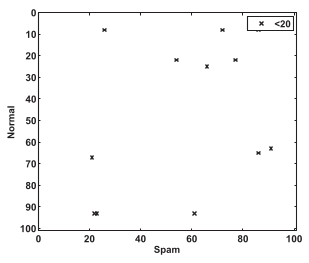 Figure 1: Comparison of interaction sparsity. Note how spammers (bottom rows) show much denser inter-linkages via mutual targets compared to normal users.
2. Markov Clustering (MCL)
Instead of forcing a fixed number of clusters (like K-Means), MCL uses Random Walks. It alternates between two operations:
- Expansion: Squaring the matrix to see where the "flow" goes in the long term.
- Inflation: Using a parameter to boost strong neighbor connections and dim weak ones, naturally separating the graph into clusters.
Experimental Results & Majority Voting
The raw MCL output often produces small "outlier" clusters. To address this, the authors applied Majority Voting—assigning these outliers to the dominant class (Spam or Normal) based on node composition.
| Inflation (r) | F-Measure (FP) | B-cubed (FB) |
|---|---|---|
| 1.5 (Standard) | 0.8529 | 0.7528 |
| 3.5 (With Voting) | 0.8750 | 0.7886 |
 Table 1: Performance gains achieved by increasing the inflation parameter and applying majority voting.
Key Findings:
- Campaign Detection: The method successfully grouped 128 spam accounts into a single large cluster (Cluster 3), proving its ability to identify coordinated attacks.
- Evasion Tactics: The study noted that some spammers share popular URLs (YouTube, News) to blend in with normal traffic—a tactic visible in Figure 3(c).
Critical Insight & Conclusion
The true value of this work lies in its unsupervised nature. By leveraging the physical intuition that "spammers move in packs," the MCL-based approach can detect new spam campaigns without needing a training set of the latest phishing links.
Limitations: The dataset size (320 profiles) is relatively small for modern OSN scales. Future work would need to address the computational complexity of matrix expansion in MCL when dealing with millions of nodes.
Final Takeaway: To fight social spam, stop looking at what the user says (content) and start looking at whom they echo and where they congregate (interactions).