
MCS-GPM: Navigating Complex Social Contexts with Multi-Constrained Graph Matching
MCS-GPM: Multi-Constrained Simulation Based Graph Pattern Matching in Contextual Social Graphs
The paper introduces MCS-GPM, a novel Graph Pattern Matching framework utilizing Multi-Constrained Simulation (MCS) to handle complex social contexts. It proposes the M-HAMC algorithm, a multithreading heuristic approach that outperforms existing methods by optimizing for multiple end-to-end constraints and minimal path lengths in large-scale social graphs.
TL;DR
Modern social networks are more than just nodes and edges; they are rich with contexts like trust, intimacy, and roles. This paper introduces MCS-GPM, a framework that moves beyond simple structural matching to support Multi-Constrained Simulation (MCS). By identifying "Strong Social Components" and utilizing a parallel heuristic algorithm (M-HAMC), the authors achieve a 46.8% speedup in query processing while significantly improving the quality of the matches found.
Background: Why Structure Alone Isn't Enough
Graph Pattern Matching (GPM) is a cornerstone of social network analysis, used for everything from finding experts to community mining. Historically, we relied on Subgraph Isomorphism (too strict and NP-complete) or Bounded Simulation (more flexible but limited to path length).
The problem? Real-world applications—like forming a trustworthy crowdsourcing travel group—require matching multiple attributes simultaneously. You don't just need a "manager" and an "assistant"; you need an assistant who is trusted by the manager and holds a strong social relationship with them. Current GPM models simply cannot handle these multidimensional constraints efficiently.
Methodology: The Core Innovations
The authors tackle the NP-complete nature of Multi-Constrained Graph Pattern Matching through three key technical pillars:
1. Strong Social Components (SSC)
The researchers observed that social structures—roles and trust levels—often remain stable over long periods. They define SSCs as subgraphs where participants maintain connections above specific thresholds of trust and intimacy. By focusing on these stable "islands," they can build indexes and compress the graph without losing vital context.
2. Context-Preserved Compression
Unlike standard compression that only looks at reachability, this method preserves the "Social Context."
- Reachability Preserved: Ancestor and descendant relations are kept.
- Graph Pattern Preserved: Ensures labels and structural topology remain queryable.
- Social Context Preserved: The compression mechanism ensures that the aggregated social impact factors (like trust) of the paths are dominated by the stored compressed path.
3. The M-HAMC Algorithm
The Multithreading Heuristic Algorithm for MC-GPM (M-HAMC) is the engine of this framework. It splits the task into:
- F-EPM (Feasible Edge Pattern Matching): A bidirectional Dijkstra-based search using a novel objective function () to find any path satisfying all constraints.
- O-EPM (Optimal Edge Pattern Matching): A refinement step that minimizes the total path length, ensuring the highest quality match.
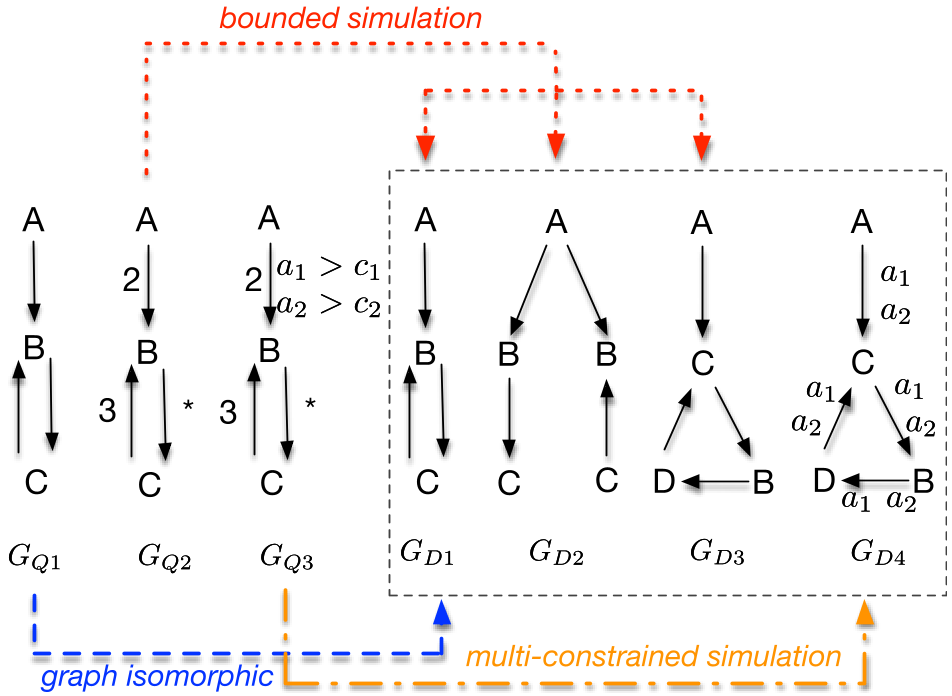 The relationship between different GPM types, showing how MC-GPM incorporates multi-constrained paths into the simulation framework.
Experiments & Results
The team tested M-HAMC against the previous HAMC state-of-the-art on five massive datasets, including Youtube and LiveJournal.
- Speed: Parallelization and SSC indexing allowed M-HAMC to process queries 46.8% faster.
- Quality: In social psychology, shorter paths usually imply stronger real-world connections. M-HAMC delivered results with 8.73% shorter path lengths on average compared to greedier approaches.
- Scalability: The processing time scaled linearly with the size of the query graph, proving its readiness for "Big Graph" applications.
 Experimental results showing the significant reduction in query processing time across different social datasets.
Critical Insight: The "Why" Behind the Success
Why does M-HAMC work so much better than previous iterations? The secret lies in the Bidirectional Heuristic Search. By searching from both the start and end nodes simultaneously and using a sophisticated objective function that balances multiple constraints (Trust, Intimacy, Role Impact, and Path Length), the algorithm prunes the search space far more aggressively than a unidirectional search could.
Conclusion & Future Outlook
The MCS-GPM framework marks a significant step toward "Context-Aware" graph analytics. By proving that we can efficiently handle multiple constraints in a simulation-based model, this work opens the door for more nuanced social applications, from secure e-commerce to optimized team formation.
Limitations: Currently, the index maintenance for highly dynamic graphs (where trust fluctuates daily) remains a challenge. Future research will likely focus on Incremental SSC Updates to keep the index fresh without full recomputations.