
Stability in the Crowd: Deciphering Infinite Horizon Capital Accumulation Games
Mean field capital accumulation games: The long time behavior
This paper investigates Mean Field Capital Accumulation Games with HARA utility in an infinite horizon setting. It extends the Nash Certainty Equivalence (NCE) framework to establish consistent mean field approximations that characterize stable long-term economic equilibria.
TL;DR
How do thousands of competing investors collectively shape the economy without a central leader? This paper explores Mean Field Capital Accumulation Games with HARA (Hyperbolic Absolute Risk Aversion) utility over an infinite time horizon. By applying the Nash Certainty Equivalence (NCE) principle, the author provides a mathematical framework to predict whether an economy settles into a stable equilibrium or spirals into chaotic cycles.
Problem & Motivation: Beyond the Central Planner
Classical economic growth theory often assumes a "hypothetical central planner." However, real-world economies are decentralized. Each agent optimizes their own consumption and investment, but their success depends on the aggregate investment level (the "Mean Field").
The core challenge is the coupling:
- Individual Impact: An agent's production efficiency decreases as the total population's investment increases (due to supply-side congestion or price drops).
- Rational Anticipation: To optimize, an agent must "guess" the future mean field. But the mean field is just the sum of everyone's optimal actions.
While finite-horizon models exist, they often fail to explain long-term stability. This paper tackles the infinite horizon, seeking conditions where rational agents can predictably anticipate the "mass effect."
Methodology: The NCE Framework
The author utilizes a recursive strategy to solve the game. The process follows three main pillars:
1. The Stochastic Dynamics
Each agent manages wealth , choosing investment to maximize HARA utility. The production function is governed by: Here, is a decreasing function of the aggregate investment , representing the "negative externality" of a crowded market.
2. Decoupling via Mean Field
In the population limit (), the aggregate investment becomes a deterministic sequence . This allows a single agent to treat the problem as a standard optimal control task, leading to a Dynamic Programming solution where the value function takes the form .
3. The Fixed Point Consistency
The "magic" of the Mean Field Game lies in the consistency condition. The sequence assumed by the agents must be exactly replicated by the mean of their optimal behaviors. This leads to the fundamental fixed-point equation:
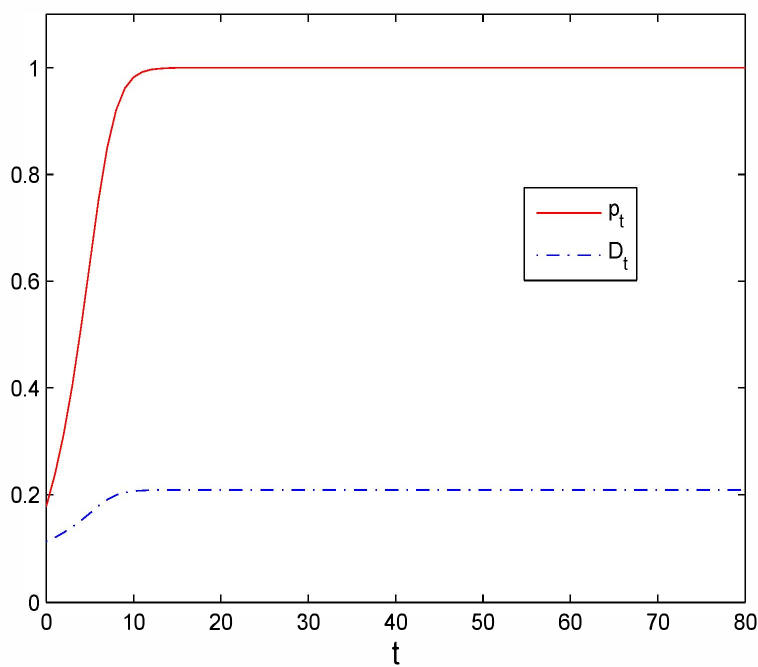 Fig 1: Numerical solutions for (mean field) and (value function coefficient) showing convergence to a steady state.
Experiments & Results: Stability vs. Chaos
The author proves that the solution is unique within the space of convergent sequences. However, the behavior of the economy depends heavily on the production parameter .
- Stable Equilibrium (): The economy enters a "transient phase" and eventually settles into a constant capital level.
- Oscillatory Behavior (): When the system is too sensitive to aggregate behavior, the fixed-point iteration fails to converge to a constant, suggesting the presence of limit cycles or chaos, similar to what is observed in complex growth theories.
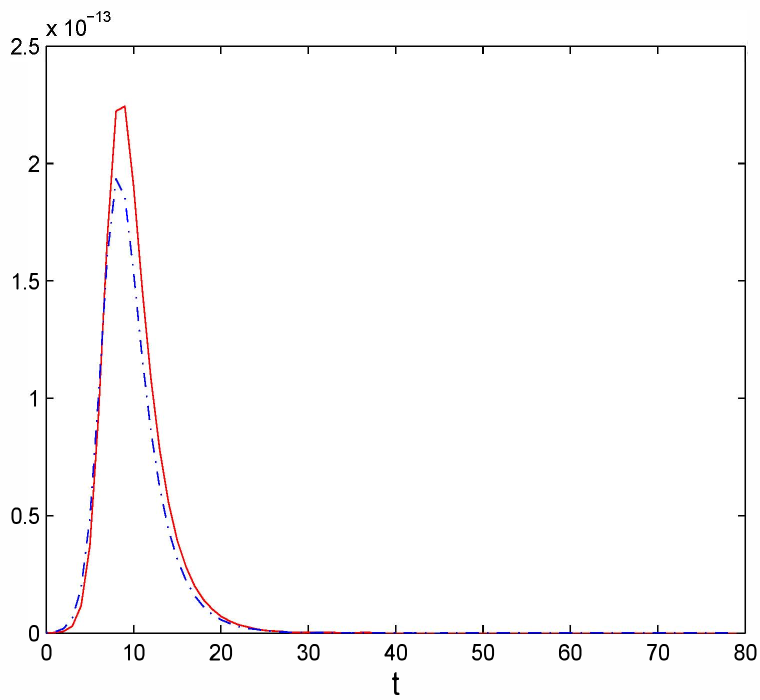 Fig 2: Convergence error of the algorithm, demonstrating the numerical robustness of the proposed recursive method in the stable regime.
Critical Insights & Future Work
Takeaway: The transition from finite to infinite horizons isn't just a matter of "adding time." It requires ensuring that the norm of the sequence is bounded, preventing the economy from exploding or vanishing.
Limitations: The paper assumes uniform agents. In a real economy, agents have different risk appetites (). Furthermore, the non-convergence at indicates that "rational anticipation" might break down in highly volatile markets, leaving room for research into bounded rationality in mean field games.
Future Outlook: Specifically, applying this to resource depletion or carbon emission games where the "congestion effect" is a physical reality would be a high-impact extension of this theoretical work.