
The War of Memes: How Direct Switching Shapes Competition in Social Networks
Mean-Field Dynamics of Inter-Switching Memes Competing Over Multiplex Social Networks
This paper proposes a Mean-Field theory framework based on a Susceptible-Infected-Susceptible (SIS) model to analyze the dynamics of multiple mutually exclusive memes competing across multiplex social networks. The core contribution is the introduction of an "inter-switching" mechanism, allowing nodes to jump directly between competitor states, and the derivation of closed-form analytical expressions for thresholds governing extinction, co-existence, and absolute dominance.
TL;DR
Researchers have developed a new mathematical framework to model how competing ideas (memes) spread over multiplex social networks like Facebook and Twitter. Unlike previous models where users must become "neutral" before changing their minds, this model introduces inter-switching, allowing direct transitions between different belief states. By applying mean-field theory, the study provides precise "tipping points" for when a meme will go extinct, co-exist with others, or achieve absolute dominance.
Background: Beyond Simple Contagion
In the traditional SIS (Susceptible-Infected-Susceptible) model, information spread is treated like a virus. However, social dynamics are more complex. Users don't just "recover" from a brand preference or political ideology; they often switch directly to a competitor. Whether it's choosing between a PS4 and an Xbox One or migrating from one news narrative to another, the "contact planes" of these competitions often span different social circles and platforms simultaneously (Multiplex Networks).
Methodology: Capturing the "Switch"
The authors utilize Mean-Field Approximation to handle the massive state-space complexity of a network with nodes. The critical innovation is the transition probability equation that accounts for two types of inbound transitions:
- Susceptible to Influenced: Standard infection based on neighbor pressure.
- Meme A to Meme B: Direct switching driven by the popularity of the rival meme on a different network layer.
The Model Architecture
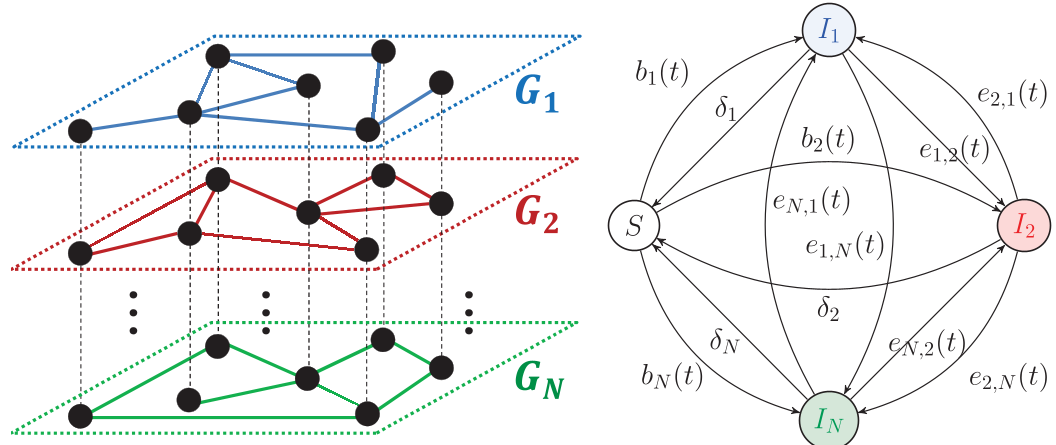 In Fig 1, the state transitions show the "S" (Susceptible) state and multiple "I" (Influenced) states, with representing the direct switching rates between memes.
The paper proves that the stability of these states is governed by the Eigenvalue of the network's adjacency matrix. Specifically, it derives the Survival Threshold (): the exact influence rate required for a meme to avoid extinction in the face of strong competition.
Phase Transitions: The Tipping Points
The research identifies three distinct phases in the life of a meme:
- Extinction: The meme's transmission rate is too low to overcome the network's recovery rate.
- Co-existence: Multiple memes find a balance, sharing the population.
- Absolute Dominance: One meme "wins," driving all others to zero.
Impact of Switching Rates
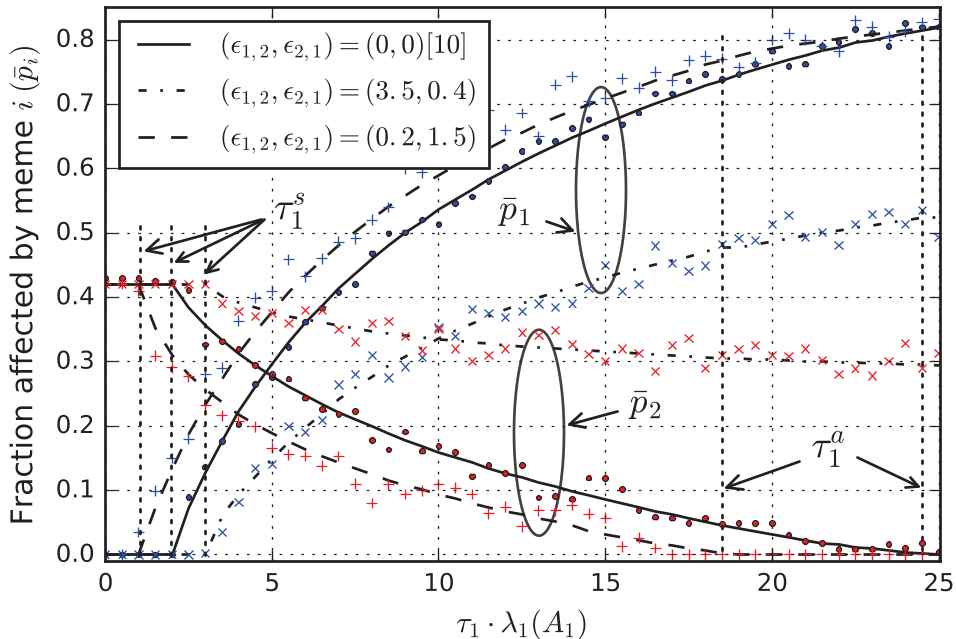 Fig 2. demonstrates how switching rates () shift the survival threshold. When switching from a rival to your meme is high, your meme can survive at a much lower native infection rate (expedited survival).
Strategic Control: The Cost of Influence
Beyond theory, the paper tackles a practical optimization problem: How much should a firm spend to control these switching rates? By formulating a non-linear optimization problem, the authors show that as a meme's native influence increases (), the monetary cost required to keep competitors at bay actually decreases because the "momentum" of the meme begins to handle the conversion naturally.
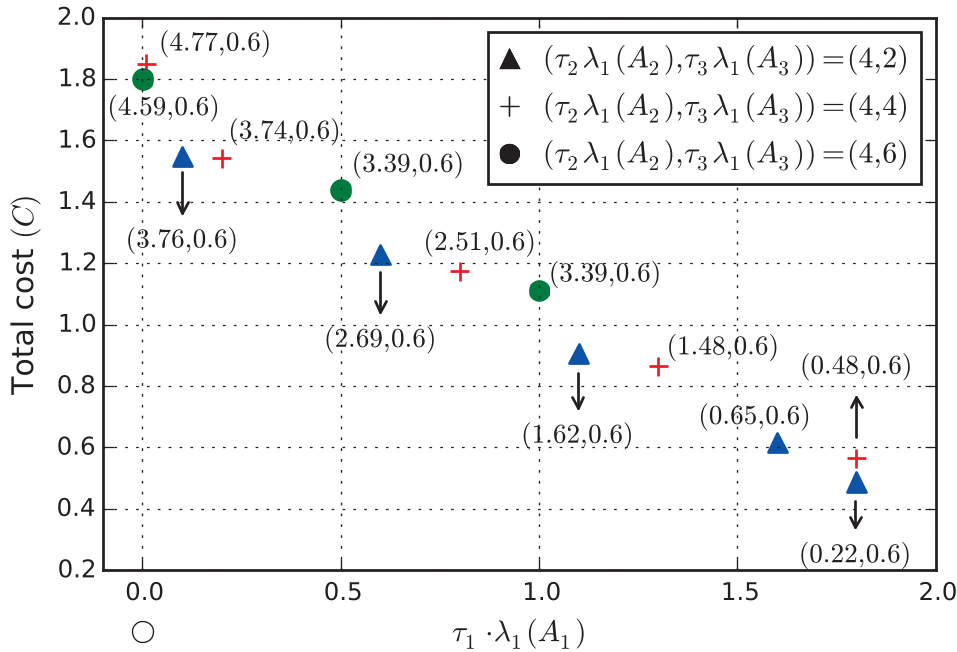 Fig 4 highlights the trade-off: higher influence rates allow for lower investment in controlling rival switching, though the cost scales with the strength of the competing layers.
Conclusion and Insights
This work moves epidemic modeling significantly closer to the reality of modern digital life. The key takeaway is that in a multiplex world, the inter-connectivity between layers is just as important as the network structure within a single layer.
Limitations: The model currently assumes a static network topology. In future work, incorporating Temporal Networks (where links appear and disappear over time) would provide an even more granular look at how viral trends explode and fade in real-time.