
Beyond Connectivity: Capturing the Temporal Pulse of Social Diffusion
Measurement-driven temporal analysis of information diffusion in online social networks
This paper presents a measurement study of information diffusion on Renren, a major Chinese OSN, focusing on the temporal "activation time" of users. The authors find that activation time follows a log-normal distribution and introduce two asynchronous diffusion models, Async-ICM and Async-LTM, which significantly refine the temporal prediction of influence maximization.
TL;DR
Most social network models tell us who will be influenced, but they rarely tell us when. This paper bridges that gap by measuring "activation time" on Renren (the Chinese Facebook). The authors discover that human reaction times in digital sharing follow a log-normal distribution and propose new asynchronous versions of the Independent Cascade (ICM) and Linear Threshold (LTM) models that better reflect the continuous flow of information in reality.
The "Time Blindness" of Traditional Models
In the study of Online Social Networks (OSN), we often treat information spread like a game of checkers—one move at a time, in discrete steps. However, real human behavior is asynchronous. If your friend shares a video at 10:00 AM, you might share it at 10:05 AM, 2 hours later, or next week.
Prior works like the standard Independent Cascade Model (ICM) assume unit time steps, which is an oversimplification. Other attempts used geometric or exponential distributions, but these were often theoretical guesses lacking empirical validation from massive, well-defined propagation datasets.
Methodology: The Renren Deep Dive
The researchers leveraged a unique period in the Renren network where friendship data and video-sharing timestamps were public. By focusing on shared video URLs, they bypassed the "noise" of text mining and focused on clear propagation traces.
Defining Activation Time
The core insight is the Activation Time (): the time difference between when user shares a video and the latest time one of 's friends shared it. This reflects the "recency effect," where users are most likely influenced by the latest stimuli in their news feed.
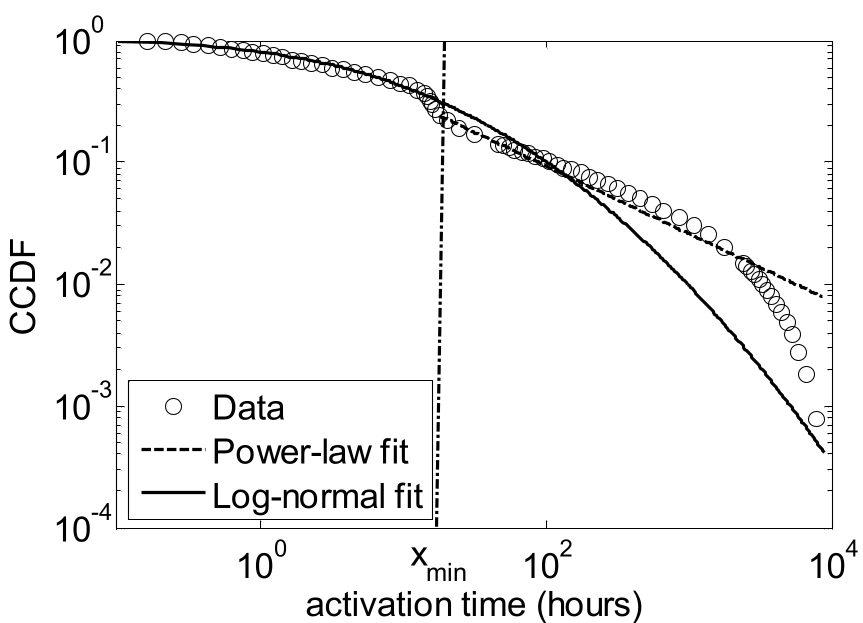 Figure 1: Empirical CCDF showing that the log-normal distribution (blue line) provides a much better fit for activation time than the power-law hypothesis.
The Log-Normal Discovery
Through a Kolmogorov-Smirnov (KS) test on millions of data points, the authors debunked the common "power-law" assumption for temporal delays. Instead, the Log-Normal Distribution emerged as the winner. This suggests a "law of proportional effect"—where the probability of a user sharing information is a product of many small, independent random factors.
Extending the Classics: Async-ICM and Async-LTM
The paper doesn't just stop at measurement; it re-engineers the pillars of diffusion theory.
- Async-ICM: When a node is successfully "activated" with probability , it doesn't flip immediately. Instead, it schedules its activation after a waiting time drawn from the measured log-normal distribution.
- Async-LTM: Once the cumulative influence from neighbors crosses a threshold, the node "waits" for the log-normal before becoming active.
Experimental Insights: The 2,000-Hour Rule
By applying these models to the Influence Maximization problem, the authors discovered a critical temporal window.
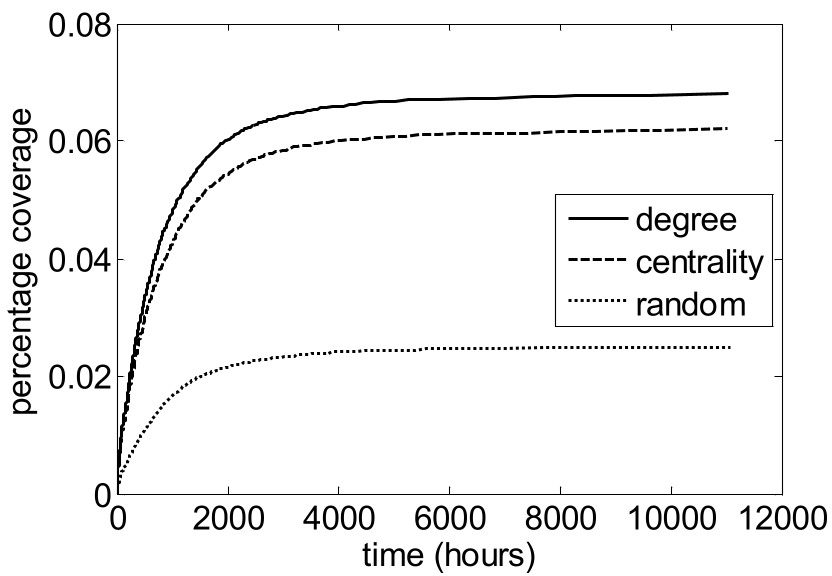 Figure 2: Temporal performance of different node selection heuristics. Note the sharp growth in the first 2,000 hours before the saturation kicks in.
Key Findings:
- Degree Heuristic Wins: Selecting nodes with the highest number of friends (Degree) is more effective than selecting those with high Betweenness Centrality, both in terms of total reach and speed.
- The Saturation Point: In the simulated Renren environment, the most significant diffusion happens within the first 2,000 hours (roughly 83 days). After this, the curve flattens significantly, suggesting that viral marketing efforts have a "shelf life."
Critical Analysis & Conclusion
While this work provides a robust framework for temporal analysis, it does operate under a "Closed World Assumption"—assuming all shares (except the first) are social-driven. In reality, external factors like search engines or front-page recommendations also play a role.
Takeaway: This paper is a wake-up call for researchers who rely on static or discrete-time models. For developers building recommendation engines or viral marketing tools, the lesson is clear: Timing is not an auxiliary variable; it is a fundamental characteristic of human social interaction. Moving forward, incorporating dynamic social ties (how friendships change over time) alongside this asynchronous delay will be the next frontier in OSN research.