
Beyond the Recommendation Algorithm: Quantifying YouTube's External Lifeblood
A Measurement Study of External Links of YouTube
This paper presents a comprehensive measurement study on YouTube's external social networks, analyzing how hyperlinks from external sites (blogs, forums, news) contribute to video popularity. By tracking nearly one million videos, it discovers that external links provide significant early-stage viewership, particularly for 'Sports' and 'Science & Technology' categories.
TL;DR
In the world of Video-on-Demand (VOD), we often focus on the internal algorithm—what the "sidebar" recommends next. This seminal measurement study shifts the gaze outward, proving that external links (blogs, forums, and news sites) are the primary engines of early-stage virality. While internal popularity follows a slow burn, external referrers provide a massive 25% viewership spike in the first 96 hours before settling into a long-tail contribution.
Background: The "Conductance" Problem
Why does a video go viral on one corner of the internet but remain invisible in another? The authors point to a phenomenon called low "conductance" between communities. Even if two online groups are adjacent in interest, they rarely exchange information unless a physical bridge—an external link—is built. This paper is the first systematic attempt to measure the strength of these bridges.
Methodology: Peering Through the JS Engine
To capture this data, the researchers built a massive gathering system to track almost one million videos. Because the YouTube API at the time restricted visibility into the full referrer tree, the team used a custom JavaScript engine to scrape the top 5 external links for each video, providing a representative snapshot of external influence.
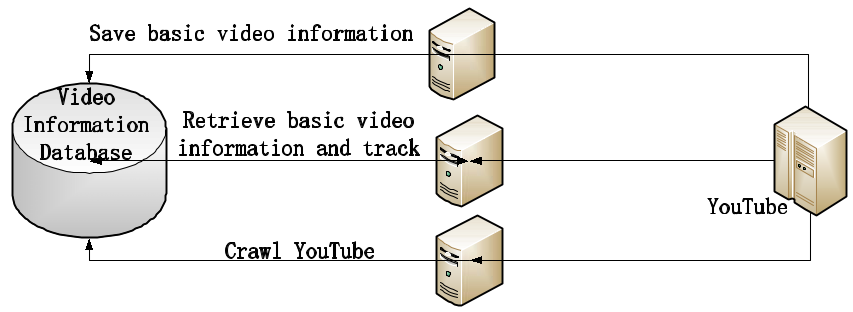 Fig 1: The framework of the information collecting system used to track 131,000+ videos daily.
Key Insights: Category and Time
The study reveals several counter-intuitive findings that challenge the typical "Music is King" narrative of YouTube:
- Category Divergence: While "Music" and "Comedy" dominate total views, they are shockingly self-contained. In contrast, 'Sports' and 'Science & Technology' derive the highest percentage of their popularity from external sources.
- The 4-Day Golden Window: External links have a "burn rate." A video gets 10% to 30% of its views from external links in the first 4 days. After day 12, this drops significantly as the blog post or forum thread moves off the front page.
- The Power-Law Decay: The contribution of external links decays according to a power law. Young videos (
 Table 1: Data traces showing the massive scale of the cumulative impact study (9.83 x 10^5 videos).
Deep Dive: The "Waist" and the "Tail"
When plotting the percentage of views from external links on a log-log scale, the researchers noticed two anomalies:
- The Waist: Between month 3 and 15, the external contribution drops faster than expected. This is due to the "short life cycle" of secondary web pages (news articles and blog posts) which are often deleted or buried.
- The Tail: For videos older than 15 months, the external contribution actually stays higher than the power-law prediction. This suggests that "top 5" links are being renewed—old links are replaced by new, active ones that keep the "classic" content alive.
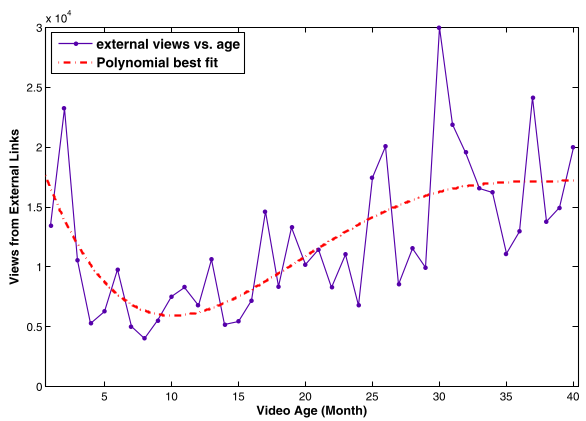 Fig 2: The trend of total views vs. external link contribution. While total views grow, the relative impact of external links peaks early.
Critical Analysis & Conclusion
This paper serves as a vital reminder that VOD platforms do not exist in a vacuum. The "External Social Network" is the catalyst that feeds the "Internal Social Network."
Takeaway for Today: Even in the age of AI-driven feeds, the "external link" logic survives in the form of "Dark Social" (shares in private WhatsApp groups or Slack). The study's conclusion that the first 4 days are critical for external embedding remains a gold standard for digital marketing strategy.
Limitations: The study only looked at the "Top 5" links due to technical constraints. In reality, the "Long Tail" of hundreds of small external links might collectively rival the impact of the top 5, suggesting that the "External Environment" is even more powerful than captured here.