
Unmasking the Architecture of Online Hate: A Comparative Study of Twitter and Whisper
A Measurement Study of Hate Speech in Social Media
This paper presents a large-scale measurement study of hate speech on Twitter and Whisper using a novel sentence-structure-based detection methodology. By analyzing millions of posts, the authors categorize hate targets, examine the role of anonymity, and map the geographical distribution of online hate across the US and other English-speaking countries.
TL;DR
This study provides a systematic, large-scale measurement of online hate speech across two contrasting platforms: Twitter (non-anonymous) and Whisper (anonymous). By shifting from simple keyword searches to a sentence-structure-based detection method, the researchers uncovered that while "hard" hate (racism) dominates public platforms, "soft" hate (behavioral/physical shaming) thrives in anonymity. Key findings show that anonymity correlates directly with the severity of the hate expressed.
The "Keyword" Trap: Why Prior Methods Failed
Traditionally, researchers and platforms like Facebook or Google monitored hate speech using massive "blacklists" of slurs. However, this approach has two fatal flaws:
- Context Loss: A slur can be reclaimed by a community or used in a non-hateful context (e.g., academic discussion).
- Evolving Targets: Haters constantly invent new "codes" or target groups (like "slow people" or "fake people") that aren't on standard lists.
The authors argue that the intent is visible in the grammar. By searching for the structure I <intensity> <hate_verb> <target>, they ensure they are capturing personal, active expressions of animosity rather than mere mentions of sensitive words.
Methodology: The Linguistic Template
The core of this research is a high-precision template designed to filter out the noise of billions of social media posts.
The Formula:
Subject (I) + Intensity (Really/F***ing) + Intent (Hate/Can't Stand) + Target (Group X)
The researchers combined this with two discovery tracks for targets:
- Syntactic: Targeting phrases like "X people" (e.g., "noisy people").
- Lexical: Crowdsourcing known slurs from Hatebase with high offensivity scores.
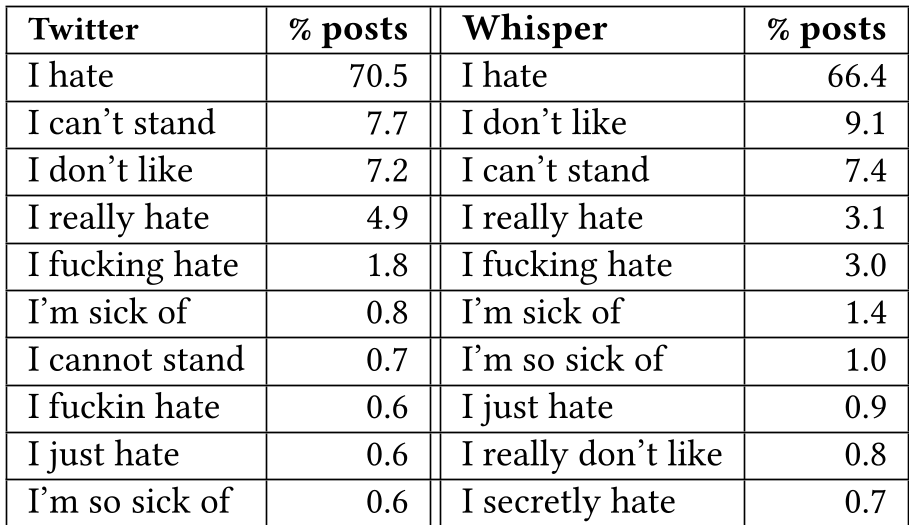 Table: The most common linguistic markers used to express hate on Twitter and Whisper.
Key Insights: Anonymity and Geography
1. Does Anonymity Fuel Hate?
The study confirms the Disinhibition Effect. By cross-referencing Twitter accounts with a database of 4.3 million "real names" from Facebook, the authors found:
- Baseline: Only 40% of random tweets are anonymous.
- Race/Sexual Orientation Hate: This jumps to 54-55% anonymity.
- Observation: People are significantly more likely to hide their real identities when spewing hate that constitutes a "hard" social taboo or potential hate crime.
2. The Geography of Animosity
Using geotagged data from Whisper, the researchers mapped hate "hotspots" in the US.
- The South and Midwest: Higher relative volumes of hate speech (1.05 - 1.07 relative amount).
- The Northeast and West: Lower relative volumes (0.91 - 0.93).
- Category Mapping: Race and Sexual Orientation hate were most concentrated in the Southern states, whereas physical-based hate (e.g., body shaming) was more prevalent in the West.
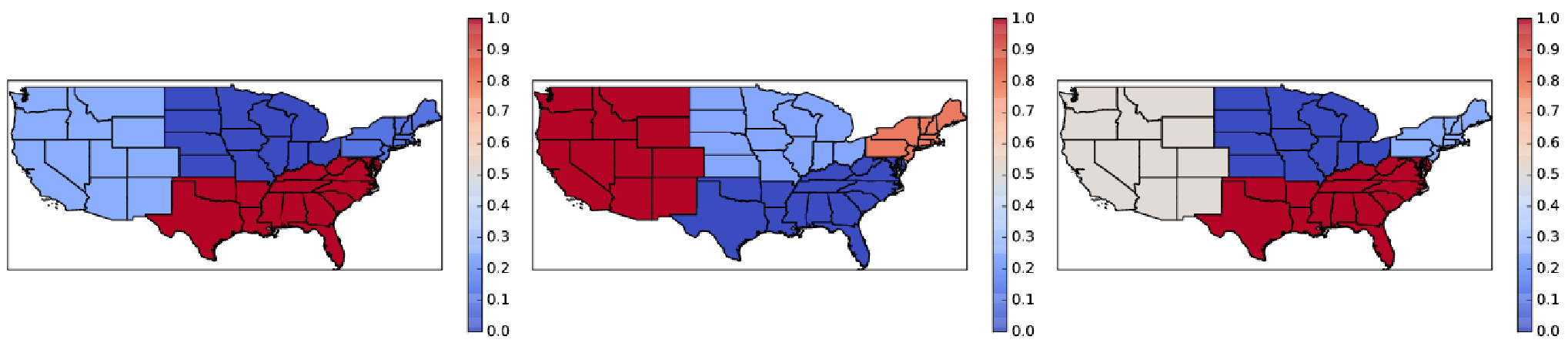 Figure: Heat maps showing regional concentrations of hate categories across the US.
Anatomy of the Hater's Logic
By using "Word Trees," the authors analyzed the context appended to hate speech.
- Justification: Many users follow a hate statement with "because..." or "they...", attempting to provide a rationale for their prejudice.
- Twitter vs. Whisper: Twitter users tend to provide more elaborate justifications (self-validation), whereas Whisper users often leave short, blunt "confessions" of hate.
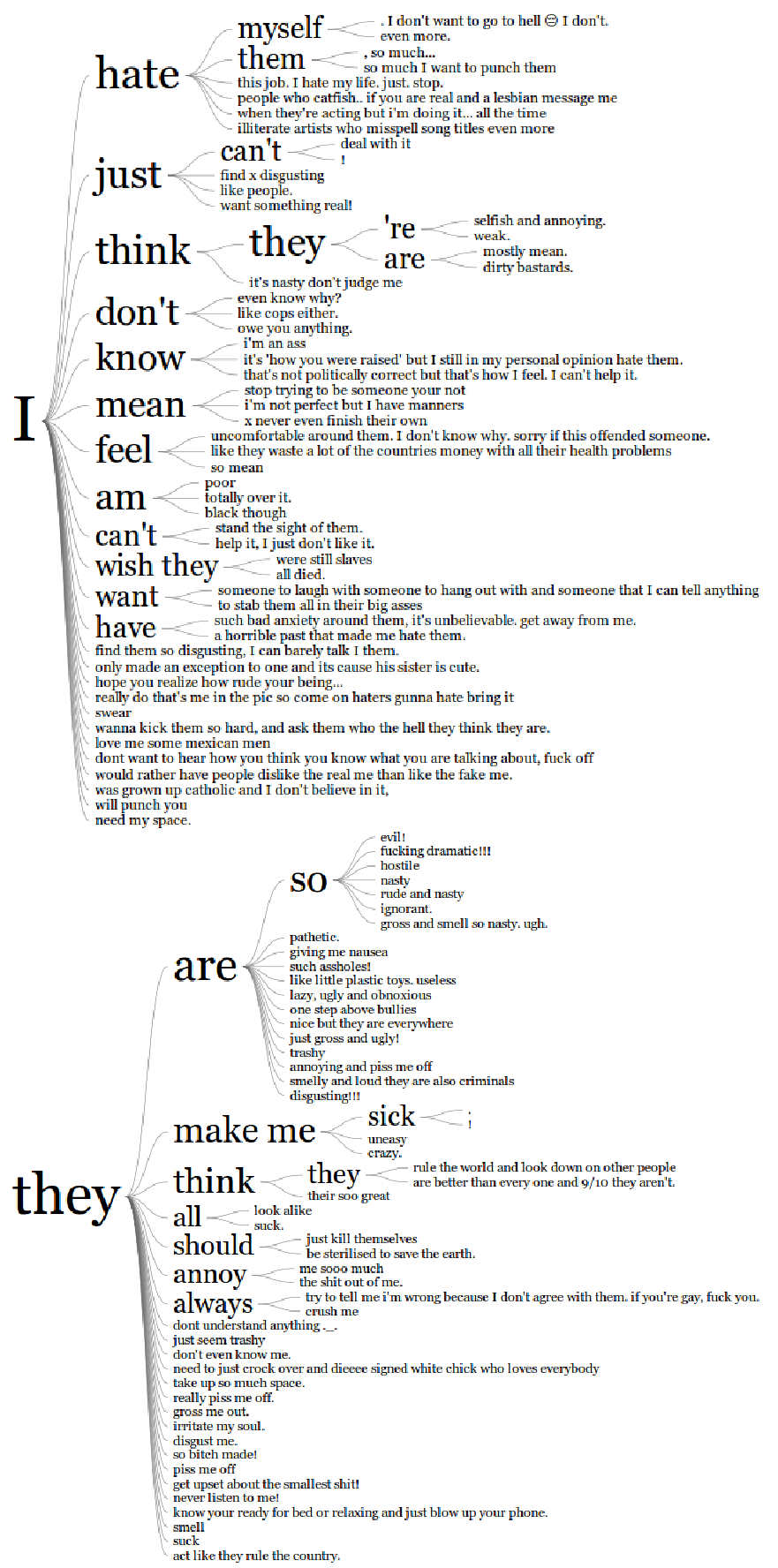 Figure: The linguistic context following "I hate...", showing how users justify their bias.
Critical Analysis & Conclusion
This paper is a seminal piece of "Digital Sociology." It reveals that online hate isn't just a monolithic block of "racism"; it is a spectrum ranging from Behavioral Shaming (the most common) to Systemic Bigotry.
Limitations: The study is limited to English and relies on a specific sentence structure, which means it likely misses sarcastic hate or "veiled" hate (low recall).
Future Outlook: For engineers building moderation systems, the takeaway is clear: Identity strength matters. Platforms allowing anonymity must deploy more aggressive NLP filters, specifically for "hard" categories like Race and Religion, which are historically linked to offline violence.