
The Reality of AI Agents: Why Simple Workflows Trumps Autonomy in Production
Measuring Agents in Production
The paper introduces MAP (Measuring Agents in Production), the first large-scale systematic study of LLM-based agents in real-world deployment. Through 20 case studies and 86 surveyed production systems, it characterizes how industry leaders build, evaluate, and scale agents, revealing a significant shift from academic autonomy toward "system-level" reliability.
Executive Summary
TL;DR: The "MAP" (Measuring Agents in Production) study by UC Berkeley and industry partners (IBM, Stanford, etc.) reveals a surprising truth: successful AI agents in the real world look very different from the autonomous "God-mode" entities seen in academic benchmarks. Production agents are defined by controllability and simplicity, typically running fewer than 10 steps before asking a human for help, and favoring hard-coded prompts over black-box optimization.
Background Positioning: This is a foundational empirical study. While academic papers iterate on "fully autonomous" planning, MAP acts as a reality check, documenting the "Leading Edge" of production practice and shifting the focus from model capabilities to system design.
The Gap Between Research and Reality
Current research narratives often celebrate the ability of agents to plan over hundreds of steps or self-correct via Reinforcement Learning (RL). However, practitioners face a different set of constraints:
- Model Brittleness: Frequent model updates from providers (OpenAI/Anthropic) break fine-tuned weights, making prompting more sustainable.
- Verification Gaps: Unlike coding tasks, real-world insurance or HR tasks don't have a "unit test."
- The Reliability Paradox: Organizations want the productivity of agents but cannot afford the hallucination risks of unconstrained autonomy.
Methodology: How Industry Builds "Real" Agents
The study highlights that practitioners achieve reliability through system-level constraints rather than algorithmic breakthroughs.
1. Architecture: Structured over Autonomous
Most deployed agents use Structured Workflows. Instead of letting an LLM "figure it out," engineers define a fixed sequence of subtasks (e.g., Coverage Lookup -> Risk ID -> Human Approval).
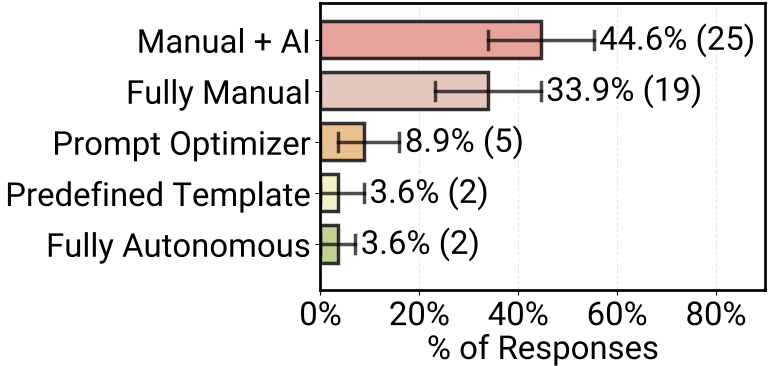 Figure: The dominance of human-driven prompt construction and structured step limits.
2. The "Minutes-Scale" Latency
Counter-intuitively, 66% of production agents tolerate latencies of minutes or longer. Why? Because agents are automating tasks that previously took humans days. This suggests that "thinking time" (inference-time compute) is a highly viable trade-off for correctness.
Evaluation: The Human is the Benchmark
In the world of production agents, formal benchmarks are rare (75% don't use them). Instead, Human-in-the-loop (HITL) is the gold standard.
- 74% of systems rely on human verification.
- LLM-as-a-judge is used by 52%, but almost always as a "triage" tool to flag low-confidence outputs for human review.
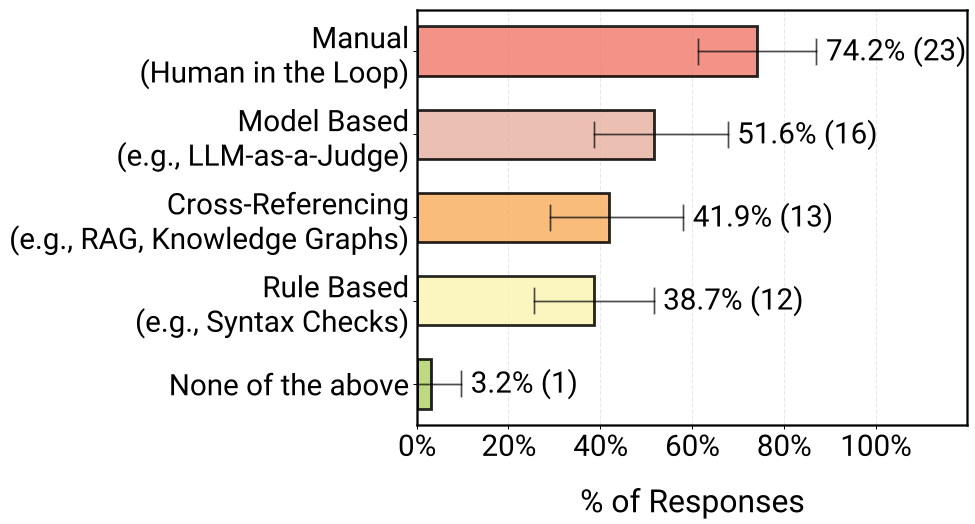 Figure: Evaluation strategies showing the heavy reliance on human judgment and model-based critique.
Critical Insights: The Move to Agent Engineering
The MAP study offers a mid-2025 snapshot of a field in transition. The key takeaway is that "Agent Engineering" is becoming a discipline distinct from ML Research.
Key Discoveries:
- Frontier Models are Foundations: 85% of teams build custom in-house scaffolds rather than using heavy frameworks like LangChain, seeking vertical integration and security.
- Productivity over Novelty: Adoption is driven by Finance, Tech, and Corporate Services for 10x gains in background tasks (e.g., insurance triaging, incident response).
- Sanity in Security: Security is handled via "Read-Only" access or sandboxing rather than complex guardrail models.
Conclusion and Future Outlook
The study concludes that the future of agents isn't necessarily more autonomy, but better augmentation. We need research into:
- Model migration tools: How to keep prompts working when GPT-5 or Claude 4 launches.
- Inference-time scaling: Trading speed for 100% correctness in asynchronous tasks.
- HITL Interfaces: Better ways for humans and agents to collaborate over 5-10 autonomous steps.
Final Thought: If you are building an agent today, stop trying to make it "fully autonomous." Fix the workflow, bound the steps, and put a human in the loop. That is the blueprint for production success.