
Measuring Social Resonance: A Topological Approach to Multi-Agent Harmony
Measuring agreement and harmony in multi-agent societies: A first approach
This paper introduces a formal framework for measuring "Agreeability" and "Harmony" in Multi-Agent Systems (MAS) using metric spaces based on Horn clause logic. It proposes a novel "model distance" metric to quantify how closely agents' goal theories align and whether negotiation processes will converge toward a consensus.
TL;DR
How do we know if a society of autonomous agents is actually "getting along"? This paper moves beyond qualitative descriptions of agent cooperation, introducing a rigorous mathematical framework using Metric Spaces to measure Agreeability (individual inclination to negotiate) and Harmony (social stability). By treating agent goals as logic theories, it provides a way to calculate the "distance" between what agents want and whether their negotiation will ever reach a steady state.
Problem & Motivation: The Measurement Gap
In the world of Multi-Agent Systems (MAS), agents are often designed with independent, and sometimes conflicting, goals. While we have plenty of strategies for how they should negotiate (e.g., contract nets, auctions), we lack a standardized way to measure the quality of the resulting society.
The author's core insight is that proximity is the key. To understand agents, we shouldn't just look at their final goals, but at the "computational distance" between how they derive those goals. If Agent A and Agent B are drifting apart in their reasoning, the society faces a risk of "chaos" rather than "harmony."
Methodology: The Geometry of Logic
The paper represents agent goals as sets of First-Order Horn clauses (logic programs). To compare two agents, the author doesn't just look at the code; they look at the Least Herbrand Model—the set of all facts that can be proven true by those rules.
1. Model Distance
Since these models can be infinite or expensive to compute, the author proposes a "compromise solution": comparing the partial models generated at each step of the reasoning process ( mapping).
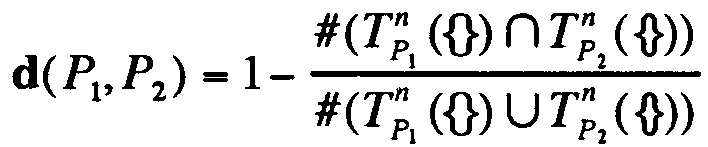
The distance is calculated at the least index where the generated sets of facts differ. This is computationally efficient because it stops the moment a discrepancy is found.
2. From Logic to Social Behavior
- Agreeability: An agent is agreeable to agent if, through successive applications of a negotiation function, its goal theory converges. If the negotiation enters an infinite loop of changes, the agent is fundamentally "disagreeable."
- Harmony: This is the global version of agreeability. Does the society as a whole converge to a stable set of shared goals under a global negotiation strategy (or "moderator")?
Experiments & Results: Quantifying "Bird-ness"
The author illustrates the metric using three different logical definitions of a "bird":
- C1: Wings and feathers.
- C2: Flies and feathers (where flying is derived from having wings).
- C3: Just feathers.
Through the mathematical apparatus, the paper shows how we can quantify the distance:

This demonstrates that even subtle logical differences (like whether "flying" is an essential attribute or a derived one) result in measurable distances that affect how agents will negotiate.
Critical Analysis & Conclusion
Takeaway
The true value of this work lies in its formalization of social stability. By framing negotiation as a function in a metric space, we can use the Banach Fixed-Point Theorem to guarantee that certain negotiation strategies will always lead to consensus (if the function is a "contraction").
Limitations
- Infinite Models: While the algorithm handles many cases, it doesn't halt for theories with equal, infinite models (though a "max iterations" timeout is suggested).
- Logic Constraints: Modern agents rarely use pure Horn clauses; applying this to probabilistic or vector-based reasoning (like LLMs) remains a significant challenge for future work.
Future Outlook
The author hints at moving toward Inductive Logic Programming (ILP), where agents don't just negotiate their current goals but learn new rules to better align with their peers. This topological framework provides the "GPS" needed to navigate that learning process toward a more harmonic society.