
Measuring Audience Retention: Why "Loyal Viewers" Matter More Than Averages
Measuring Audience Retention in YouTube
This paper investigates audience retention on YouTube, utilizing an "Ego network" approach to analyze how viewers engage with individual video channels. It defines key engagement metrics (APV, AVD), evaluates the impact of shortening videos on viewer loyalty, and proposes a new "Loyalty Measure" focused on the fraction of the audience remaining until the end of the video.
TL;DR
Is your video too long, or is the content just not "sticky"? This paper explores the mathematics of YouTube audience retention. By analyzing 1,000+ videos through an "Ego network" lens, the authors provide a framework to decide when to cut content and why standard metrics like Average Percentage Viewed (APV) might be lying to you.
The Problem: The Bias of the Average
For video creators, the "Average Percentage Viewed" (APV) is a primary KPI. However, it harbors a mathematical bias: longer videos are almost always penalized. If you have a 10-minute video and a 2-minute video, the former requires significantly more effort to maintain a high APV, even if the content is superior.
The authors argue that we need to move beyond simple averages to understand causality—specifically, how the duration of a video influences the abandonment process.
Methodology: The Ego Network Approach
Unlike massive studies that look at "typical" videos across the platform, this research uses an Ego Network approach. The authors scrutinized their own channels (e.g., altman2208, eitan meir altman) to see how specific changes in video structure affect retention.
They decompose the engagement graph into three segments:
- The Nose: The first 2% where the largest drop-off usually occurs.
- The Body: The steady middle section.
- The Tail: The inflection point at the end.
The Math of Shortening Videos
The paper introduces Theorem 4.1, which provides the mathematical grounds for shortening a "causal" video.
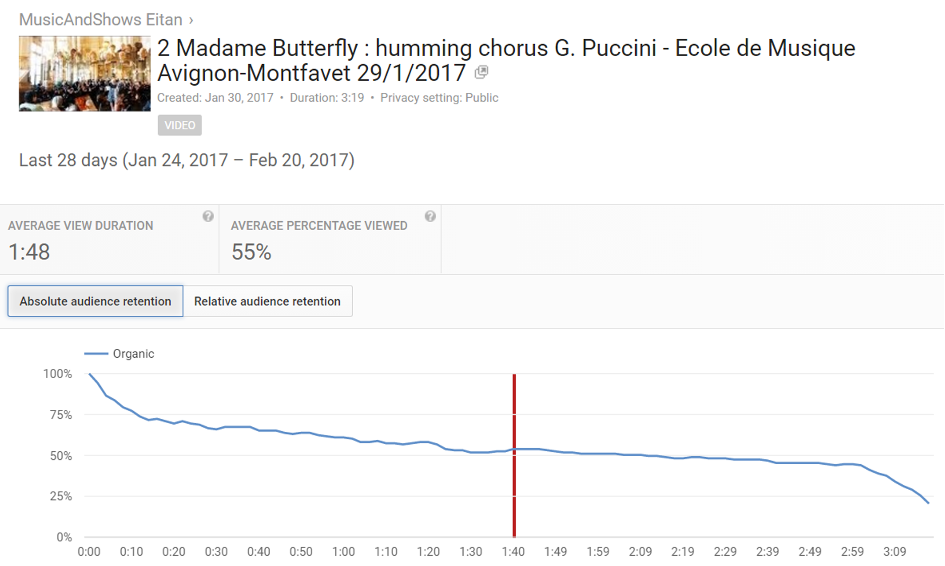
The core insight? If your retention curve is strictly decreasing, shortening the video will mathematically guaranteed increase your APV. However, the author warns that if your "Body" retention is flat (loyal viewers are staying), the gain from shortening is marginal and might even be counterproductive for your brand.
Experimental Insights: When APV and RAR Conflict
The authors highlight a fascinating inconsistency between YouTube’s Relative Audience Retention (RAR) (how your video performs against similar-length videos) and APV.
In one experiment involving the song "Sur le pont d’Avignon", they shortened a video and found that while the APV remained stable across different time periods, the RAR fluctuated wildly.
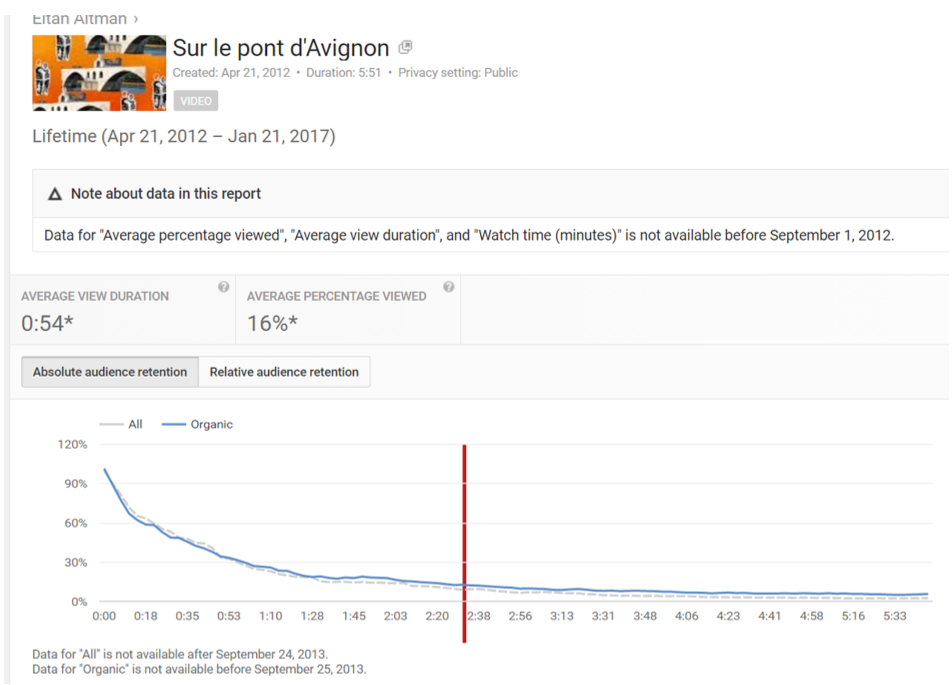 Figure: Absolute retention for a shortened video showing the "Body" of the engagement.
The Proposed "Loyalty Measure"
Because APV is so sensitive to duration, the authors propose a Loyalty Measure: the fraction of the audience that stays until the very end of the video body. Why is this the superior metric?
- The Punchline: Most value (or the "ask") is at the end.
- The End Screen: YouTube allows recommendations in the last 20 seconds. If viewers leave early, they never see your next video.
- Future Interest: Viewers who stay until the end are significantly more likely to subscribe.
Critical Analysis & Takeaways
The paper successfully bridges the gap between pure statistical modeling and creator-centric strategy.
Key Takeaways for Creators & Researchers:
- Causality Matters: Don't just look at the drop; ask if it happened because of an intro (The "U-shape" nose) or because the video reached a natural conclusion.
- Relative vs. Absolute: A low APV on a long video might still result in a "High" RAR ranking if it maintains better-than-average retention for its category.
- Don't Cut for the Sake of Averages: If 20%+ of your audience reaches the end of an 8-minute video, shortening it to 4 minutes might double your APV but will cut your total "Watch Time"—a metric YouTube's algorithm values highly for monetization.
Limitations: The study primarily uses music and lecture-style videos. The dynamics of high-intensity "MrBeast-style" editing, where retention is artificially propped up by fast cuts, might require a different mathematical model.
Future Work
The authors suggest that future retention models should incorporate Network Operation Characteristics (like losses and delays) to see how technical playback quality impacts the psychological decision to "stop watching."