NovelSum: Decoding Data Diversity for Better LLM Instruction Tuning
Measuring Data Diversity for Instruction Tuning: A Systematic Analysis and A Reliable Metric
This paper introduces NovelSum, a state-of-the-art diversity metric for instruction tuning (IT) data, which achieves a high correlation (r=0.97) with model performance. By considering both inter-sample differences and local information density, the authors also developed NovelSelect, a greedy data selection strategy that consistently outperforms current SOTA methods like K-Center-Greedy and QDIT.
Executive Summary
TL;DR: Researchers from Fudan University have cracked the code on measuring "Data Diversity" for LLM instruction tuning. They present NovelSum, a metric that finally aligns with actual model performance (Pearson's r=0.97). By leveraging this metric, they developed NovelSelect, a data selection strategy that significantly outperforms standard methods by picking samples based on their "Density-Aware Novelty."
In the Academic Landscape: This work moves beyond the "black-box" nature of data engineering. It identifies why traditional semantic distance metrics fail and provides a rigorous mathematical framework to quantify what makes an instruction dataset "diverse" in a way that actually helps LLMs learn.
Problem & Motivation: The "Diversity" Illusion
In the world of Instruction Tuning (IT), we know that quality and diversity beat quantity. However, "diversity" has remained a fuzzy concept. Researchers often use simple tricks like:
- Lexical Diversity: Counting unique words (too shallow).
- Distance-based Semantic Diversity: Putting points as far apart as possible in embedding space.
The authors find a fatal flaw in the latter: it ignores information density. In domains like mathematics or coding, many samples might look "similar" in embedding space but contain radically different logical steps. Traditional metrics would call these redundant; NovelSum recognizes their unique contribution.
Methodology: The Core of NovelSum
NovelSum's brilliance lies in two components: Proximity Weighting and Density Awareness.
1. Proximity-Weighted Uniqueness
Instead of just summing all distances between points, NovelSum gives higher weight to a sample's nearest neighbors. Why? Because a sample’s novelty is defined by how it differs from its closest relatives, not how far it is from a random sample across the galaxy of the dataset.
2. Density-Aware Distance
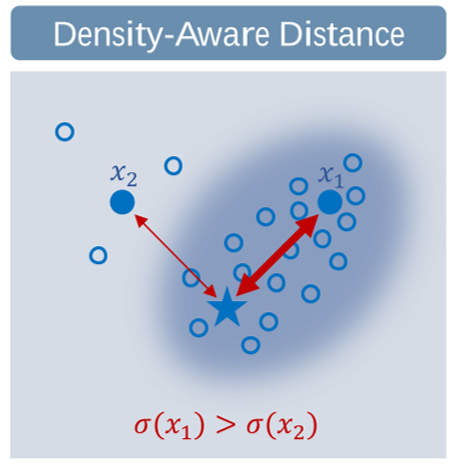
The metric adjusts the distance between points based on the local density of the source data pool (). Where is the local density. This ensures that in "crowded" but information-rich areas (like logic or reasoning tasks), even small semantic distances are recognized as providing significant novelty.
Experiments & Results: The 0.97 Correlation
Extensive testing on LLaMA-3-8B and Qwen-2.5-7B verified that NovelSum is the most reliable "thermometer" for dataset health.
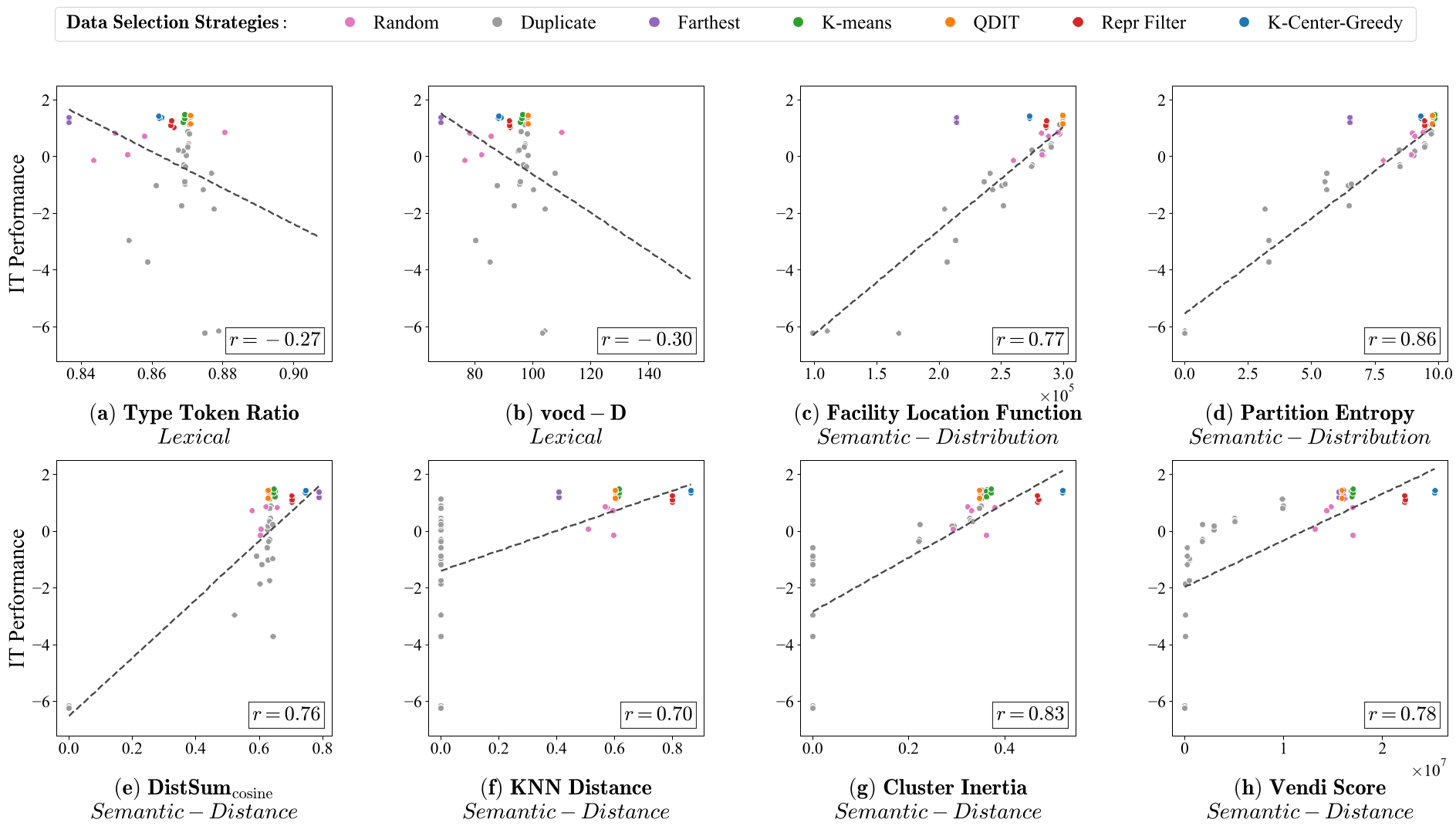
- Comparison: While existing metrics like Vendi Score or Cluster Inertia show inconsistent correlations, NovelSum remains rock-solid across different models.
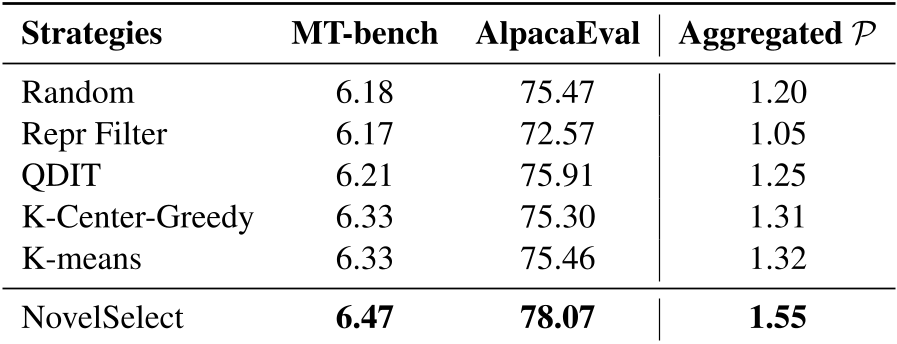
- NovelSelect Performance: When used as a selection objective, the greedy strategy NovelSelect produced models with significantly higher MT-bench and AlpacaEval scores compared to the current gold standards (K-Center-Greedy and QDIT).
Ablation Insights
The ablation study revealed that removing either proximity weighting or density awareness caused the correlation to plummet. Specifically, removing the proximity weight () dropped the performance correlation from 0.97 down to 0.55, proving that "local neighborhood" analysis is the secret sauce.
Critical Analysis & Conclusion
Takeaway
Diversity isn't just about "distance"; it's about uniqueness relative to local context. NovelSum provides the first reliable objective function to optimize instruction datasets systematically.
Limitations & Future Work
The authors acknowledge that:
- Embedding Dependency: The metric works best when the embedding model matches the fine-tuning backbone.
- Domain Specificity: While general IT is covered, domain-specific tasks (like deep medicine or law) might require refitting the density calculation pool.
Future Outlook: We expect "NovelSum-like" objectives to be integrated into automated data flywheels, where models autonomously select their next 10k training samples from a sea of raw web data to maximize learning efficiency.