
Measuring the Effect of Social Network Data on Music Recommendation: Beyond Collaborative Filtering
Measuring the Effect of Social Network Data on Music Recommendation
This paper explores "Measuring the Effect of Social Network Data on Music Recommendation" by integrating social media footprints—specifically Facebook Fans Pages and Check-in data—into recommendation algorithms. The study proposes a hybrid social-filtering approach and demonstrates that music-associated fans page data significantly outperforms random selection and check-in location categories in recommendation accuracy.
TL;DR
This study investigates how different types of social network data—specifically from Facebook—impact the quality of music recommendations. By comparing user-specific "Fans Pages," localized "Check-in" data, and peer-group interests, the research identifies that explicit brand/artist associations on social media are the strongest predictors of musical taste, significantly outperforming random baselines and even geographical context.
Background & Motivation
In the era of streaming, the "Cold Start" problem remains a significant hurdle: how do you recommend music to a user with no listening history? Traditional Collaborative Filtering (CF) fails here. The authors' intuition is that our social media "shadow"—the pages we like and the places we visit—functions as a proxy for our cultural identity. However, not all social data is created equal. Does knowing where someone eats (Check-ins) help predict what they listen to, or is it better to look at what their friends like?
Methodology: The Social Signal Hierarchy
The researchers extracted data via the Facebook Graph API, categorizing social signals into three main buckets:
- Direct Interest: Music-associated Fans Pages liked by the user.
- Social Context: Music-associated Fans Pages liked by the user’s friends.
- Behavioral Context: Categories of locations where the user has "checked in."
The goal was to measure which combination of these features produced the highest user satisfaction rating (on a scale of 1-5).

Empirical Results: Interest Trumps Location
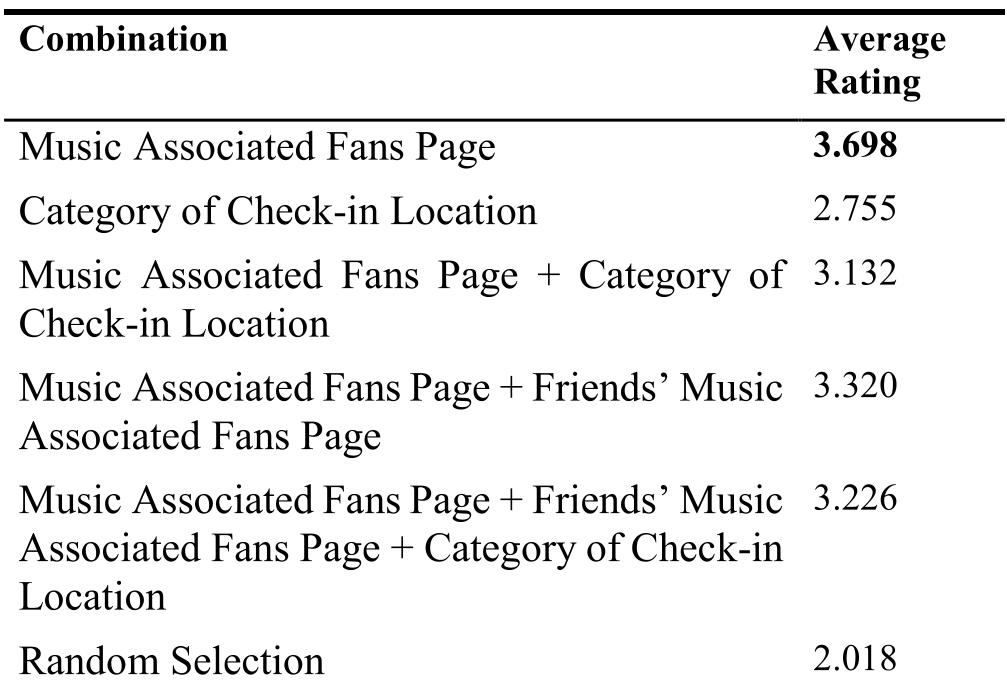
The experimental results provide a clear hierarchy of data value. As shown in the performance table below, the specific affinity for music-related pages is the "Golden Feature."
| Combination | Average Rating (1-5) |
|---|---|
| Music Associated Fans Page | 3.698 |
| Music Associated Fans Page + Friends' Pages | 3.320 |
| Category of Check-in Location | 2.755 |
| Random Selection | 2.018 |
Why did Check-ins fail?
A fascinating insight from the data is that adding Check-in Location data actually reduced the average rating. This suggests a low correlation between a user's physical movement (e.g., checking into a gym or restaurant) and their acoustic preferences. In the realm of music, our "digital identity" (what we follow) is a much stronger signal than our "physical footprint."
Critical Insight & Conclusion
The core takeaway for Recommender Systems (RecSys) practitioners is the divergence of social signals. While multi-modal data is often seen as a "holy grail," this paper proves that adding more data types can introduce noise.
Key Takeaways:
- Direct Social Affinity: Following an artist's page is a high-intent signal that serves as a robust foundation for Zero-shot recommendations.
- The Peer Influence Gap: Interestingly, a user's own likes were more predictive than their friends' likes (3.698 vs 3.320). Personal identity still outweighs social conformity in music.
- Limitations: The study relies on Facebook's ecosystem (circa 2016). In today's landscape, short-video interactions (sequence of 'likes') might provide even denser signals than static 'Fans Pages.'
Ultimately, the paper reinforces that for specialized domains like music, domain-specific social signals (interest graphs) are far superior to general behavioral metadata (location graphs).