
How UX Design Shapes Social Science: The Impact of Web Layouts on Social Network Data
Measuring ego-centered social networks on the web: Questionnaire design issues
This paper investigates questionnaire design issues for measuring ego-centered social networks via web surveys. It explores how the visual layout of name generators and the format of name interpreters (alter-wise vs. question-wise) influence reported network size, composition, and data quality. The study identifies that the number of name boxes significantly impacts the reported number of social ties.
TL;DR
Collecting data on social networks is notoriously difficult, especially on the web where no interviewer is present to guide the respondent. This paper demonstrates that something as simple as the number of text boxes on a screen can "fake" the size of a person's social circle, and that the order in which we ask questions determines whether a respondent completes a survey or quits in frustration.
The "Invisible Interviewer" Problem
In traditional sociology, an interviewer helps the respondent navigate the complex task of listing friends and describing their relationships. On the web, the User Interface (UI) becomes the interviewer. The authors argue that most web users don't read instructions—they scan for visual cues. If a UI provides ten boxes, the respondent feels an implicit pressure to fill them, even if their "true" network is smaller. Conversely, a single box might be misinterpreted as a prompt for a single group (e.g., "my family") rather than a list of individuals.
Methodology: The Anatomy of a Web Network Survey
The researchers tested three specific design variables in a controlled experiment:
- Name Generator Layout: Providing 1, 5, or 10 boxes for names.
- Name Interpreters Format:
- Alter-wise: Ask all questions about "Friend A," then all about "Friend B."
- Question-wise: Ask for the "Gender" of all friends, then the "Age" of all friends.
- Survey Length: 6 vs. 11 attributes per friend.
 The study workflow: from network generation to alter characteristics.
Key Insights: Why UI Matters More Than Instructions
1. The Power of Text Boxes
The results were striking: the average network size dropped from 4.7 (10 boxes) to 3.1 (1 box). This suggests that the interface acts as a "suggestibility" tool. Furthermore, labels like "5" or "10" created heaping—a statistical anomaly where results cluster around these round numbers regardless of reality.
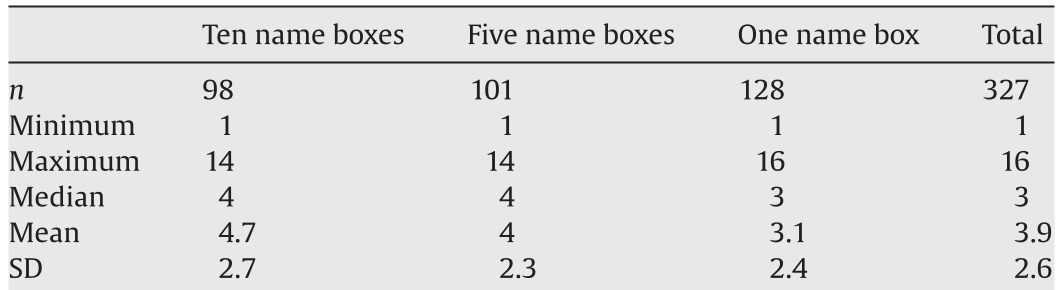 Table showing the significant difference in mean network size based on box count.
2. Question-Wise vs. Alter-Wise
Conventional wisdom might suggest that focus on one person at a time (Alter-wise) is more natural. However, the study proved the opposite for web surveys. The Question-wise format was significantly more efficient:
- Lower Item Non-Response: 8% vs. 20% in the alter-wise group.
- Lower Drop-out Rates: Respondents felt less burdened when evaluating one attribute across all friends simultaneously.
Critical Analysis & Future Directions
The paper concludes that there is no "perfect" static design. A single box reduces heaping but increases non-valid responses (like people typing "everyone at work"). The authors suggest a Dynamic UI (Web 2.0) approach:
- Start with a single box.
- Once a name is entered, dynamically add the next box.
- Use real-time validators to prevent plural entries (e.g., "friends") or fake names.
Limitations
The study used a non-probability sample of Slovenian internet users, meaning the absolute network sizes (e.g., 3.9 avg) shouldn't be generalized to the global population. However, the relative differences between the experimental groups remain a robust warning to survey designers: the medium is, to a large extent, the measurement.
Final Takeaway
To get high-quality social network data, stop treating the questionnaire like a digital piece of paper. Treat it like a dynamic interface. Use Question-wise layouts and dynamic input fields to minimize cognitive load and maximize data integrity.