
Quantifying Closeness: A Decision-Making Approach to Online Friendship Strength
Measuring Friendship Strength in Online Social Networks
The paper proposes a quantitative metric for measuring friendship tie strength in Online Social Networks (OSNs), specifically calibrated for young adults on Facebook. By integrating sociological maintenance theories with the Analytic Hierarchy Process (AHP), the authors developed a weighted formula using five key interaction variables to help users identify and revive fading connections.
TL;DR
Not all social media "friends" are equal. This paper introduces a mathematically grounded metric to quantify Tie Strength using the Analytic Hierarchy Process (AHP). By analyzing variables like tagged photos and message frequency, the researchers created a model that matches human intuition of friendship in 75% of test cases, specifically for the young adult demographic on Facebook.
Background: Beyond the Binary Friend Request
In the early days of social networks, a "friend" was a binary status—you either were one or you weren't. However, sociological reality is much more nuanced. As defined by Granovetter and Krackhardt, Strong Ties provide emotional support and trust, while Weak Ties are essential for novel information and job opportunities.
The problem is that OSNs (Online Social Networks) often suffer from "context collapse" where a high-school acquaintance and a best friend are treated identically by the algorithm. The authors argue that to help users maintain relationships (Relationship Maintenance), we need a transparent, real-time metric to signal when a bond is weakening.
Methodology: The AHP Strategy
The core innovation here isn't just picking variables; it's how they are weighted. Instead of using a standard linear regression where the weights are determined by "best fit," the authors used Analytic Hierarchy Process (AHP).
1. The Variables (The "What")
After homeschooling 27 potential Facebook features, they settled on five key indicators:
- : Number of mutual friends (Network stability)
- : Messages exchanged in the last month (Direct interaction)
- : Shared pages liked (Similarity)
- : Photos tagged together (Physical proximity/Shared activities)
- : Likes on comments (Low-stakes engagement)
2. Standardization via CDF
Raw numbers (e.g., 10 messages vs. 100 mutual friends) cannot be compared directly. The authors used the Cumulative Distribution Function (CDF) of real user data to map these values into a [0, 1] range. This ensures that a user with 50 mutual friends is ranked relative to the typical distribution of the community.
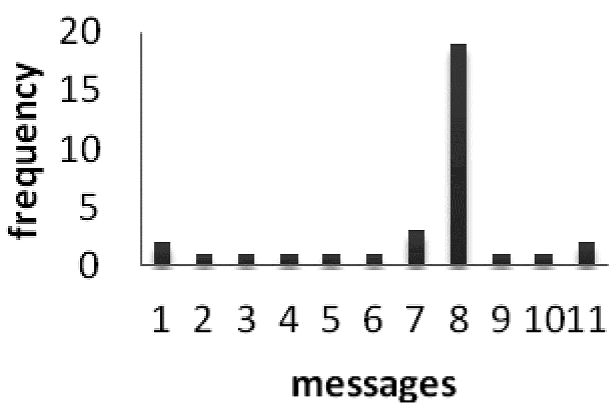 Figure: The CDF curve for mutual friends (), showing how raw counts are mapped to probability-based scores.
3. The Weighting (The "Why")
Through pairwise comparisons by real users, AHP generated the following weights ():
- Photos Together (): 0.332 (The heaviest weight)
- Messages (): 0.290
- Mutual Friends (): 0.121
This suggests that for young adults, being physically present together (captured in photos) is the ultimate sign of a strong tie.
Experimental Results
The authors tested the metric in two ways:
- Absolute Assessment: Users saw a score (e.g., "78%") for a friend. Only 41% agreed, largely because humans find it hard to judge what "78% friendship" means in a vacuum.
- Relative Assessment: The system compared two friends and asked, "Is Friend A closer to you than Friend B?" Here, the accuracy jumped to 75%.
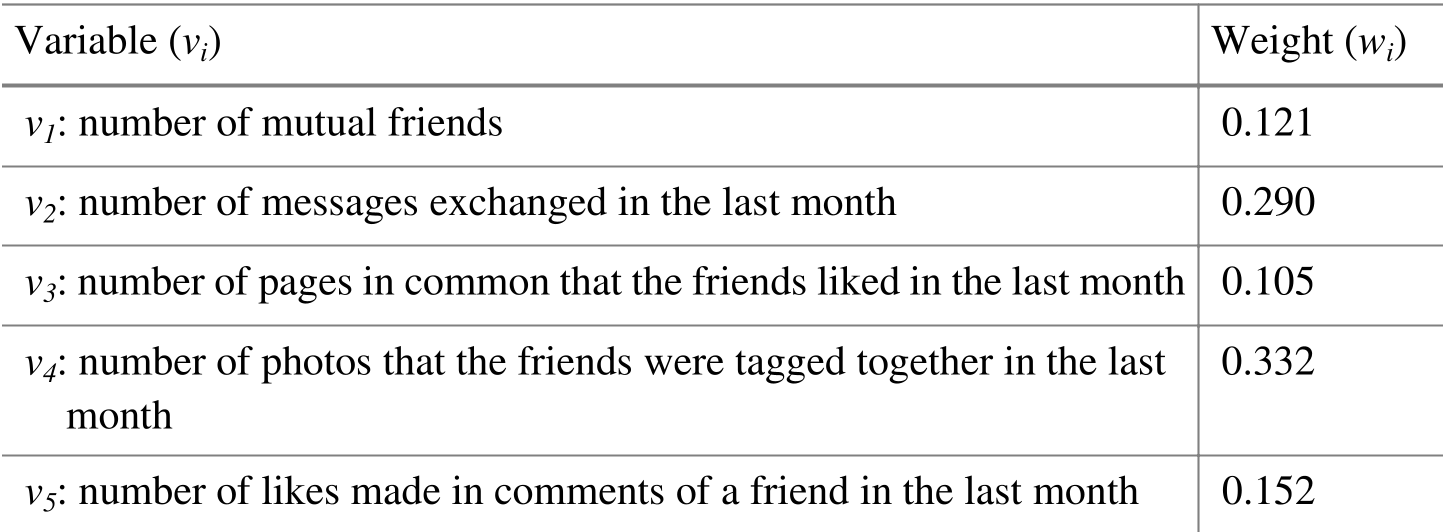 Table: Final weights assigned to the five variables after AHP processing.
Critical Insight: The "Offline" Blindspot
One of the most fascinating findings in the qualitative feedback was the discrepancy in "offline" interactions. Some users disagreed with the metric because they saw a friend every day in person but rarely interacted on Facebook. This highlights a fundamental limitation: The metric measures Online Tie Strength, not Total Tie Strength.
Conclusion & Future Work
This research provides a scalable, privacy-conscious way to measure relationship health without needing to read the actual content of messages. By using AHP, the authors provide a "human-in-the-loop" weight system that reflects actual social priorities. Future iterations could adapt these weights dynamically based on the age of the user—perhaps "Shared Photos" matter less to professionals on LinkedIn than "Mutual Connections."
Key Takeaway: If you want to keep a friendship alive in the digital age, tagging a photo is still the "Gold Standard" of engagement.