
From Citations to Social Impact: Measuring Blogger Influence via the H-index Family
Measuring the Influence of Bloggers in Their Community Based on the H-index Family
This paper introduces a novel framework for identifying influential bloggers by adapting the H-index family (H-index, G-index, R-index, and Pi-index) from scientometrics to social media. By integrating the iFinder model's post-scoring mechanism with binning techniques, the authors measure blogger impact based on cumulative productivity and sustained influence rather than single-post performance.
TL;DR
In the world of social media, is a blogger influential because of one viral tweet, or because they consistently provide value? This paper argues for the latter. By borrowing the H-index—a gold standard for measuring scientific productivity—and applying it to the blogosphere, the researchers provide a more stable, spam-resistant way to identify true community leaders.
Background: The Flaw in "One-Hit Wonder" Metrics
In previous studies, such as the iFinder model, a blogger's influence was often defined by their best post. While this captures viral moments (like a major Apple product leak), it has two fatal flaws:
- Vulnerability to Spam: A user could manipulate a single post to gain top-tier status.
- Short Decay: Once a single high-scoring post becomes obsolete, it no longer reflects the blogger's current standing.
The authors suggest that influence should be accumulative. Just as a professor's H-index measures both the quantity and quality of their papers over time, a blogger's score should reflect their consistent ability to engage the community.
Methodology: Bridging Scientometrics and Social Media
The challenge: H-indices require integer "citation counts," but social media influence scores (derived from links and comments) are typically normalized decimals between 0 and 1.
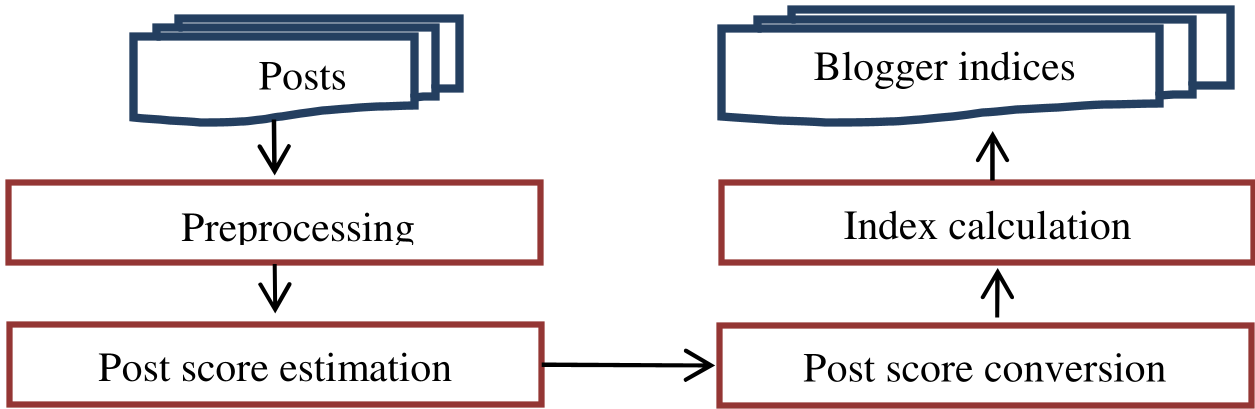
1. Estimating Post Quality (The iFinder Foundation)
The authors first use the iFinder algorithm to calculate an initial score for every post, considering:
- Inbound Links: Bonus for being referenced by others.
- Outbound Links: A small penalty for "borrowing" content.
- Comments: A proxy for engagement quality.
- Post Length: A crude but effective measure of content depth.
2. The Binning Strategy
To use the H-index family, the authors convert these [0,1) scores into integers using two methods:
- Equal-frequency Binning: Sorting posts and dividing them into groups with equal numbers of posts.
- Equal-width Binning: Dividing the [0,1] range into equal intervals.
3. Applying the H-index Family
With these "integer citations," they calculate multiple variants:
- H-index: posts with at least points.
- G-index: Emphasizes high-impact posts even more than the H-index.
- R-index: The square root of the sum of citations in the "Hirsch core."
Experimental Insights: Who is Really Influential?
The authors tested their model on the TUAW (The Unofficial Apple Weblog) dataset, containing 10,000 posts.
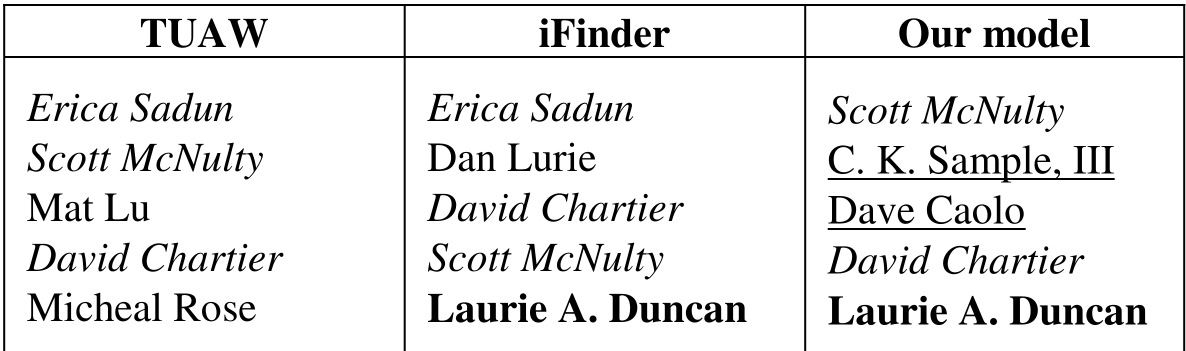
H-index vs. iFinder
The results revealed a significant shift in rankings. Dan Lurie, who ranked high in iFinder due to a single high-engagement iPhone post, dropped in the H-index ranking. Conversely, bloggers like Scott McNulty and C. K. Sample III, who maintain a high volume of quality posts, rose to the top.
Temporal Dynamics
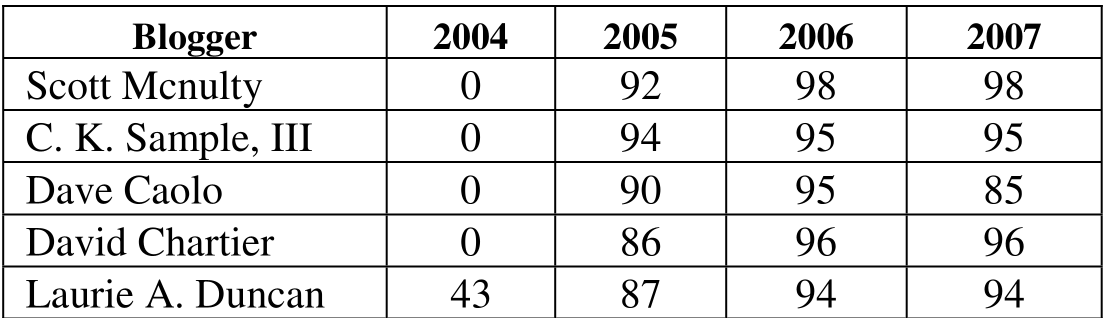
Crucially, the H-index in social media isn't just a "lifetime achievement award." By calculating the index within specific time windows, the authors showed that influence is dynamic—it can rise and fall based on a blogger's current activity level.
Critical Analysis & Conclusion
The Takeaway: The H-index family provides a "career-based" view of social influence. It successfully penalizes spammers and rewards professional consistency.
Limitations:
- The model still relies on post length as a proxy for content quality, which may not hold true in the era of microblogging (Twitter/X).
- The binning method ( or ) is somewhat arbitrary and can significantly alter the final index values.
Future Work: The authors aim to integrate temporal "decay" factors (post time) and expand the model to platforms like Facebook and Twitter, where the "half-life" of content is even shorter than in traditional blogs.