
Measuring Information Society: Decoding the Digital Divide of the 1990s
Measuring information society Dynamics of European data on usage of information and communication technologies in Europe since 1995 q
This paper presents a longitudinal analysis of the "Information Society" in Europe using data from the European Commission’s "Measuring IS" surveys (1995-1999). It introduces the Information and Communication Technology Adoption Scale (ICTAS) to quantify ICT penetration and identifies significant socio-demographic disparities across the EU.
TL;DR
This seminal paper by Andrea Ricci analyzes the "Measuring Information Society" (MIS) surveys conducted by the European Commission between 1995 and 1999. It challenges the optimistic rhetoric of a uniform technological transition, revealing instead a deeply divided Europe characterized by gender gaps, economic barriers, and a linguistic/regional split in ICT adoption.
Background: Beyond the Rhetoric
By the mid-1990s, "Information Society" (IS) had become a buzzword in political and industrial circles. However, the term remained semantically ambiguous. Ricci argues that for the IS to be more than a metaphor, it must be measured. The paper moves away from technological determinism—the idea that technology automatically transforms society—and looks at how humans actually use (or ignore) these tools.
Problem & Motivation: The Gap in Empirical Evidence
Early theories of the IS were split between:
- Qualitative Approaches: Focused on how information flows "compress time and space."
- Quantitative Approaches: Focused on the "wired" infrastructure and information economies.
The author identified a dangerous lack of objective measurement, which allowed for "simplistic analyses" of progress. To fix this, the European Commission launched the MIS surveys to provide a counterweight to the hype, focusing on 12 key technologies and 12 social applications.
Methodology: Mapping the ICT Landscape
The methodology evolved from a 1995 pilot survey (7,500 telephone interviews) to the more robust 1997 survey (15,000 face-to-face interviews).
The Two Poles of Adoption
The research identified two distinct technological clusters:
- The Televisual Pole: Technologies like Teletext and decoders—cheap, easy to use, and focused on entertainment.
- The PC Pole: PCs, Modems, and the Internet—expensive, steep learning curve, and high maintenance.
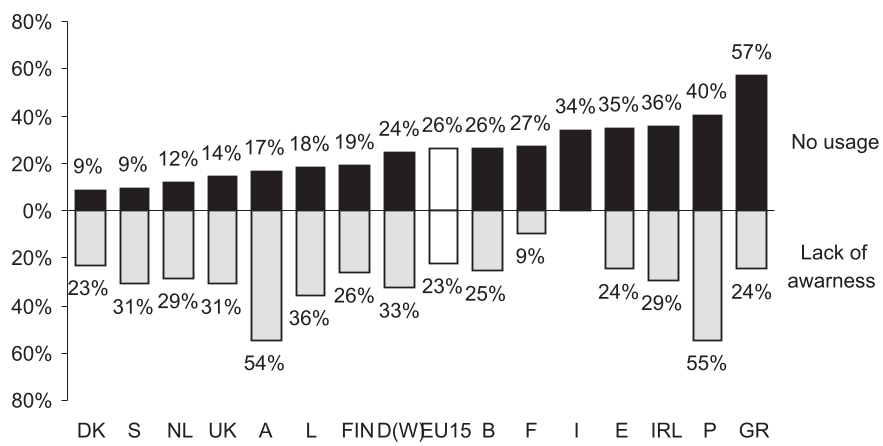 Figure: The framework of personal factors (age, gender, income) used to analyze adoption.
Key Results: A Divided Europe
The findings in 1995 were a "wake-up call" for policymakers:
- Usage Levels: On average, Europeans used only 2.1 out of 12 proposed technologies.
- The Internet Ignorance: In 1995, nearly 44% of Europeans had never heard of the Internet.
- The Gender Gap: Women were significantly less likely to use ICTs compared to men, though they showed equal interest in social applications like tele-education and telemedicine.
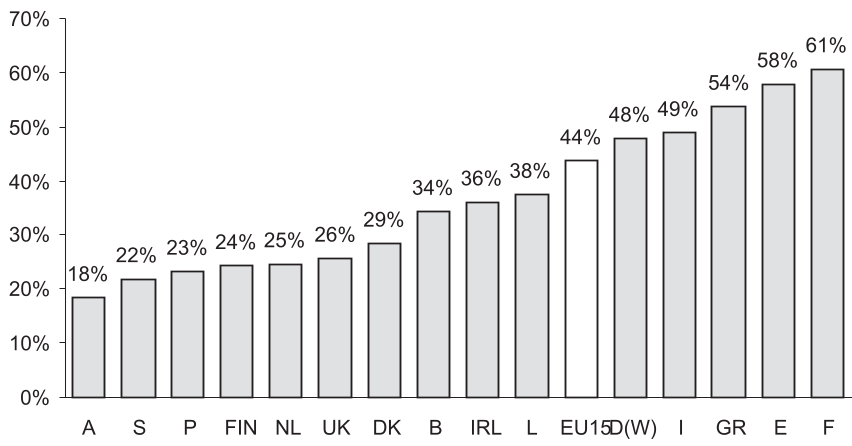 Figure: The data reveals that in the mid-90s, the "Information Highway" was still an unknown concept for almost half the population.
By 1997, while awareness had improved, usage remained polarized. Northern countries (Finland, Sweden) emerged as "heavy users," while Southern countries trailed, despite showing high levels of interest and "willingness to pay" for specific services like e-government.
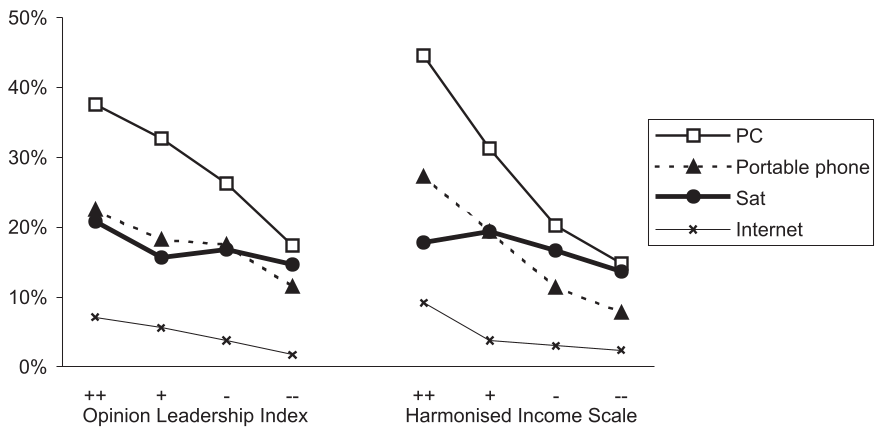 Figure: The correlation between Opinion Leadership, Revenue, and ICT usage.
Critical Insight: The "Noise Society"
One of Ricci’s most profound contributions is the classification of European society into three tiers:
- The Informatized Minority: Heavy users who can filter and control the "signal."
- The Noise Society: The largest group—passive consumers overwhelmed by the data stream, using technology mostly for "psychological relief" or entertainment.
- The Conscious Un-informatised: Educated individuals who deliberately choose to boycott certain digital trends.
Future Outlook: A Warning on Social Casting
Ricci concludes with a stark warning: ICT adoption risks creating a new caste system. If access remains tied to structural economic development and gender roles, technology will reinforce social divides rather than bridge them.
Takeaways for Modern Research:
- Social Dimension: Policy must facilitate access for "less favored segments" to prevent ICT from becoming a marker of social class.
- Knowledge vs. Entertainment: A high PC penetration rate is meaningless if the tools are only used for passive entertainment rather than knowledge management.
- Trans-nationality: The digital economy requires multilingual and cross-border portals to truly thrive as a "digital internal market."
Conclusion
This paper serves as a historical benchmark, reminding us that the "Information Society" was never a guaranteed outcome of technological progress, but a result of complex socio-economic negotiations that continue to this day.