
Java Memory Tracing: Debugging the Student's Mental Model through Data Mining
Measuring Instruction Comprehension by Mining Memory Traces for Early Formative Feedback in Java Courses
This paper introduces a specialized educational tool designed for Java programming courses that assesses instruction comprehension through detailed memory traces (tracking stack, heap, and static areas). By employing a data mining approach on interval sequences derived from Abstract Syntax Trees (AST) and student inputs, the tool provides early formative feedback and identifies systematic mental model misconceptions.
TL;DR
For novice programmers, the computer is often a "black box" that behaves unpredictably. This research presents a Java Memory Tracer tool that requires students to manually record the state of the stack and heap during execution. By applying data mining to these "memory traces," the system automatically identifies specific code patterns—like for-loop updates or variable scopes—where students' mental models fail, providing a scalable way to offer formative feedback.
The Problem: Success by Chance
The "notional machine"—the simplified mental model of how a computer executes code—is often broken for beginners. A student might write a working loop but fundamentally misunderstand when the increment occurs or how variables are popped off the stack. Conventional feedback (like unit tests or compiler errors) tells a student what is wrong with their code, but not what is wrong with their internal logic.
The author argues that without a "mechanical understanding" of the language, students are merely trial-and-error coding.
Methodology: Fusing ASTs with Memory Traces
The core innovation lies in how the researcher bridges the gap between raw student errors and abstract programming concepts.
1. Memory Traces as the Vehicle
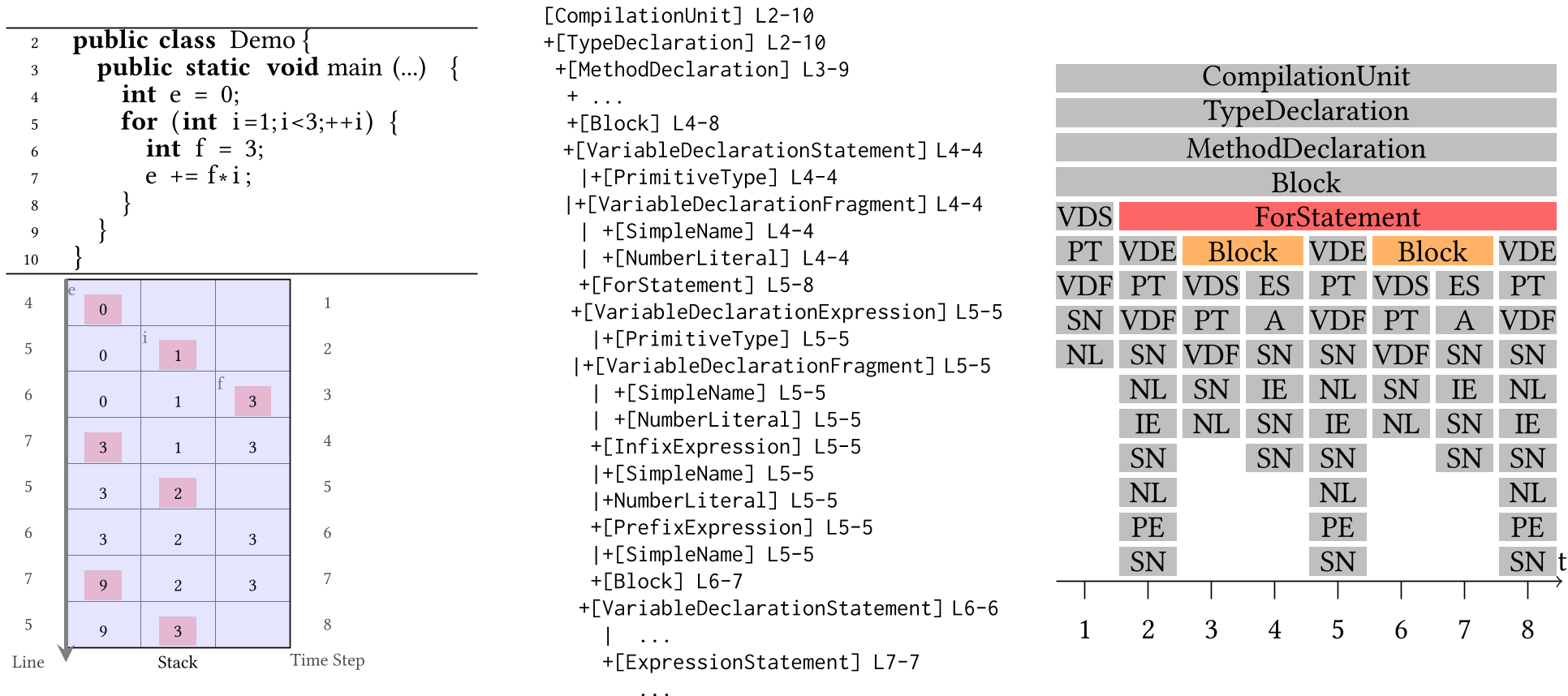
Instead of abstract analogies (like "variables are boxes"), students must use specific memory addresses and stack frames. This forces them to adhere to the true mechanics of Java, making the transition to professional debuggers seamless.
2. The Interval Mining Approach
The system doesn't just look at a "wrong answer." It performs a Data Fusion:
- AST Analysis: identifies the type of instruction (e.g., Variable Declaration, Infix Expression).
- Trace Alignment: maps these instructions to specific time steps in the student's trace.
- Allen’s Interval Relationships: It uses 13 temporal relationships (e.g., A meets B, A overlaps B) to define "Code Patterns." For instance, a pattern might be defined as "A Variable Declaration within an If-Block ending at the current step."
Experiments: What Actually Trips Students Up?
The study analyzed over 22,000 evaluated traces. By mining these traces, the author discovered "Error Patterns" that are statistically significant predictors of failure.
Key Findings & Patterns
- Variable Lifetime (Pattern A): Students frequently forget to remove variables from the stack when an
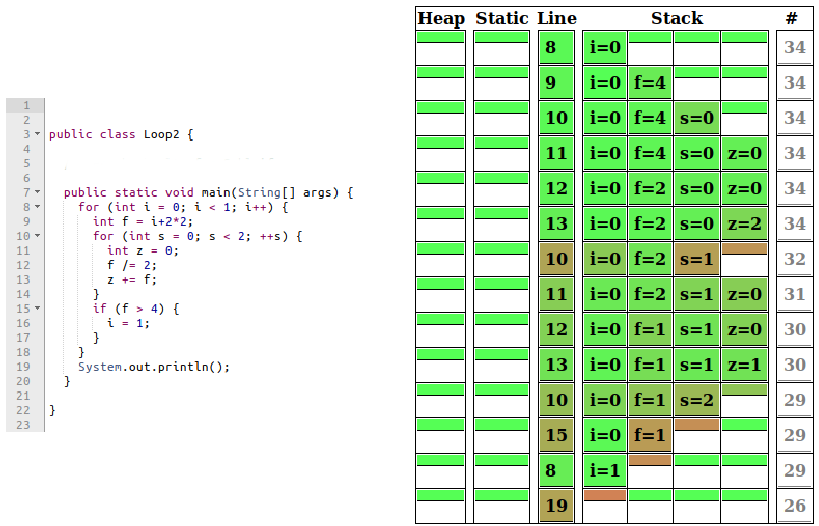
ifblock ends. The error rate here was a staggering 73%. - For-Loop Semantics (Pattern C): There is significant confusion regarding when the update statement (e.g.,
i++) and the condition check actually occur in the execution flow. - Method Invocation (Pattern D): Forgetting to copy arguments onto the stack or missing the
thisreference in method calls remains a major roadblock.

The tool also offers a Live Exercise mode, where a lecturer can see a "heat map" of class errors in real-time, allowing for immediate pedagogical adjustment.
Critical Insight & Perspective
What makes this work stand out from typical "Auto-graders" is its focus on Consistency. The author correctly identifies that students are often inconsistent; they might get a concept right once but fail it in a different context. By mining patterns across multiple exercises, the tool filters out "slips" (careless errors) and highlights "systematic misconceptions."
Limitations: While the tool is excellent for imperative and basic OO Java, scaling this to complex topics like multi-threading or complex design patterns might make the traces too cumbersome for manual entry. The "manual" nature of the trace is a double-edged sword: it ensures engagement but risks student fatigue.
Conclusion
This study proves that we can treat student learning data like a telemetry stream. By mining the "memory traces" of their thoughts, we can identify exactly where the mental gears are grinding. For CS educators, this offers a path toward a truly personalized, automated tutor that understands why a student is failing before the student even realizes they've misunderstood a concept.