JSocialLib: Bridging the Gap Between API Data and Social Perception
Measuring interactivity and geographical closeness of Online Social Network users to support social recommendation systems
This paper introduces JSocialLib, a meta-API library designed to enhance Social Recommendation Systems (SRS) by quantifying user interactivity and geographical closeness. By integrating data from multiple Online Social Networks (OSNs) like Facebook and Twitter, it provides a unified framework for friend recommendations based on implicit social signals.
TL;DR
Researchers from the University of Zurich have developed JSocialLib, a meta-API library that addresses the technical frustrations of building Social Recommendation Systems (SRS). By intelligently weighting public/private interactions and geographical proximity data, the library aligns algorithmic "friend" recommendations with the actual subjective perception of users.
The "API Wall" and the Interactivity Gap
Developers building social apps (like Instagram or PiCsMu) often hit a wall: OSN APIs are restrictive, noisy, and limited. Furthermore, just because two people are "friends" on Facebook doesn't mean they are close in real life.
The authors identify three core pain points:
- Rate Restrictions: APIs like Facebook's limit calls to 600 per 10 minutes.
- Feature Invisibility: APIs hide the "how" and "why" of interactions.
- Data Staleness: The information provided is often incomplete or outdated.
Methodology: Perception-Driven Calibration
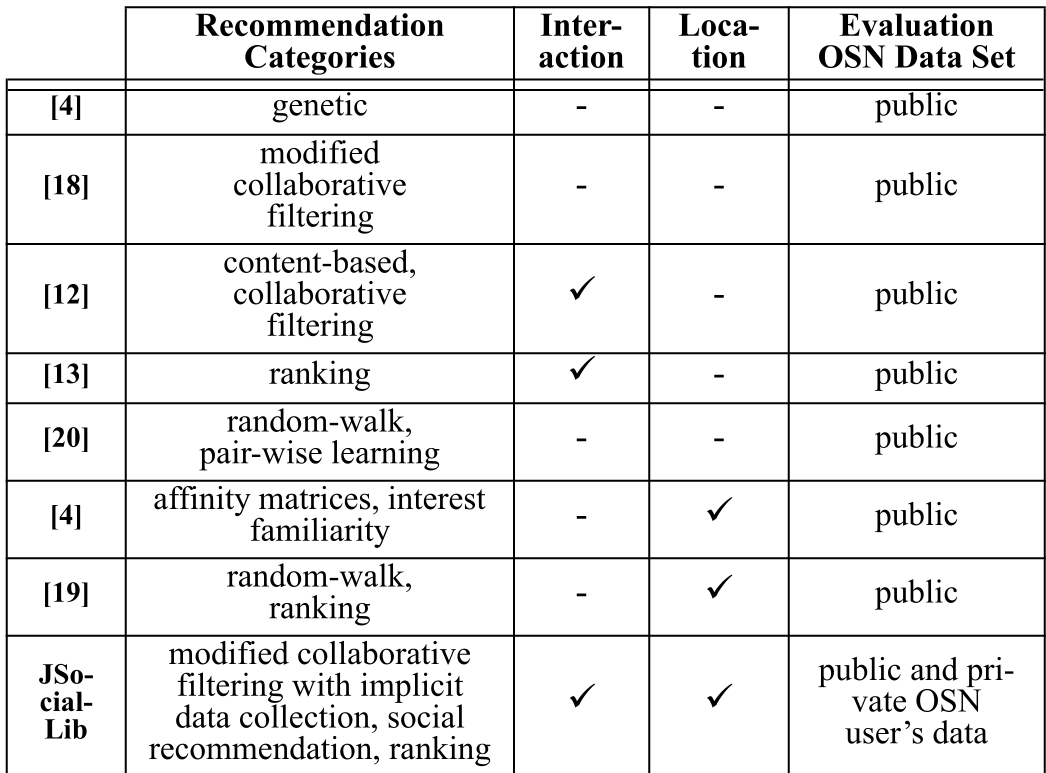
Unlike traditional collaborative filtering, JSocialLib doesn't just look at the existence of a link. It analyzes the frequency and type of interactions (Public Posts vs. Private Messages) and Geographical Closeness (Hometown vs. Location Tags).
1. Interaction-Based Method
It calculates an Interactivity Score (IS) which is a weighted sum of:
- Public Post Sent/Received (PPS/PPR)
- Private Message Sent/Received (PMS/PMR)
The genius lies in the Ratio Thresholds (). If User A sends 100 messages but User B never replies, JSocialLib recognizes this as an "unacknowledged" interaction and discards it to prevent spam from skewing recommendations.
2. Location-Based Method
This method measures proximity using both static attributes (hometown) and dynamic content (GPS tags on photos). It incorporates a Temporal Decay Component: a match in location today is weighted more heavily than a match from three years ago.
Prototyping and SOTA Results
The authors validated JSocialLib through a web survey of 290 participants from 20 countries, creating a ground-truth dataset of human perception.
- Public is King: The calibration revealed that users perceive Public Posts Sent as 3x more significant than Private Messages. Public Posts Received are 9x more significant than Private Messages Received.
- Top-5 Precision: The interaction method achieved a strong alignment, correctly identifying 2 out of the top 5 friends a user feels closest to.
- The 7km Rule: For geographic proximity, the study found that users consider friends within a 7 km radius as "geographically close."
Critical Insight: The "Never" Group Paradox
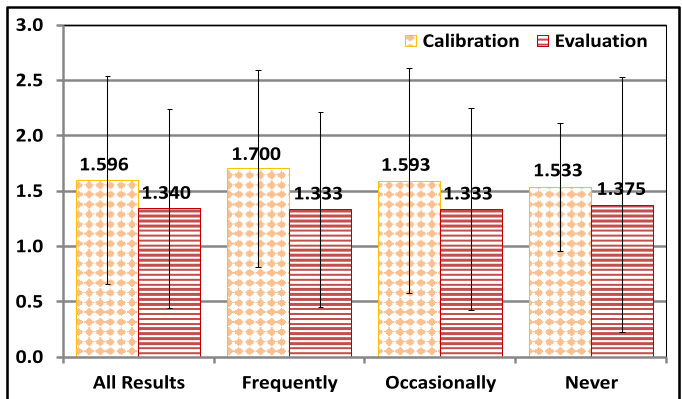
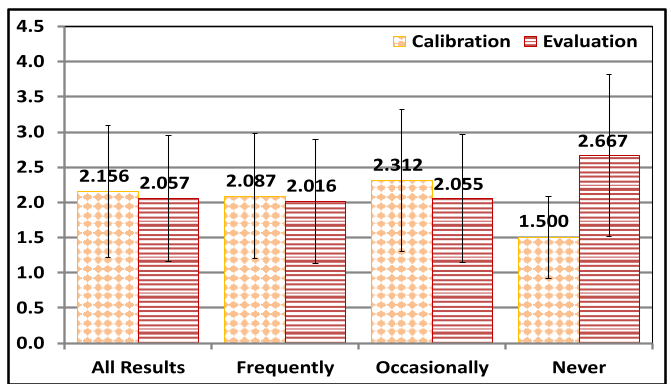
Interestingly, as seen in the results, users who claimed to "Never" interact on Facebook (the "Never" group in Fig 1 & 2) caused the model to fluctuate. This highlights a fundamental limitation: Electronic signals cannot measure relationships that exist entirely offline.
Summary & Future Outlook
JSocialLib proves that we can build better recommendation engines by:
- Implicit Harvesting: Moving away from asking users for "likes" to observing natural behavior.
- Cross-Platform Synthesis: Acting as a meta-layer over multiple APIs.
- Privacy-First Analysis: Evaluating counts and metadata rather than parsing the semantic content of messages.
While geographical data remains sparse due to privacy concerns, the interaction-based approach is ready for high-accuracy implementation in modern social apps.