
Local Topological Anonymity: Redefining Privacy in the Age of Graph Propagation
Measuring Local Topological Anonymity in Social Networks
The paper introduces "Local Topological Anonymity" (LTA), a novel metric designed to quantify a node's resistance to local re-identification attacks in social networks. By leveraging structural similarity measures within a node's -neighborhood, the authors propose three LTA variants and validate them against state-of-the-art de-anonymization propagation algorithms.
TL;DR
As social network data becomes a prime asset for researchers and businesses, the risk of de-anonymization grows. This paper shifts the focus from global "k-anonymity" to Local Topological Anonymity (LTA). It provides a mathematical framework to measure how well a user is "hidden" in their immediate neighborhood, effectively predicting whether an attacker can find you once they've identified your friends.
Background: The Two-Phase Attack
In the world of graph de-anonymization, attackers usually play a two-act play:
- Global Seed Identification: Identifying "outliers" with unique global properties (e.g., a node with an extremely specific degree).
- Local Propagation: Once a few "seeds" are found, the attacker looks at their neighbors. If you are the only person connected to a "seed" with a specific structural signature, you are compromised.
While phase one is well-studied, this paper addresses the blind spot: How do we measure vulnerability in phase two?
The Intuition: Hiding in the Crowd
The core insight of LTA is that structural equivalence is the enemy of the attacker. If you look exactly like everyone else in your 2-hop neighborhood (your friends and their friends), you are effectively invisible.
The authors propose , calculated using Cosine Similarity: Your LTA score is the average similarity between you and all nodes in your local neighborhood. A high score means you "blend in," while a low score marks you as a structural anomaly—a prime target for propagation.
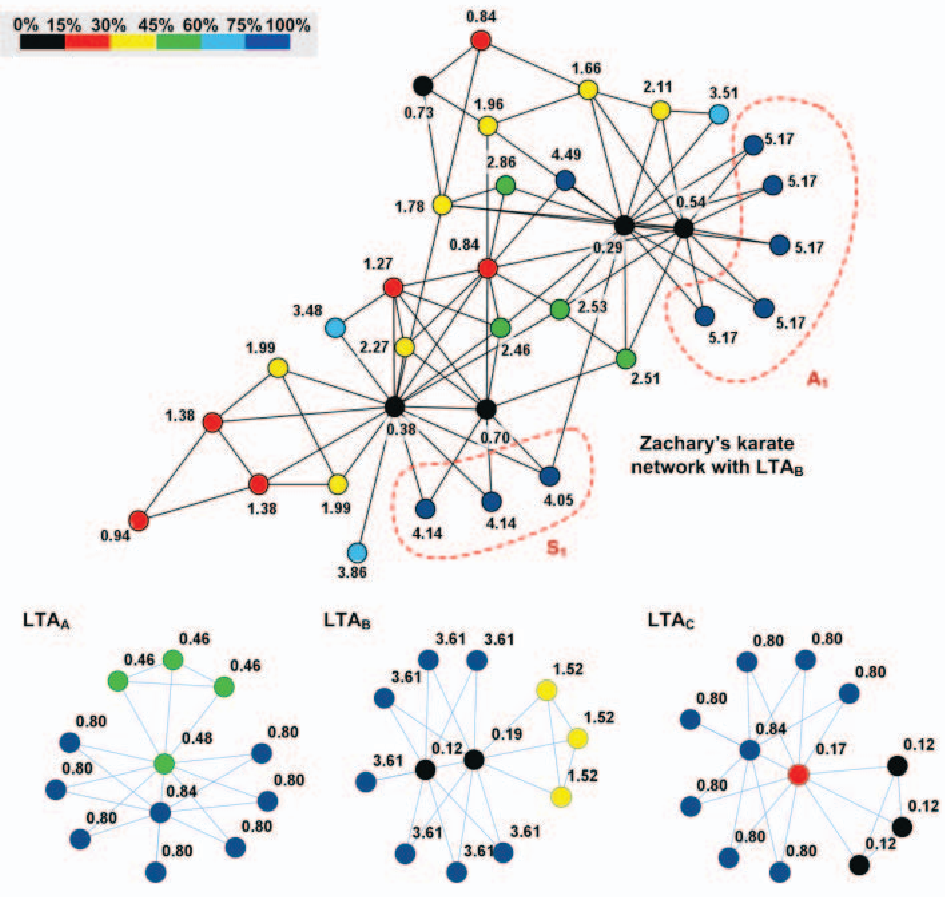 Figure 1: Visualizing LTA scores. Brightly colored nodes represent higher anonymity sets, while darker nodes are structurally unique hubs vulnerable to attack.
Methodology: Validating the Shield
To test if LTA actually predicts danger, the authors used a "perturbation strategy" on real-world networks (Epinions, Wikipedia, LiveJournal). They created two versions of the same graph with slight variations and ran the state-of-the-art Narayanan-Shmatikov de-anonymization algorithm.
They found that (the simplest average) was a remarkably stable predictor. The simulation showed that as LTA increases, the probability of a node being correctly re-identified drops sharply.
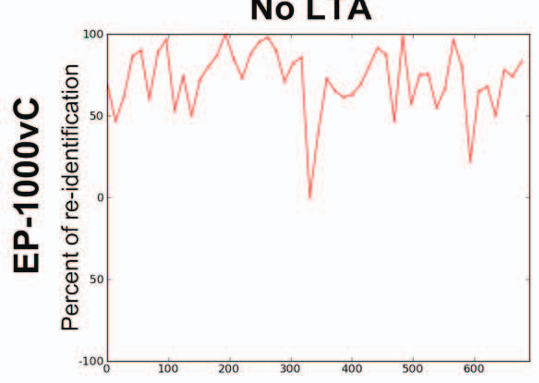 Figure 2: The correlation between and Re-identification rates. The downward trend confirms that higher LTA values correlate with lower success for the attacker.
Critical Analysis: Why This Matters
The value of LTA is its computational efficiency. Unlike global metrics that require knowledge of the entire multi-million node graph, LTA only requires information about your 2-hop neighborhood.
Key Insights:
- Inductive Bias: The metric assumes attackers use structural similarity (like cosine similarity), which matches the current SOTA algorithms.
- The "Hub" Paradox: High-degree nodes (hubs) often have lower LTA despite being connected to many people, because their connection signature is much harder to replicate.
- Ablation of Variants: The paper tested more complex versions ( and involving standard deviations), but the simplest average () proved most robust, suggesting that "average similarity" is the primary barrier to propagation.
Conclusion & Future Outlook
LTA is a vital addition to the privacy toolkit. However, the authors admit that a node could have a high LTA and still be vulnerable to a global attack if its overall position in the network is unique. The next frontier in this research is a Unified Anonymity Score that merges both global and local risks into a single, definitive privacy metric.
For developers building social platforms, LTA offers a way to warn users: "Your current privacy settings make you a structural outlier. Adding these types of connections could help you blend in."