
Decoding the Privacy Quotient: A New Metric for Social Media Leaks
Measuring privacy leaks in Online Social Networks
This paper introduces a quantitative framework for measuring user privacy in Online Social Networks (OSNs) through a metric called the "Privacy Quotient" (PQ). The study combines a comprehensive user attitude survey with a proposed system, "Privacy Armor," which utilizes Item Response Theory (IRT) and Naive approaches to calculate real-time privacy leak percentages in unstructured data (status updates and posts).
Executive Summary
TL;DR: This paper tackles the "Privacy Paradox" in Social Networks—where users claim to value privacy but continue to share sensitive data. It proposes the Privacy Quotient (PQ), a mathematical metric to quantify a user's digital exposure. The authors also unveil Privacy Armor, a conceptual model that warns users in real-time when their status updates (unstructured data) might leak sensitive information like political views or contact details.
Background: Positioned at the intersection of Social Computing and Information Security, this work moves beyond binary privacy settings (on/off) toward a nuanced, Item Response Theory (IRT)-based measurement of human behavior in digital spaces.
The Problem: The Complexity of the "Default" Setting
Most users are aware of privacy risks, but "Privacy Fatigue" is real. The authors' survey highlights a critical friction point: 63.33% of users find privacy settings confusing and time-consuming, leading many to stick with defaults. This lack of transparency means users share "Unstructured Data"—posts, tweets, and comments—without realizing the cumulative privacy cost.
Current solutions are either too technical (data mining algorithms) or too passive (static settings). There is a dire need for a "Privacy Scale" that interprets data sensitivity through a human-centric lens.
Methodology: Calculating the Privacy Quotient
The core of the paper lies in quantifying two abstract concepts: Sensitivity and Visibility.
1. The Naive Approach
The authors define Sensitivity () as an inverse function of an item's popularity. If few people share their "Address," it is highly sensitive. Visibility () captures how far that information spreads within the network.
2. Privacy Armor: Protecting Unstructured Data
Unstructured data (textual posts) is the hardest to protect because it is "messy." The authors propose a two-module system:
- Module 1 (The Classifier): Uses a binary classifier to scan posts for sensitive identifiers (Contact numbers, Location, Political affiliations).
- Module 2 (The Alert System): Calculates a "Leak Percentage" (). For example, a user posting "Having lunch with Congress supporters" triggers a leak calculation based on the sensitivity of political views relative to their total profile sensitivity.
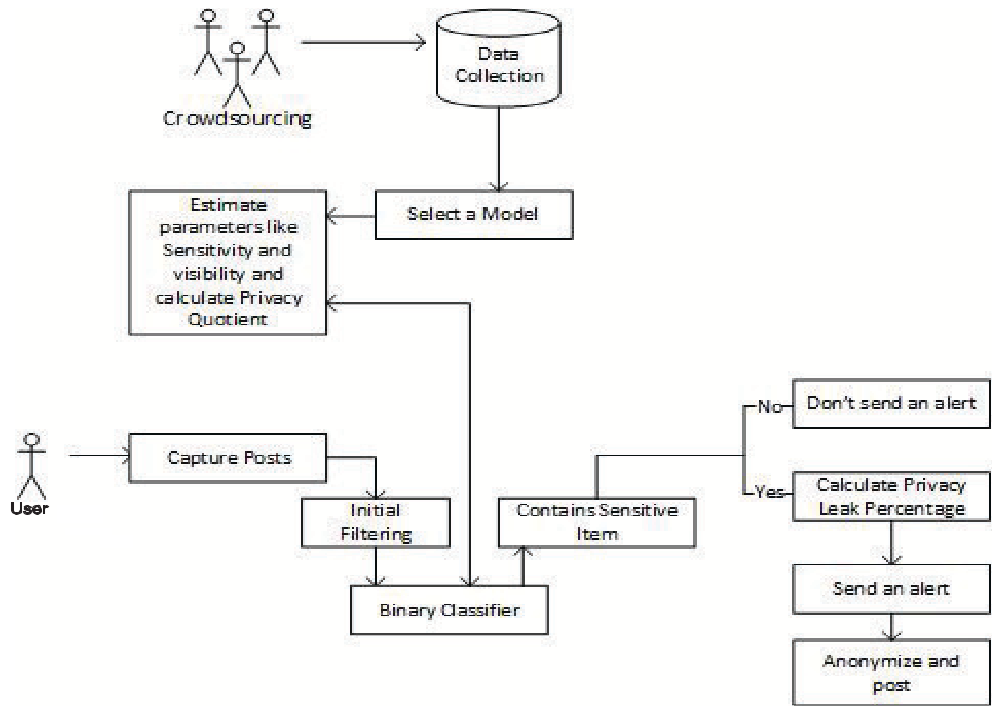 Fig 1: The Privacy Armor architecture analyzing unstructured input.
Experimental Insights
The study categorized common profile items by their inherent sensitivity risks. The data confirms our intuition but provides a mathematical anchor:
| Profile Item | Sensitivity Score |
|---|---|
| Address | 0.85 |
| Political Views | 0.68 |
| Contact Number | 0.60 |
| Birthdate | 0.11 |
The authors discovered that while users are most protective of their physical address, they are surprisingly "loose" with birthdates and hometowns, which are often used in identity theft or security questions.
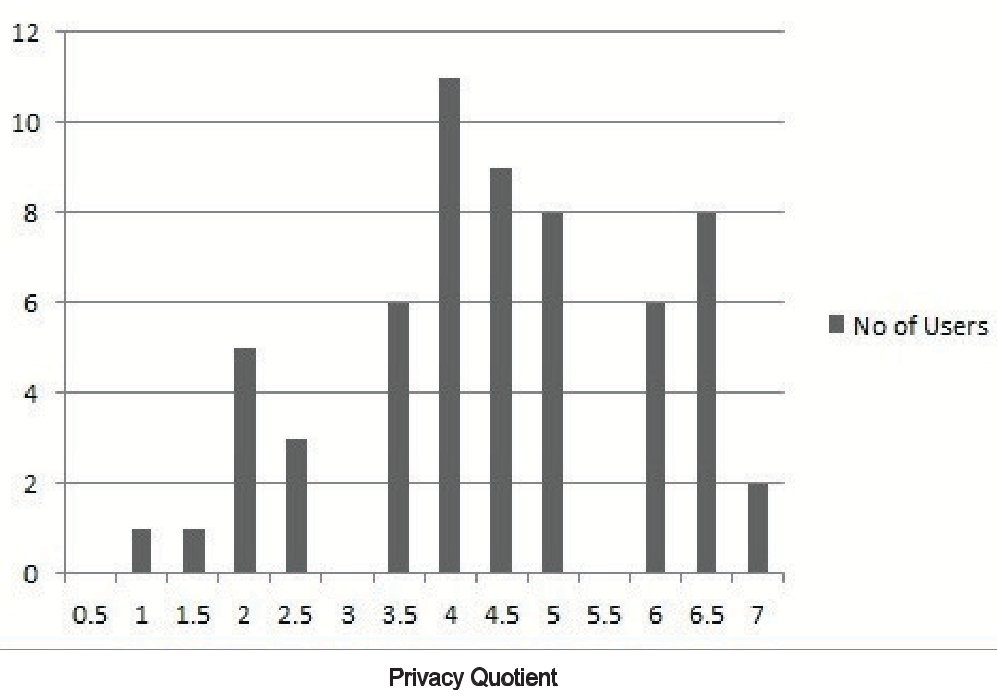 Fig 2: Distribution of users across the Privacy Quotient scale.
Critical Analysis & Future Outlook
Takeaway
The shift from "protecting data" to "measuring quotients" is vital. This work provides a foundation for OSNs to implement active privacy coaching rather than passive gatekeeping.
Limitations
- Subjectivity: The sensitivity of an item is calculated based on group behavior (introvert vs. extrovert populations). If a whole community is extroverted, the system might under-report sensitivity.
- Complexity of Language: While the binary classifier looks for keywords, it may struggle with sarcasm, nuances, or coded language in unstructured text.
Future Work
The authors plan to implement the Privacy Armor model across different nationalities to see how cultural norms influence the Privacy Quotient. As AI continues to evolve, integrating Natural Language Processing (NLP) with IRT will be the next frontier in keeping our digital lives truly private.
Editor's Note: This research serves as a reminder that in the age of OSNs, our privacy is not just a setting, but a measurable asset that requires constant monitoring.