
Beyond Neutrality: Capturing Social Proximity through Shared Friends and Enemies
Measuring the Similarity of Nodes in Signed Social Networks with Positive and Negative Links
This paper introduces a novel node similarity measure specifically designed for signed social networks containing both positive (trust) and negative (distrust) links. By incorporating neighbor-based comparisons and similarity propagation based on balance theory, the method achieves superior performance in friend recommendation tasks compared to traditional unsigned and degree-based signed network algorithms.
TL;DR
Researchers from Shandong University have proposed a new similarity measure for Signed Social Networks. Unlike previous methods that treat all connections as positive or rely solely on node degrees, this approach leverages the semantic weight of both trust and distrust. By rewarding shared opinions and penalizing contradictory ones, the method significantly improves the accuracy of friend recommendations on platforms like Epinions.
Background Positioning: This work bridges the gap between classic neighbor-based similarity (like Jaccard) and the psychological frameworks of Balance Theory, specifically targeting the "open problem" of negative link integration in graph mining.
The "Distrust" Blind Spot
In traditional social network analysis, edge weights are typically non-negative. However, real-world systems like Epinions or Slashdot allow users to explicitly "distrust" or "foe" others.
The authors identify a critical flaw in existing SOTA:
- Unsigned Measures: If User A and User B both interact with User C, they are seen as similar. But if A trusts C and B distrusts C, they are actually diametrically opposed.
- Degree-based Signed Measures: Current signed indicators often look at the volume of links (e.g., high negative in-degree) rather than the identity of the nodes being evaluated.
Methodology: The Logic of Alignment
The core intuition is simple yet mathematically rigorous: Two users are similar if they evaluate the same people in the same way.
1. Basic Similarity Formula
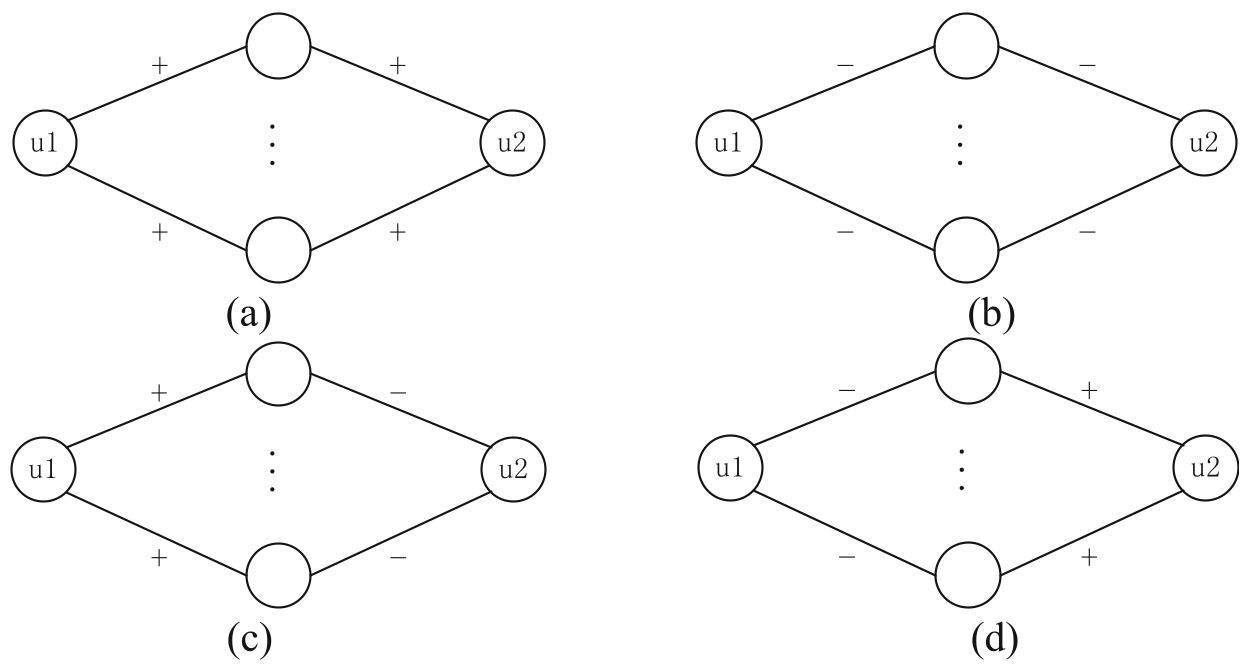
The authors define similarity by looking at the intersection of neighbor sets. In an undirected graph, they categorize common neighbors into:
- : Common neighbors where evaluations are the same ( or ).
- : Common neighbors where evaluations differ ( or ).
The similarity score is given by:
2. Directed and Propagated Similarity
For directed networks, the model expands to account for both incoming attitudes (how others see the users) and outgoing attitudes (how the users see others). Furthermore, to avoid "zero-similarity" issues between nodes with no immediate neighbors, they introduce a propagation step: This encapsulates the transitive property: "The friend of my friend is my friend."
Experimental Results
The authors tested their method against FriendTNS and Shortest Path algorithms using the Epinions dataset.
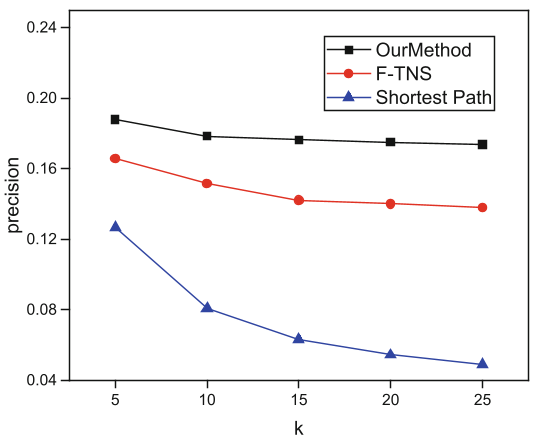
As shown in the Precision/Accuracy charts, the proposed method (solid line) maintains a consistent lead. The primary takeaway from the ablation perspective is that incorporating the negative output neighbor set provides a unique fingerprint of a user's taste/bias that positive links alone cannot capture.
Critical Insight & Conclusion
This paper serves as a reminder that in the era of polarized social media, disagreement is as informative as agreement. By treating a "distrust" link as a first-class citizen in the similarity equation, the authors have created a more robust metric for recommendation systems.
Limitations: The current propagation is limited to two hops to avoid "noise" from distant nodes. Future work could explore using Deep Learning (like Signed-GCNs) to learn these embeddings automatically, potentially capturing even more complex social motifs beyond basic balance theory.
Takeaway for Practitioners: When building recommendation engines for platforms with blocked/ignored lists, don't just exclude those links—use them to find clusters of users with shared "dis-tastes."