
Beyond the Friendship Fallacy: Decoding Interest Similarities via Network Topology
On measuring social friend interest similarities in recommender systems
This paper investigates the correlation between social relationships and user interest similarities in Recommender Systems. By analyzing datasets from Douban, Foursquare, and Epinions, the author reveals that while "trust" is a strong indicator of similarity, general "friendship" often fails to reflect shared interests unless structural network features are considered.
TL;DR
Is your best friend really the best person to recommend your next movie? This seminal SIGIR '14 paper by Hao Ma challenges the core assumption of social recommenders. By analyzing massive datasets from Douban and Foursquare, the study reveals a startling truth: general friendship is a poor proxy for shared interests. However, by diving into subgraph topology and co-friend counts, we can mathematically identify which friends actually share our "taste."
The "Friendship Fallacy" in Recommender Systems
For years, the recommendation community operated under a simple heuristic: if and are friends, they must like the same things. While this holds for Trust Networks (like Epinions, where you follow someone because of their taste), it fails spectacularly in Friendship Networks (like Douban or Facebook).
The author's initial analysis showed that a user's average similarity with their friends is often no better than their similarity with a random stranger. This is because friendships are often inherited from real-world constraints (e.g., being high school classmates) rather than selected based on shared hobbies.
Methodology: The Power of Local Graph Structure
To salvage the value of social data, the paper shifts from what the link is to where the link sits in the local graph.
1. The Co-friend Metric
The simplest yet most effective finding: Intersection matters. If you and a friend share dozens of mutual connections, the probability of a shared social context (and thus shared taste) skyrockets.
 In Foursquare, similarity increases sharply as the number of shared friends grows, providing a clear signal for recommendation engines.
2. Subgraph Topology Patterns
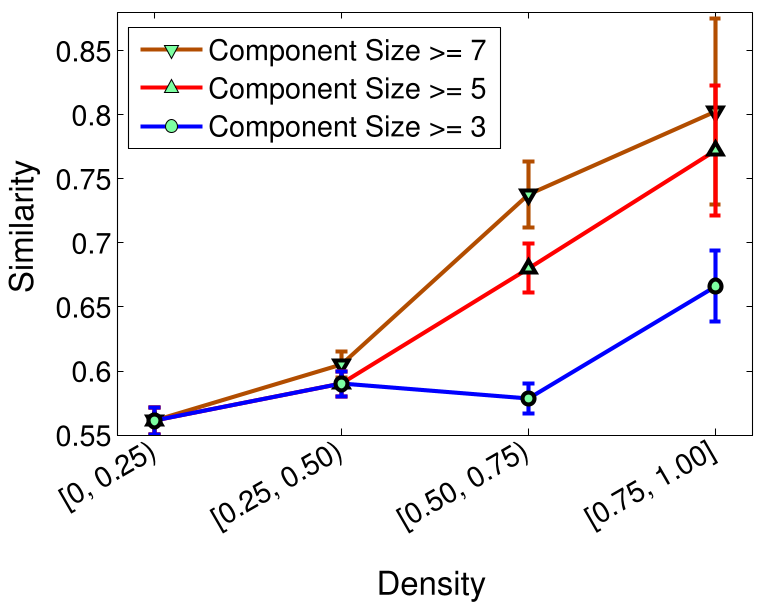
The paper analyzes n-node subgraphs (from 2 to 5 nodes). The insight here is the Clustering Effect: nodes that form "cliques" (fully connected subgraphs) are significantly more similar than nodes in "star" or "line" formations.
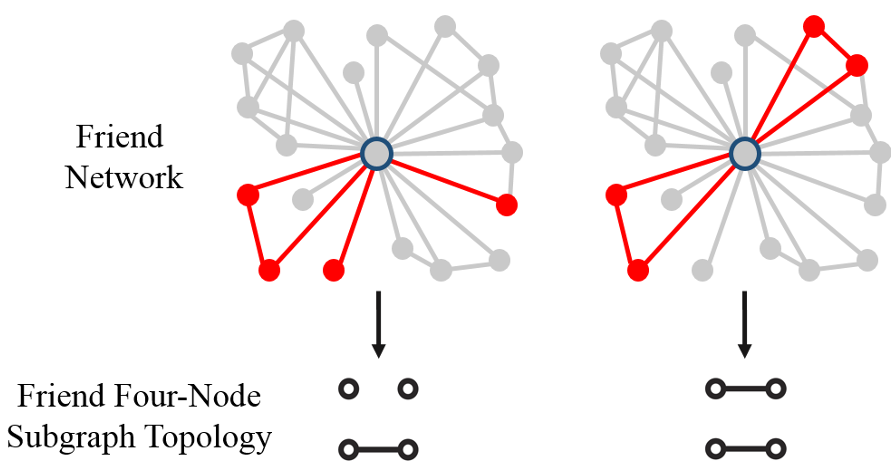 Examples of 4-node subgraph topologies. The density of edges within these small groups acts as a filter for interest similarity.
Key Results: Fine-Grained Precision
The data speaks for itself across three major platforms:
- Epinions (Trust): High similarity baseline ( of users are more similar to trusted peers than random ones).
- Douban/Foursquare (Friendship): Similarity is roughly compared to random chance—until structural features are applied.
- The Topology Boost: Users in fully connected 5-node subgraphs are 1.6x more similar than those in disconnected components.
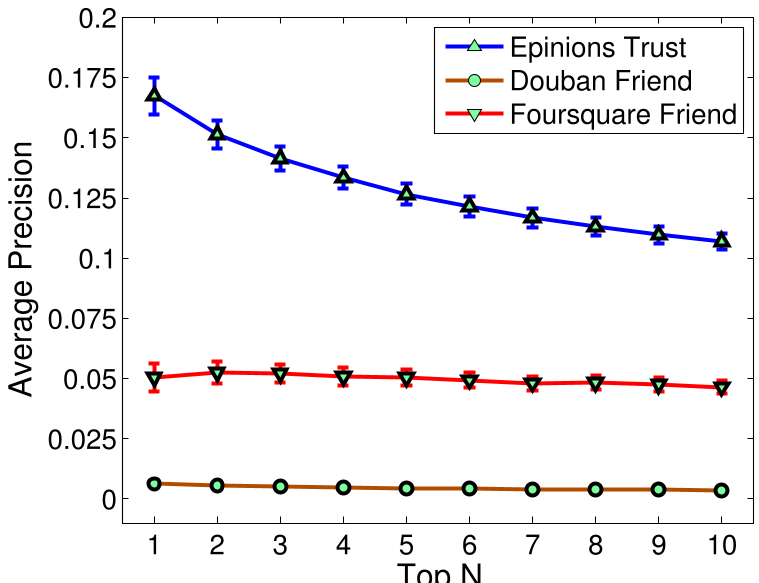 Top-N hit accuracy confirms that trust-based systems (Epinions) naturally outperform general friendship systems unless structural intelligence is added.
Critical Analysis & Professional Insights
This work is a cornerstone for Graph-based Recommendation. It proves that "Social Context" is not a monolith.
Why it works: The biological/sociological intuition is that high-density subgraphs represent "Interest Cocoons." If five people all know each other and check into the same places, the "social contagion" of interests is much stronger than a bridge link between two distant acquaintances.
Limitations:
- Computation: Enumerating 5-node subgraphs for millions of users is expensive (the author had to use sampling).
- Dynamics: It doesn't account for how interests change over time (Temporal Dynamics).
- Cold Start: For new users with few friends, these structural features are unavailable.
Conclusion
Hao Ma's research provides a roadmap for modern social apps. If you are building a recommender, stop treating the social graph as a flat list of IDs. Look for the cliques, count the co-friends, and weight your edges by structural density. That is where the true "signal" of human interest resides.