
Decoding the Invisible Bond: An Axiomatic Approach to Implicit Social Networks
Measuring tie strength in implicit social networks
This paper presents a formal axiomatic framework for measuring tie strength in implicit social networks derived from person-event bipartite graphs. By defining eight core axioms, the authors characterize the mathematical space of valid tie-strength measures and demonstrate that ranking ties is equivalent to finding a linear extension of a natural partial order.
TL;DR
How do you measure the strength of a friendship if nobody "clicks" a follow button? This paper provides the mathematical "rulebook" for implicit social networks. By defining eight fundamental axioms, the authors prove that measuring tie strength is essentially a task of ranking events based on frequency and intimacy, transforming a heuristic guessing game into a rigorous theoretical framework.
Background: The Signal-to-Noise Problem
Explicit social links (like Facebook friends) are often noisy—influenced by polite reciprocation or peer pressure. Implicit networks, derived from "events" (being in the same photo, on the same email thread, or in the same room), offer a truer signal. However, without a formal standard, how do we compare "two shared small meetings" against "ten shared large conferences"?
The Eight Commandments of Tie Strength
The authors propose that any valid measure of tie strength must satisfy eight axioms. These aren't just arbitrary rules; they represent our physical and social intuition:
- Isomorphism: The names of people don't matter; only the structure does.
- Baseline: No shared events means zero strength.
- Frequency: More events always mean stronger ties.
- Intimacy: Smaller, more exclusive events create stronger bonds than massive ones.
- Popularity: Larger events generate more total "social capital" for the group.
- Conditional Independence of Vertices: Events you didn't attend shouldn't affect your tie strength.
- Conditional Independence of Events: The boost from Event A shouldn't depend on whether Event B happened.
- Submodularity: The "law of diminishing returns"—each additional shared event adds slightly less incremental value.
The Core Methodology
The authors prove a powerful Characterization Theorem. It states that any function satisfying these axioms must follow a specific form:
Where:
- is a decreasing function that rewards "Intimacy" (smaller events).
- is an increasing submodular function that aggregates "Frequency."
The Partial Order Intuition
The paper reveals that these axioms naturally define a Partial Order (). For many pairs, the "correct" ranking is mathematically forced. For others (the "non-obvious" cases), the choice depends on the specific application.
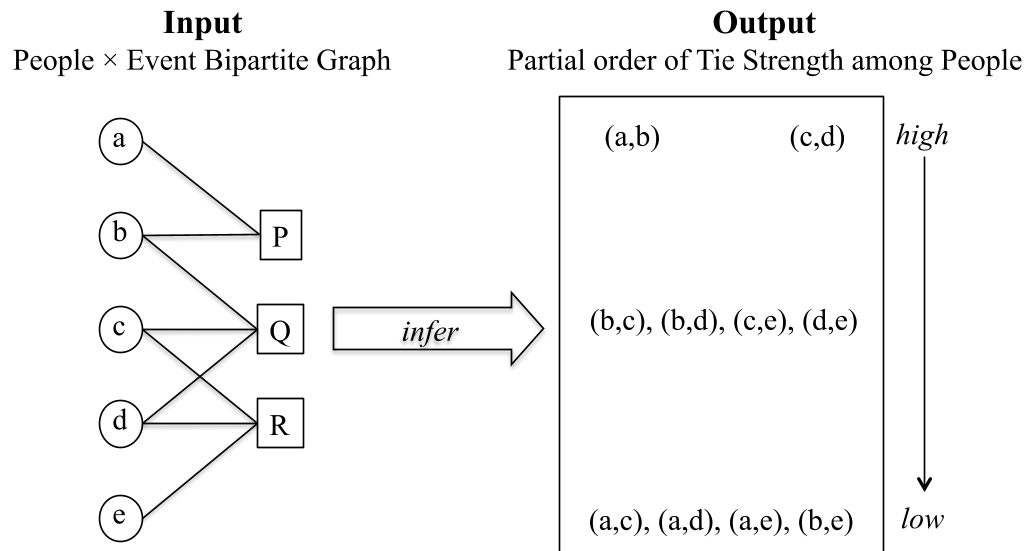 Figure 1: Visualizing how shared events (circles on the right) induce connections between people (circles on the left).
Experiments: Shakespeare and Smart Phones
To test this, the authors applied their "Linear" measure to characters in Shakespearean plays (treating scenes as events) and the MIT Reality Mining dataset (bluetooth proximity).
Key Insights:
- The "Bob" Test: Without reading a word of the script, the algorithm correctly identified Ariel and Prospero (The Tempest) and Macbeth and Lady Macbeth as the strongest ties based purely on stage co-presence.
- The Failures of Popular Metrics: Interestingly, heavily used metrics like the Jaccard Index and SimRank actually violate several axioms, such as Conditional Independence or Submodularity.
- Axiom Completeness: In the "clean" world of theatre, the axioms resolve almost of all possible tie comparisons, leaving virtually no ambiguity.
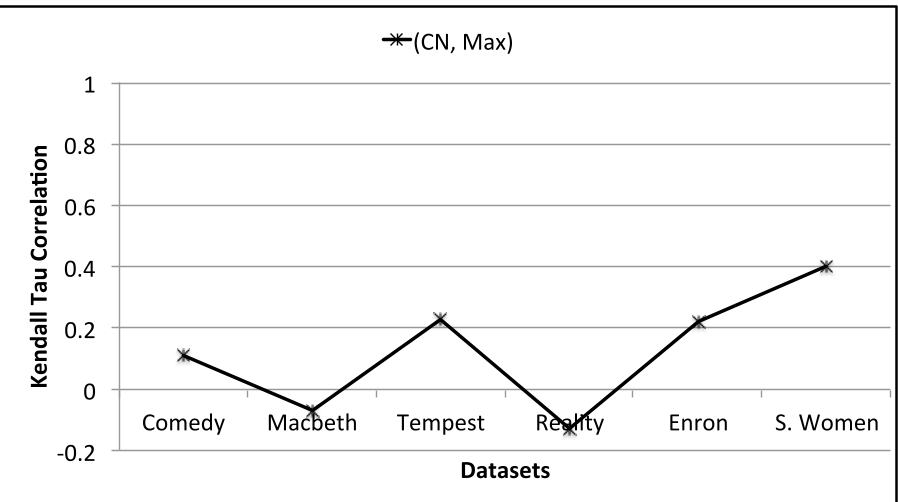 Figure 2: The inferred social network of 'The Tempest'. The thickness of lines represents the strength calculated via the Linear measure.
Critical Analysis & Takeaways
The brilliance of this work lies in its Theoretical Boundary Setting.
- The Takeaway: You shouldn't argue about whether "Shared Emails" are better than "Shared Meetings" in a vacuum. Instead, you should decide how your application weights Intimacy vs. Frequency and then choose a linear extension consistent with the partial order.
- Limitations: The model assumes all events are of equal "type." In reality, a shared 1-hour coffee is different from a shared 1-hour commute. The axioms also ignore "indirect ties" (friends of friends), which are central to measures like SimRank but were intentionally excluded here to preserve the "Conditional Independence" property.
Future Outlook
This axiomatic framework provides a "litmus test" for any new social algorithm. As we move toward more complex hypergraph representations of social interaction, the principles of Intimacy and Frequency established here will remain the bedrock of social signal processing.
Summary by Senior Academic Tech Editor. Original Paper: "Measuring tie strength in implicit social networks" (2012).