
Beyond De-identification: Measuring Structural Privacy with Topological Anonymity
Measuring Topological Anonymity in Social Networks
This paper proposes "Topological Anonymity" (ta), a novel metric to quantify privacy in social networks by analyzing graph structures. It combines node degree and clustering coefficients to detect node identity and edge inference breeches, demonstrating that naive anonymization is insufficient for complex relational data.
TL;DR
Simply removing names from a social network dataset—naive anonymization—is a failed strategy. This paper introduces Topological Anonymity (ta), a metric that quantifies how easily a person can be "found" in a graph based on their connections. By combining Node Degree and Clustering Coefficients, the authors provide a mathematical framework to evaluate if a network's structure inherently protects or exposes its participants.
The Motivation: The "Unique Signature" of Connections
In a typical database, individuals are rows. In a social network, they are nodes in a complex web. Even if you replace "John Doe" with "Node 42," his unique position (e.g., "the only person connected to 50 people who also know each other") acts as a fingerprint.
The authors identify two critical breeches:
- Node Identity Breech: Pinpointing a specific individual because their degree (number of connections) is unique.
- Edge Inference Breech: Determining if two of a person's friends are also friends with each other by observing the local "cliquishness" (clustering coefficient).
Methodology: Quantifying the "Hiding Ability"
The core of the paper is the Topological Anonymity (ta) formula. It isn't just about how many people have the same number of friends; it's about whether those people look different locally.
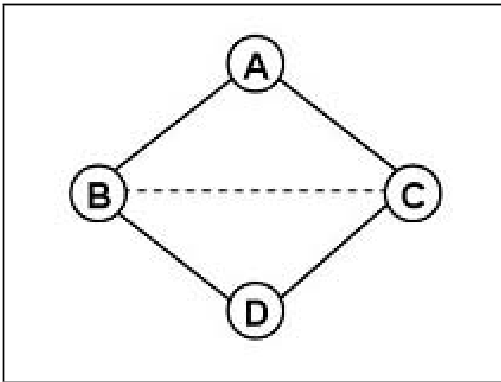 Figure 1: A simple graph showing how node position determines anonymity.
A network is considered "Private" if:
- Every node belongs to a "Degree Set" with more than members (avoiding unique signatures).
- There is variance in the Clustering Coefficient () within those sets. If everyone in has the same , an adversary can infer edge existence with 100% certainty.
The formula effectively subtracts "vulnerable" nodes from the total and normalizes the result:
Experimental Insights: Not All Graphs are Equal
The researchers compared three types of networks:
- Binomial (Random): Nodes have a similar number of neighbors. These are the most "anonymous."
- Scale-Free (Power Law): A few "hubs" have many connections. These are common in the real world but offer poor privacy.
- Real World (Political Blogs): These performed the worst. Structural outliers (popular blogs) are nearly impossible to hide.
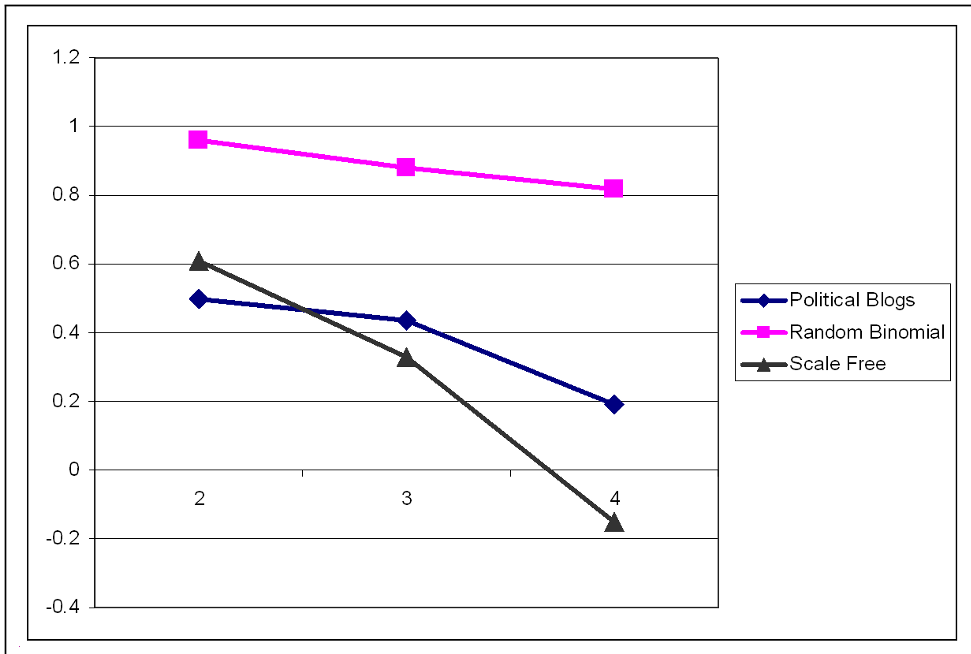 Figure 6: Comparative analysis showing that real-world and scale-free networks have significantly lower topological anonymity.
Critical Analysis: The Paradox of Symmetry
The paper reveals a fascinating trade-off:
- High Symmetry: Makes nodes look the same (good for node privacy) but makes local neighborhoods identical (bad for edge privacy, as the variance drops to zero).
- Randomness: Introduces the necessary "noise" to prevent edge inference but can inadvertently create a unique "hub" node that is easily identified.
Limitations:
- The current metric assumes a "Passive Adversary." Active adversaries (who plant fake nodes to map out the network) would likely require even more robust measures.
- The metric is local. It doesn't account for "Global" signatures like path lengths or eccentricity.
Conclusion
This work marks a shift from viewing privacy as a data-attribute problem to a topological problem. For data scientists releasing social datasets, "Topological Anonymity" provides a benchmark to decide how much perturbation (adding/removing edges) is required to reach a safe threshold before the data is public.