
Trust in the Shadows: Measuring Social Networks via Linear Uncertainty Theory
Measuring trust in social networks based on linear uncertainty theory
The paper proposes a novel social network trust measurement model based on linear Uncertainty Theory. It derives recommended trust from direct trust values using linear uncertainty distributions and introduces two weighted operators—path length and trust quality—to aggregate multi-path trust relationships accurately.
TL;DR
Quantifying trust in social networks is notoriously difficult due to data sparsity and the inherent subjectivity of human belief. This paper breaks away from traditional probability and fuzzy logic, introducing a framework based on Uncertainty Theory. It allows researchers to calculate trust across complex, multi-path chains even when direct data is missing, using mathematical "belief degrees" to simulate expert judgment.
Problem & Motivation: The Limits of Probability
In a social network, trust is dynamic and elusive. Most existing systems rely on:
- Probability Theory: Requires large historical datasets to build frequency distributions—data that rarely exists for specific interpersonal links.
- Fuzzy Logic: While good for ambiguity, it often lacks the rigorous axiomatic foundation needed for transitive, multi-node "belief" aggregation.
The authors argue that trust isn't about how often someone was reliable (frequency), but the belief degree we assign to their future behavior under uncertainty.
Methodology: The Core of Uncertainty
The authors define trust as an Uncertain Variable () following a linear distribution. The innovation lies in how they handle Recommended Trust (indirect trust).
1. Single-Path Constraints
By utilizing the "Duality" and "Product" axioms of Uncertainty Theory, the paper establishes that the joint trust of a chain is limited by its weakest link. They transform these logical constraints into optimization problems: where is the required confidence (belief degree).
2. Multi-Path Aggregation
Trust rarely travels through a single line. The model introduces two critical weights:
- Path Length Weight: Penalizes longer chains using a penalty factor .
- Trust Quality Weight: Evaluates the average "gravity" of trust across all intermediate nodes.
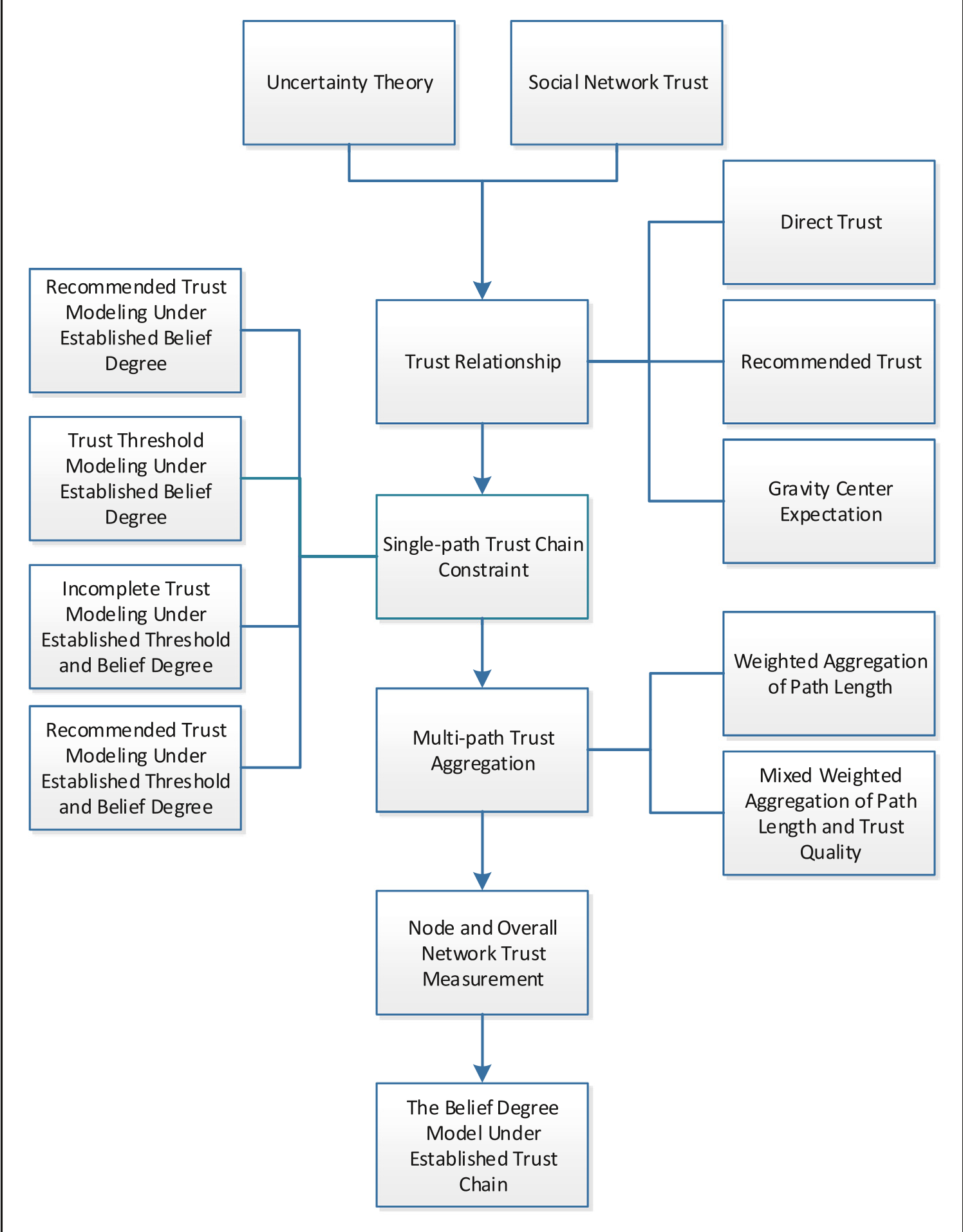 Figure: The structural flow of the social network used in the case study.
Experiments: Solving for the Unknown
The paper validates the model through a case study involving four nodes (A, B, C, D).
One of the most impressive feats is Incomplete Trust Modeling. If a link in the chain is unknown (e.g., node B to D), the model can backtrack from the desired network belief degree to calculate the necessary parameters for that missing link.
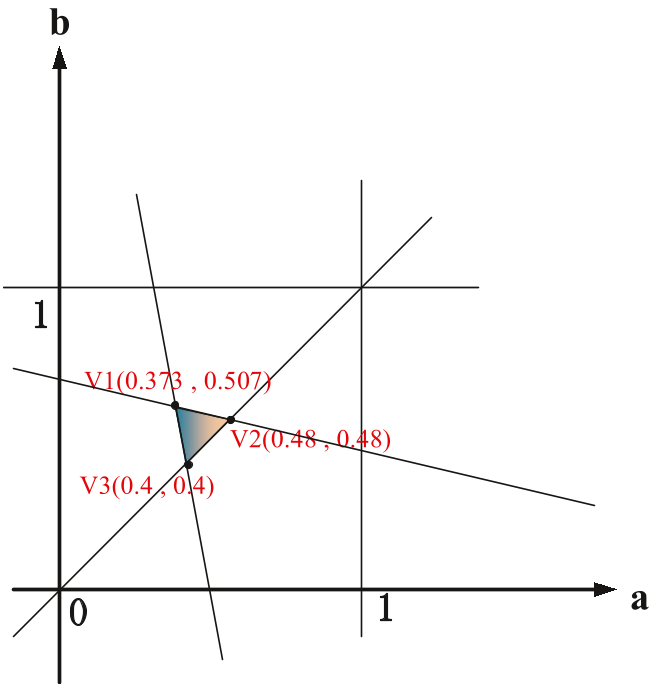 Figure: Feasible domain polygons used to determine the distribution parameters via the Gravity Expectation method.
Key Results:
- Stability: The model calculates an "Overall Network Trust degree" (e.g., 0.685), providing a single health metric for the entire system.
- Precision: It identified that shorter paths with higher intermediate trust (Path 3) were significantly more reliable than longer, "noisier" paths.
Critical Analysis & Conclusion
Takeaway
This paper effectively shifts trust modeling from "objective frequency" to "subjective belief." By using linear uncertainty distributions, it simplifies the mathematical overhead while maintaining high logical rigor. This is particularly valuable for E-commerce reputation systems and Strategic Alliances, where decisions are made based on expert opinions rather than big data.
Limitations
- Linear Assumption: The paper assumes trust follows a linear distribution. In reality, trust often erodes exponentially or follows a "step-function" behavior once a threshold of betrayal is met.
- Scalability: While the math is solid, applying this to a network with millions of nodes may require significant optimization of the nonlinear programming solvers used.
Future Work
The next frontier is integrating Real-world Simulation to validate these belief degrees against actual human behavior, potentially moving beyond linear distributions to more complex normal or parabolic uncertainty models.