
Your Data is Your Identity: Predicting Crowdsourcing Quality via Model Fit
Measuring Quality of Workers by Goodness-of-Fit of Machine Learning Model in Crowdsourcing
The paper introduces a novel method to predict the quality of crowdsourcing workers by calculating the "Goodness-of-Fit" (GoF) of machine learning models trained on each worker's individual task history. Using BERT-based classifiers, the study achieves a significant correlation (Pearson coefficient up to 0.444) between a worker's internal labeling consistency and their external accuracy against ground truth.
TL;DR
This research proposes a paradigm shift in crowdsourcing quality control: evaluating a worker not by how much they agree with others, but by how internally consistent their logic is. By training a BERT model on a single worker's results, the "Goodness-of-Fit" (GoF) score serves as a proxy for their reliability. If a machine can't learn your pattern, you're likely a spammer.
Context & Motivation: The Multi-Worker Bottleneck
In the world of curated datasets, "spammers" are the primary enemy. These are workers who provide random or low-effort answers to earn quick wages. Traditionally, we solve this via Majority Voting (MV): assign the same task to 5 people and hope the majority is right.
However, MV has two fatal flaws:
- Expense: You must pay 5-10 people for every single data point.
- Latency: You can't judge worker A until workers B, C, and D have finished.
Yu Suzuki from Gifu University asks: Can we judge a worker's quality using only their own submitted history?
Methodology: The "Learnability" Hypothesis
The core intuition is fascinatingly simple:
- The Good Worker: Follows a set of linguistic rules. Their labels correlate with the text. A state-of-the-art model (like BERT) should be able to "fit" this data easily.
- The Spammer: Selects labels randomly or follows a nonsensical pattern. The data is noisy, and the model will fail to reach a high F1 score during cross-validation.
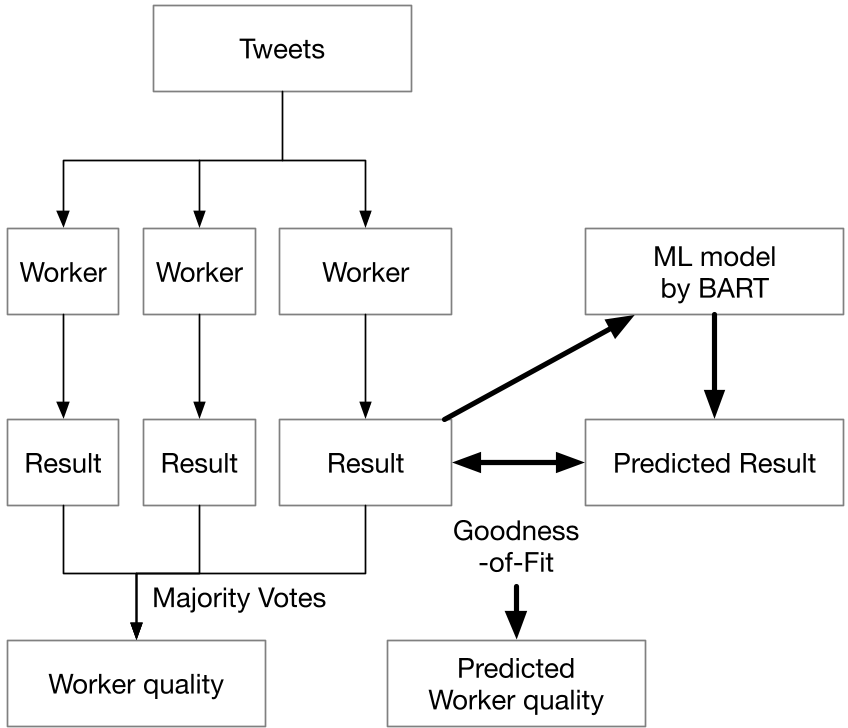 Figure 1: System overview showcasing the parallel paths of majority voting (evaluation) and the proposed GoF calculation.
The system uses 10-fold cross-validation. For each worker, it splits their task history into training and testing sets, calculates the F1 score, and treats that score as the "quality metric."
Experiments: When Does the Signal Emerge?
The author tested this on a COVID-19 tweet classification task. Using BERT as the backbone, the study compared the GoF scores against the "Acceptance Rate" (how often the worker agreed with the majority).
Key Findings:
- F1 > Accuracy: The F1 score proved to be a much more sensitive indicator of quality than raw accuracy, especially when label distributions were imbalanced.
- The 200-Task Threshold: This is the paper's most practical finding. As shown in the time-series plots, spammers often look "okay" for the first 50-100 tasks because the model can overfit small samples. After 200 tasks, the gap between spammers (low GoF) and honest workers (high GoF) becomes undeniable.
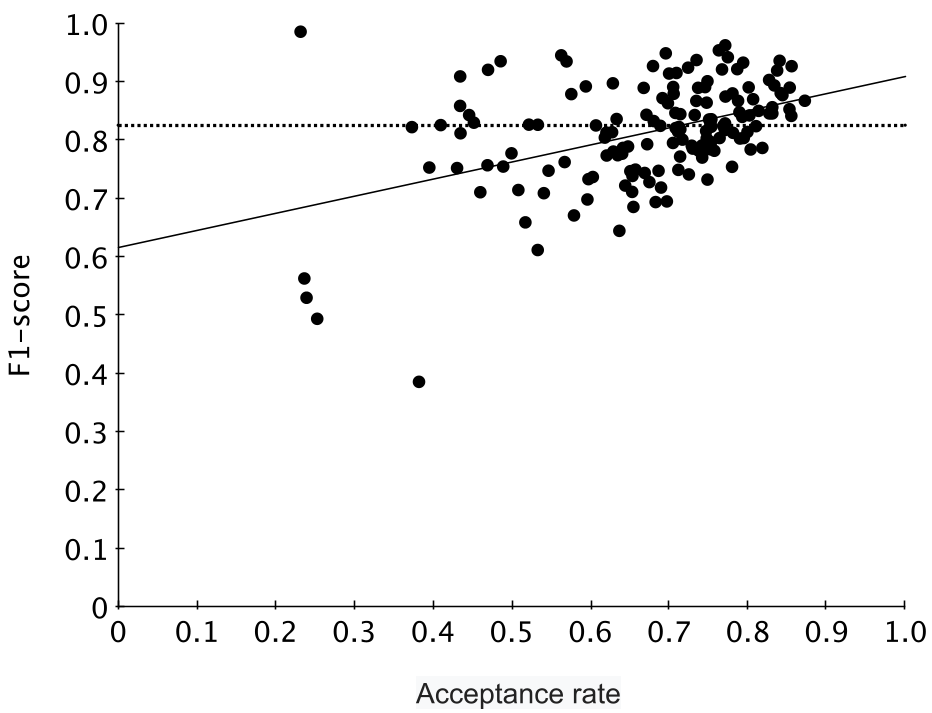 Figure 2: Correlation between actual worker quality (R) and the model's F1 score.
Critical Insight: Honest Mistakes vs. Spam
One of the most interesting "failures" of the system occurred with workers who acted in good faith but misunderstood instructions (e.g., confusing "facts" with "opinions"). These workers had high GoF scores (because they were consistent) but low acceptance rates (because they were consistently wrong).
This suggests that while GoF is excellent at identifying random spammers, it might need to be paired with behavioral analytics to catch misinformed workers.
Conclusion & Future Outlook
The "Goodness-of-Fit" method offers a path toward Real-time Quality Control. Crowdsourcing platforms could implement this on the backend to silently monitor workers. Once a worker hits 200 tasks with a declining F1-fit, they could be automatically flagged or removed before their low-quality data pollutes the entire project.
Takeaway: If you want to be a successful crowdsourcing worker, be consistent—because the AI is watching how well it can learn from you.