
The Hidden Cost of Hiding Friends: Mechanism Design for Networked Housing Markets
Mechanism Design for Housing Markets over Social Networks
This paper introduces the "Networked Housing Market," a resource allocation problem where agent participation depends on information diffusion through a social network. The authors investigate whether the Top Trading Cycles (TTC) algorithm can maintain Strategy-Proofness (SP), Pareto Efficiency (PE), and Individual Rationality (IR) when agents have incentives to hide information from their followers.
TL;DR
Can you get a better house by not telling your friends about a housing swap meet? In a traditional "Housing Market," the Top Trading Cycles (TTC) algorithm ensures everyone plays fair. However, this paper reveals that when participants must hear about the market through a social network, they can often benefit by hiding information from their followers. The authors prove several impossibility results but offer a "Modified TTC" for tree-structured networks that restores fairness.
Why Information Flow Breaks Market Fairness
In classic economic theory (Shapley and Scarf, 1974), the housing market is a closed system. Everyone is already there. But in the real world—think kidney exchanges or local item swaps—you only participate if someone "invites" you or forwards the info.
The authors identify a new type of manipulation: Information Diffusion Manipulation. In an auction, we might pay you to invite others. But in housing markets, there is no money. If I invite my friend, and they want the same house I do, they are now my rival. If I don't tell them, the market is smaller, competition is lower, and I might get a better deal.
The Problem: General Impossibility
The paper delivers a "cold shower" result: For any market with 3 or more agents on a general network, no mechanism can be simultaneously:
- Strategy-Proof (SP): No one lies about their favorites or hides their friends.
- Pareto Efficient (PE): No one can be made better off without making someone else worse off.
- Individually Rational (IR): No one ends up with a worse house than they started with.
The Technical Core: When Does TTC Work?
The authors analyze the standard Top Trading Cycles (TTC) algorithm. In TTC, everyone points to the owner of their favorite house. When a cycle forms (A wants B’s, B wants A’s), they swap and leave.
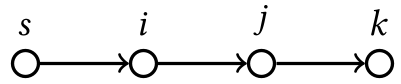 Figure: A social network where agent j can benefit by hiding information from agent k to manipulate the resulting swap.
1. Preference Restriction: Acyclicity
The paper shows that TTC is only safe from manipulation if everyone’s preferences are Acyclic. This means everyone roughly agrees on the "tiers" of houses. If preferences are too diverse, the incentive to hide others becomes too strong.
2. Network Restriction: The "Star" and "Tree"
If the moderator (the person running the market) is connected to everyone (a Star Network), no one can hide information. But real networks are often Trees (hierarchical).
For Tree networks, the authors propose the Modified TTC.
The Key Insight of Modified TTC: Each agent is only allowed to point to (and thus swap with) their parent, themselves, or their descendants. By restricting the "direction" of swaps, the mechanism removes the benefit of cutting off a branch of the tree. If you cut off your followers, you are only destroying your own potential trade partners without reducing competition from other branches.
Experiments & Theoretical Results
The paper focuses on axiomatic proofs rather than benchmarks, establishing the boundaries of what is mathematically possible:
- Incompatibility Proof: They demonstrate a case where agent prevents info from reaching the market. Without in the pool, ends up with her initial house, but the removal of forced a different cycle that ultimately benefited in a later step.
- Modified TTC Success: They prove that on a tree, the Modified TTC satisfies "Strict Core for Neighbors" (SC4N). This means no parent-child pair can find a better swap outside the mechanism.
 Figure: Step-by-step execution of Modified TTC. Dash-dotted edges show the pointing relations restricted by the tree structure.
Critical Analysis & Future Outlook
Deep Insight
The genius of the "Modified TTC" is that it aligns the social hierarchy with the exchange hierarchy. Usually, constraints on who you can trade with are seen as a negative for efficiency. Here, the authors show that a spatial constraint (only trading with descendants/parents) is the price we pay for incentive compatibility (making people tell the truth).
Limitations
- Efficiency Loss: By restricting swaps to tree branches, we might miss "Global Pareto Efficiency." A great swap might exist between two people on distant branches of the network, but the Modified TTC will forbid it to prevent cheating.
- Tree Assumption: Most social networks (Facebook, Twitter) are not trees; they have cycles. Extending this to general graphs without losing SP is an open—and very difficult—challenge.
Conclusion
This paper is a foundational step in merging Graph Theory with Mechanism Design. It teaches us that in the digital age, being a "gatekeeper" of information is a powerful tool for manipulation, and our algorithms must be designed to make that gatekeeping useless.