
[Mechanistic Insights] Looped Reasoning: How Recurrent LLMs Mimic Feedforward Logic in Latent Space
A Mechanistic Analysis of Looped Reasoning Language Models
This paper presents a mechanistic analysis of Looped Reasoning Language Models, identifying that recurrent Transformer blocks converge to cyclic fixed points in the latent space. It demonstrates that these models emergentize "stages of inference" within each loop that mirror standard feedforward Transformers, maintaining stable attention patterns across recursive iterations.
TL;DR
Recent advancements in AI have shown that we can make LLMs "think harder" by looping their layers, but how they actually organize this extra thinking has been a black box. This paper provides a mechanistic deep dive, revealing that looped models don't just repeat themselves; they settle into cyclic fixed points and self-organize into stages of inference that perfectly mirror their deeper, feedforward cousins.
The Motivation: Scaling Computation Without Adding Parameters
Standard Transformers are feedforward: if you want more "thought," you need more layers (and more parameters). Looped Transformers (like Ouro, Huginn, or Retrofitted Llama) change the game by reusing the same weights across multiple iterations.
But does a looped model just spin its wheels, or does it move toward a meaningful destination? The authors set out to determine if these models reach a stable "equilibrium" and how their attention patterns evolve as they "reason" through a loop.
Methodology: The Geometry of a Loop
The core of the analysis focuses on Cyclic Recurrence. Instead of a single layer, a block of layers is repeated times.
The authors demonstrate that if a model reaches a fixed point such that , then every layer within that cycle must also trace a consistent path. They use ColSum Concentration—a metric representing how much attention "mass" is focused on specific tokens—to track these dynamics.
Key Visual: Attention Stability
As shown in the similarity matrices below, the diagonal patterns prove that attention at any given layer is most similar to itself in the next recurrence. The model isn't wandering; it is converging.
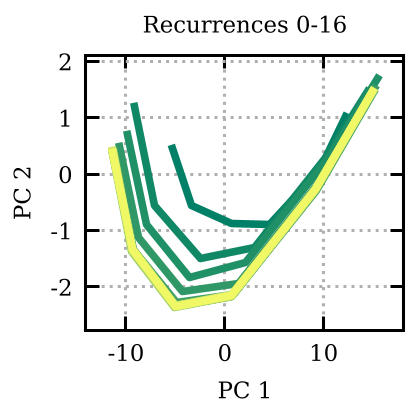 Figure: Frobenius norm between attention patterns. Diagonal lines indicate cyclic similarity, confirming attention-head stability across recurrences.
Methodology: The Role of Input Injection
A critical discovery is that not all looped architectures are created equal. The authors found that Input Injection (re-introducing the original input at the start of each loop) is the "secret sauce" for stability.
- With Input Injection: Models like Retrofitted Llama converge rapidly to a fixed trajectory.
- Without it: Models like Ouro can become "unstable" or converge to degenerate states where every layer does the same thing.
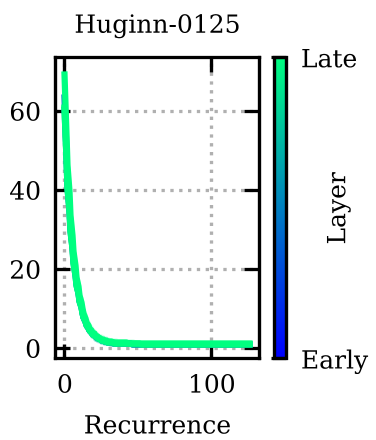 Figure: PCA trajectories showing how Retrofitted Llama reaches a cyclic fixed point where subsequent iterations perfectly overlap.
Result: Self-Organizing "Stages of Inference"
The most striking finding is that looped models naturally organize into "stages of inference" (Mixing -> Compression -> Prediction) within each loop. Even when a model is trained from scratch with constant recurrence, it learns to perform these distinct roles.
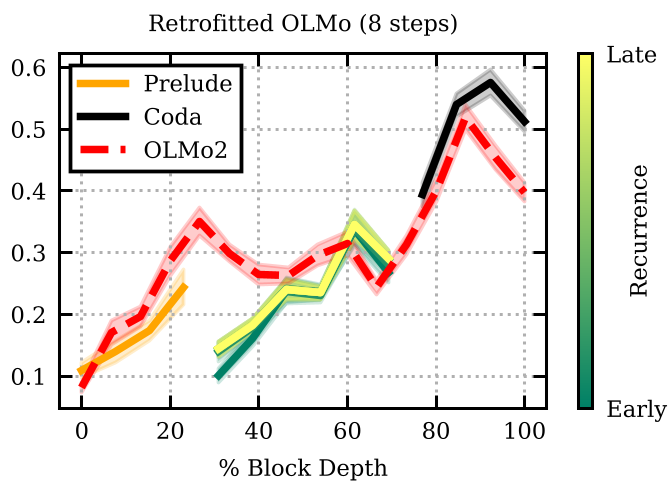 Figure: ColSum concentration across depths. Note how Ouro (left) and Retrofitted Llama (center) replicate the mixing/concentration stages of standard Llama (dashed red lines).
Conclusion & Future Impact
This mechanistic analysis proves that the "stages of inference" are a universal property of Transformers, whether they are 100 layers deep or a 10-layer block repeated 10 times.
Wait, what's the catch? The authors noted that Normalization matters. Models like Huginn-0125, which normalize the residual stream too aggressively, fail to develop the "massive activations" required for these inference stages to emerge.
For future researchers, this work provides a blueprint for designing Adaptive Computation: we can now potentially prune or sparsify specific stages of the loop (like the "middle" compression stage) to make reasoning even faster without losing the "fixed point" stability required for deep thought.