
Inside the Loop: How Recurrent Language Models Self-Organize for Reasoning
A Mechanistic Analysis of Looped Reasoning Language Models
This paper presents a mechanistic analysis of looped reasoning language models, identifying that their recurrent blocks converge to cyclic fixed points in latent space. The study evaluates models like Ouro, Huginn-0125, and retrofitted Llama, demonstrating that they achieve state-of-the-art reasoning by repeating "stages of inference" similar to deep feedforward Transformers.
TL;DR
Researchers have discovered that "looped" language models—which recycle layers to scale computation—don't just wander in latent space. Instead, they converge into cyclic fixed points that perfectly mirror the "stages of inference" found in massive feedforward Transformers. This study reveals that for a looped model to actually get "smarter" with more loops, it requires specific architectural ingredients like input injection to keep its internal logic stable.
The "Why": De-mystifying Recurrent Reasoning
Traditional Large Language Models (LLMs) are feedforward: one pass through layers, and you get a token. But the frontier of AI reasoning (e.g., DeepSeek-R1) involves spending more "thinking time." Looped Transformers achieve this by passing data through the same block multiple times.
While efficient in terms of parameters, the mystery remained: Does a looped model just do the same thing over and over, or does it evolve logic like a deeper model? This paper proves it's the latter—but only if the architecture stays stable.
Methodology: The Cyclic Fixed Point
The authors propose that many looped models reach a state where the internal representation doesn't necessarily stop changing, but it traces a consistent cycle.
Key Insights from Dynamics:
- Proposition 4.1: If a recurrent block reaches a fixed point, the entire cycle of layers within that block follows a stable trajectory.
- Proposition 4.2: Once these states converge, the Attention Patterns stabilize. This is the "smoking gun" for consistent reasoning.
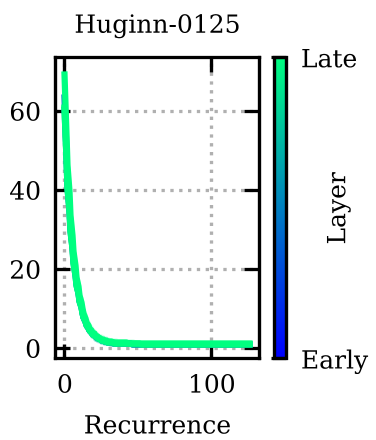 The figure above illustrates a Latent Space Trajectory where the hidden states of a retrofitted Llama model perfectly overlap, signaling that a cyclic fixed point has been attained.
Mirrored Stages of Inference
The most striking discovery is that looped models replicate the "stages of inference" found in standard LLMs. In a 32-layer Llama, early layers "mix" information (high entropy), middle layers focus on specific tokens (attention sinks), and late layers refine the prediction.
The authors found that in models like Ouro and Retrofitted Llama, each pass through the loop replicates these stages. Even more fascinating: models trained from scratch with constant recurrence self-organize into these stages even without being told to.
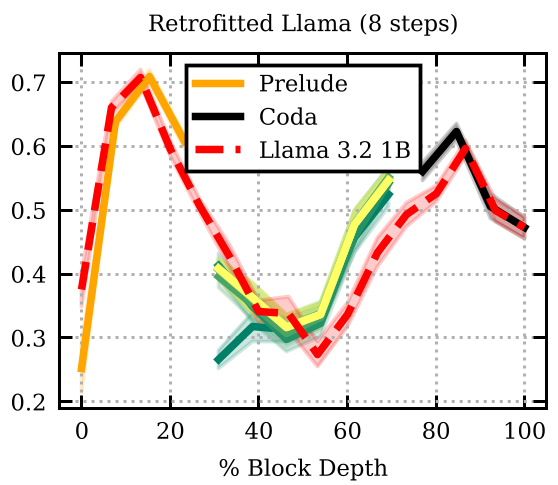 Comparison of "ColSum Concentration" (a proxy for attention focus) across Ouro, Llama, and OLMo. The recurrent loops (yellowing lines) follow the same functional curve as their feedforward cousins.
The Stability Trap: Why Input Injection Matters
The study highlights a critical failure mode. Models like Ouro do not use Input Injection (re-introducing the original input at every loop). Without this "anchor," the model’s internal logic drifts when you increase the number of loops at test time.
- Stable Models (Retrofitted Llama): Can loop 128 times and maintain logical stages.
- Unstable Models (Ouro): Their "stages of inference" fall apart when looping beyond what they saw during training.
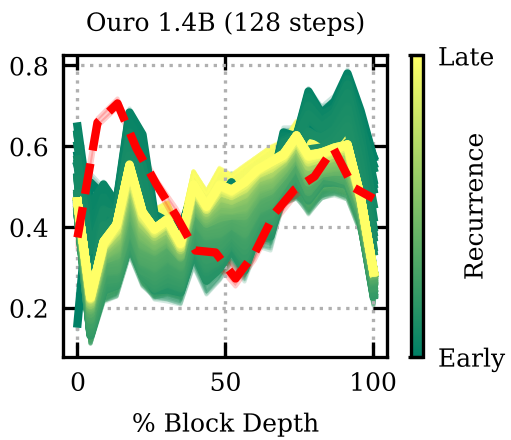 While Retrofitted Llama (left) stays rock-solid over 128 recurrences, Ouro (right) drifts, explaining why its performance degrades with too much "thinking time."
Conclusion & Takeaways
This analysis provides a floorplan for the next generation of reasoning models. It proves that:
- Recursive Depth is Functional Depth: Parameters don't need to be unique to perform unique logical stages.
- Architectural Safeguards: If you want to scale reasoning via loops at test-time, input injection and pre-norm structures are not optional—they are the anchors of logical stability.
The findings suggest a future where we can design "lean" models that act like giants, simply by recycling their internal logic through stable, cyclic fixed points.