
BlogCrawler: Harnessing Social Network Topology for Precision Media Monitoring
Media Monitoring Using Social Networks
This paper introduces BlogCrawler, a specialized search engine that leverages the inherent social network properties of the blogosphere to improve media monitoring. By utilizing "expert" seed nodes and community-aware crawling, it provides highly relevant results for general keyword queries without requiring complex contextualizing terms.
Executive Summary
TL;DR: BlogCrawler is a specialized search engine prototype that stops trying to solve search through better keywords and starts solving it through better neighborhood selection. By treating the blogosphere as a social network, it uses "expert" nodes to define a search boundary, ensuring that general queries like "budget" yield contextually perfect results for media analysts.
Background Positioning: This work sits at the intersection of Link Analysis (PageRank/HITS) and Social Network Analysis (SNA). It is a practical application of "Small World" theory to the problem of information overload in the early-to-mid 2000s blogosphere.
The Problem: The "Context Tax" of Modern Search
Search engines are historically "topic-blind." If you search for "budget," the engine doesn't know if you are a teenager planning a vacation, a political scientist studying the Canadian Parliament, or a cinephile looking for a movie review.
To get what we actually want, we pay a "Context Tax": we are forced to add keywords like "Canadian federal" to our query. The authors argue that this complexity is a bug, not a feature. In the blogosphere, context is already encoded in the hyperlinks—bloggers link to people they read, trust, and agree with.
Methodology: The Social Intelligence of BlogCrawler
1. The Expert-Seed Crawling Strategy
Instead of crawling the entire web, BlogCrawler starts with a few "expert" blogs (e.g., reputable political blogs). Because of Community Structure, these blogs act as gateways to a dense cluster of similar content.
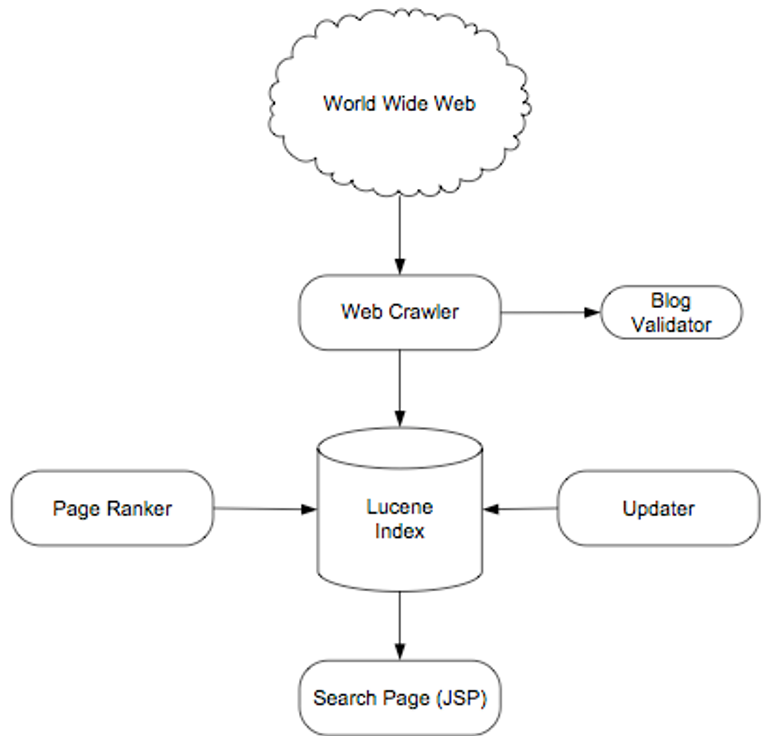
2. The BlogValidator (The Noise Filter)
To prevent "leaking" into the general web (news sites, corporate pages), the authors implemented a structural heuristic. Since blogs usually have consistent date-entry formats, the validator checks for:
- Sequential date patterns in the HTML.
- Uniform HTML tag sequences surrounding these dates. This allowed the crawler to maintain a 94% success rate in staying within the "blogosphere" boundaries.
3. Topic-Sensitive Ranking
Simple PageRank can be "gamed" or dominated by massive, unrelated hubs. BlogCrawler uses a Biased PageRank:
- Expert nodes are given a high initial rank.
- During iteration, this "rank juice" flows primarily to their direct neighbors.
- This forces the search results to prioritize sites that the chosen experts actually trust and link to.
Experiments: Quality over Quantity
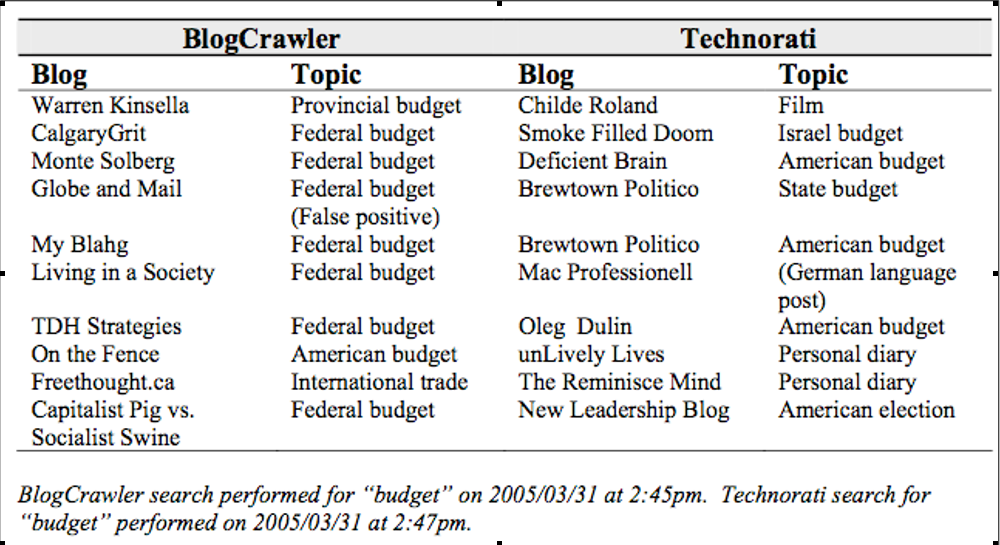
The researchers compared BlogCrawler against Technorati (the leading blog tracker of the era).
The "Budget" Test:
- Technorati: Returned a "plethora of blogs with no consistent topic"—ranging from German personal diaries to American election rants.
- BlogCrawler: Focused almost exclusively on the Canadian Federal Budget, because the crawl was seeded with experts in that niche.
Critical Insight & Conclusion
The true innovation of BlogCrawler isn't the search algorithm itself, but the recognition of the blogosphere as a curated human hierarchy. By leveraging the "Small World Effect," the authors proved that you only need to crawl a few levels deep from a trusted source to capture an entire discourse community.
Takeaways for Modern Research:
- Inductive Bias: In an era of LLMs, we often forget that topology matters. Relying on user-curated links is a powerful inductive bias that reduces the dimensionality of the search problem.
- Limitations: The system relies heavily on the quality of the initial "expert" seeds. If the seeds are biased or narrow, the resulting "social search" becomes an echo chamber—a precursor to the algorithmic filters we see today.
Conclusion: BlogCrawler demonstrates that the most efficient way to find "what people are thinking" isn't by indexing the whole world, but by following the digital breadcrumbs of the experts already in the room.