
Beyond Richness: Why We Share Deals on Twitter but Not on Facebook
A media symbolism perspective on the choice of social sharing technologies
2018-03-11
Summary
Problem
Method
Results
Takeaways
Abstract
This study explores how users choose between various social sharing technologies (blogs, microblogs, SNS, social bookmarking, and forums) using the lens of "Media Symbolism." Validated by focus group interviews and over 1 million behavioral observations, the research identifies that users prefer microblogs and social bookmarking for sharing commercial content over personal social networking sites (SNS).
## TL;DR
Why are you comfortable tweeting a discount code to thousands of strangers but hesitant to post it on your private Facebook wall? This study reveals that our choice of social media isn't about the technology's "richness," but the **symbolic meaning** the platform carries. Users view personal social networking sites (SNS) as "sacred" spaces for relationship maintenance, making commercial content feel like "spam," whereas microblogs and social bookmarking sites are seen as "utility hubs" for information distribution.
## Background & Motivation: The Failure of Traditional Media Theories
In the early days of the internet, we chose media based on **Media Richness Theory**: you used email for simple text and face-to-face for complex emotions. However, in the age of 5G and smartphones, every social app is "rich." Whether it's a Blog, Microblog (Twitter/Weibo), or SNS (Facebook), they all support video, text, and instant feedback.
The authors argue that we must look at **Media Symbolism**—the idea that the medium itself is a message. Choosing a platform sends a symbolic cue about the intent of the information being shared.
## Methodology: The "Accessibility-Consumption" Framework
The researchers categorized platforms along two unique dimensions to map their symbolic value:
1. **Social Accessibility**: Is the network "Closed" (private connections) or "Open" (publicly searchable)?
2. **Content Consumption**: Do you consume the content "On-site" (reading the whole post on the platform) or "Off-site" (clicking a link to an external merchant)?

They matched these categories against over **1 million observations** of actual sharing behavior via a social sharing widget.
## Key Insights: Why SNS is the "Least Preferred" for Commercial Content
The study's most striking finding is the rejection of SNS for commercial sharing.
* **Social Surveillance**: Users feel that sharing a commercial "deal" on a personal network like Facebook or Renren signals a low-quality social interaction. Focus group participants noted: *"If someone shared commercial content on personal SNS, I would consider it spam."*
* **The Microblog Advantage**: Microblogs are seen as news-oriented. Because they often lead to **off-site consumption**, the sharer is perceived as a "curator of information" rather than a "marketing spammer."
## Strategic Results for E-commerce
The quantitative analysis yielded several actionable "Strategic Priorities" for digital marketers:
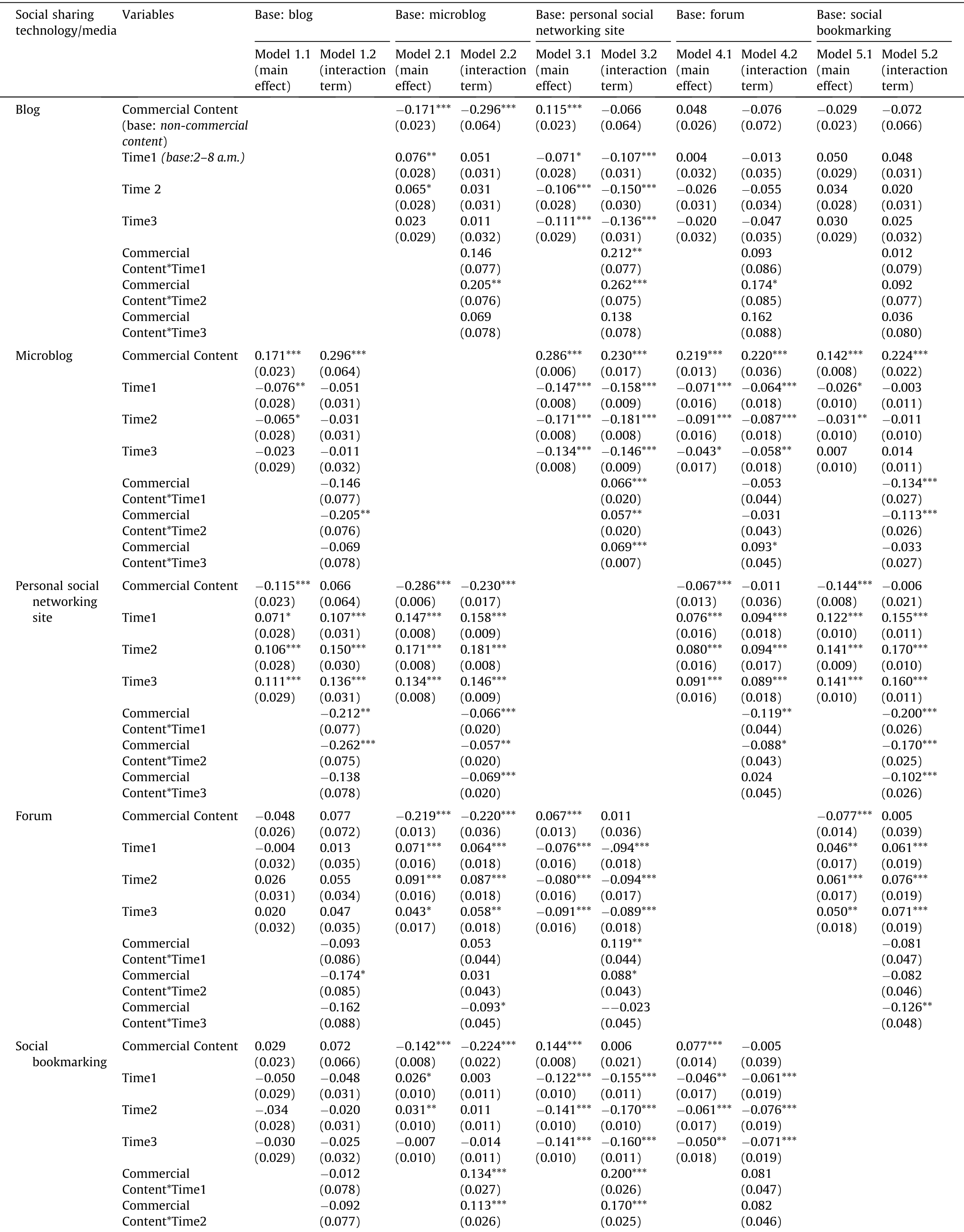
* **The Microblog SOTA**: Microblogs (Model 2.1) showed the strongest positive coefficients for commercial content sharing.
* **The Daytime Window**: While SNS is generally avoided for "deals," the likelihood of SNS commercial sharing actually *increases* during business hours (8 a.m.–2 p.m.). This suggests that during the workday, the symbolic barrier between "professional/informational" and "private/social" blurs.
## Critical Analysis & Future Outlook
While the study provides a massive dataset to back its claims, it has limitations. The data originates primarily from the Chinese digital ecosystem (Weibo, Renren, etc.). As platforms like **Instagram** and **TikTok** blend "Open Accessibility" with "Rich On-site Consumption" (via Social Commerce), the symbolic boundaries identified here are shifting.
**Takeaway for the Future**: Marketers shouldn't just put "Share" buttons everywhere. They should prioritize microblog and bookmarking icons on product pages, while reserving SNS sharing for "lifestyle" or "milestone" content that carries the symbolic weight of personal connection.
## Conclusion
The medium is indeed the message. When we share, we aren't just moving data; we are managing our social identity. By understanding that Twitter symbolizes "Discovery" while Facebook symbolizes "Belonging," companies can better predict where their next viral sale will come from.