
Beyond Traditional Stats: Mining New Insights from Pediatric Asthma Data
Medical Knowledge Discovery from a Regional Asthma Dataset
This study applies advanced data mining techniques—including Kohonen's Self-Organizing Maps (SOM), Apriori association rules, and C5.0 decision trees—to a regional dataset of ~17,000 pediatric asthma records. The research successfully identifies non-trivial patterns in asthma symptoms and demographics, achieving a predictive accuracy of up to 92%.
TL;DR
Pediatric asthma is not just a clinical challenge but a massive data problem, costing the Australian community billions annually. This research moves beyond standard p-values to employ Knowledge Discovery in Databases (KDD). By applying SOMs, Apriori, and C5.0 algorithms to a dataset of 17,000 children, the authors uncovered hidden correlations between socio-economics and sleep, while achieving a 92% prediction accuracy for asthma diagnosis.
Problem & Motivation: The Limits of Traditional Analysis
While traditional statistics are the bedrock of medicine, they often falter when faced with high-dimensional, heterogeneous data. The "uniqueness" of medical data—fraught with ethical constraints and technical silos—means that critical patterns regarding asthma triggers often remain "obscured." The authors' intuition was that visual segmentation and machine learning classifiers could reveal links that simple regression might miss, particularly concerning the socio-environmental factors of the Barwon region in Victoria.
Methodology: A Multi-Stage KDD Pipeline
The study followed the CRISP-DM (Cross Industry Standard Practice for Data Mining) model but innovated in the "Data Understanding" phase.
1. Structural Visualization
Before modeling, the authors used GraphViz and the ACCENT principles to map the structural hierarchy of 77 variables, eventually optimizing them down to 30 core attributes across four categories: Demographics, Symptoms, Asthma cases, and Medication.
2. The Core Algorithms
- Kohonen’s SOM (Self-Organizing Maps): Used to project high-dimensional data onto a 2D grid. This allowed the team to visually "see" how variables like age, gender, and socio-economic status (SEIFA) clustered around symptoms like sleep disturbance.
- C5.0 Decision Trees: Selected for its speed and its ability to "prune" nodes, providing a transparent logic path for physicians to follow.
- Neural Networks: Used as a performance benchmark against the decision trees.
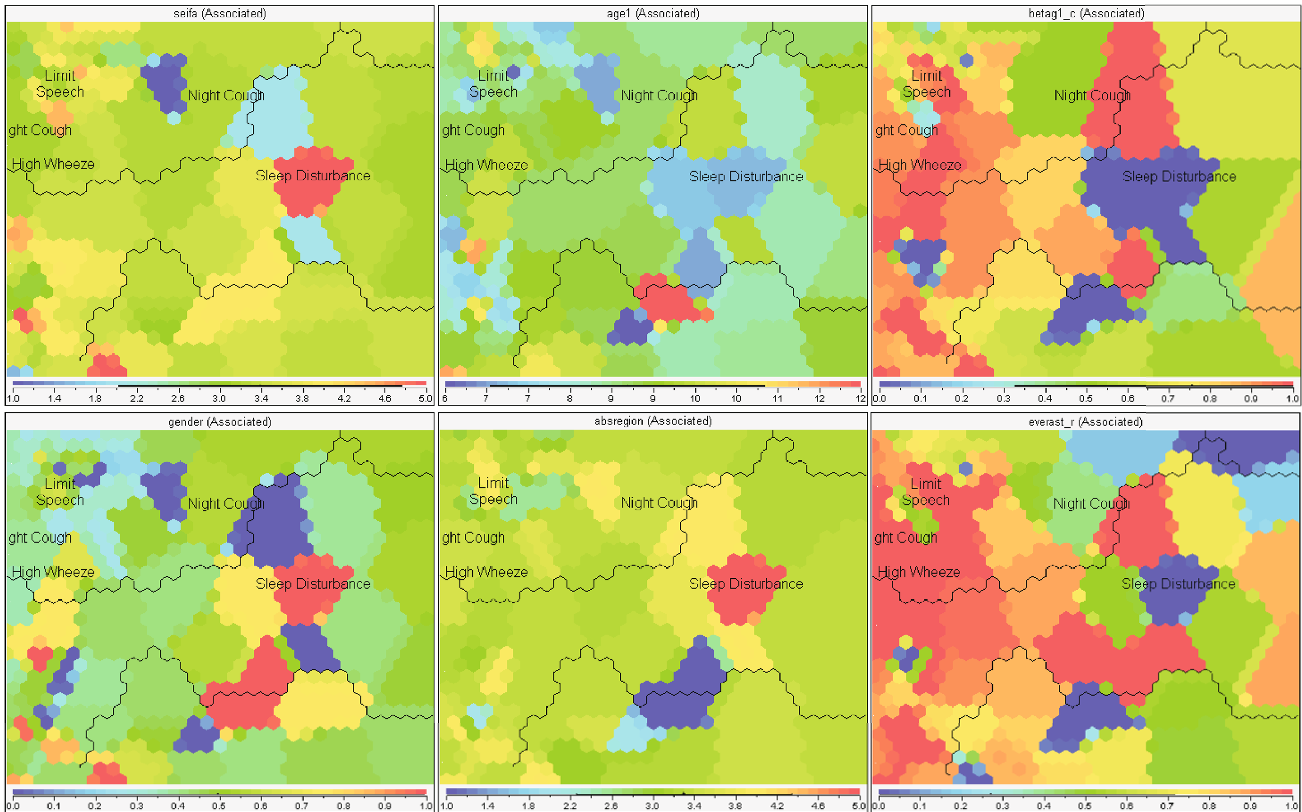 Figure 1: SOM clusters showing the correlation between socio-economic indices and sleep disturbance.
Experiments & Results: Challenging Medical Intuition
The experimental results provided both high-accuracy models and surprising "negative" findings that challenge current literature.
- Predictive Performance: The C5.0 model reached an 88.2% accuracy, which jumped to 92% when simplified. The Neural Network was equally robust, maintaining levels above 90%.
- The "Sleep Disturbance" Insight: In a striking discovery, SOMs showed that children in "Inner City" areas and those with higher socio-economic status had higher sleep disturbance, likely due to urban noise (sirens, activity) rather than asthma. This suggests that "sleep disturbance" might be a noisy predictor in clinical surveys.
- The Gender Paradox: While existing literature heavily links gender to asthma risk, the Neural Network rated gender as the lowest determinant (7% weight), and industrial pollution was the second weakest (9%).
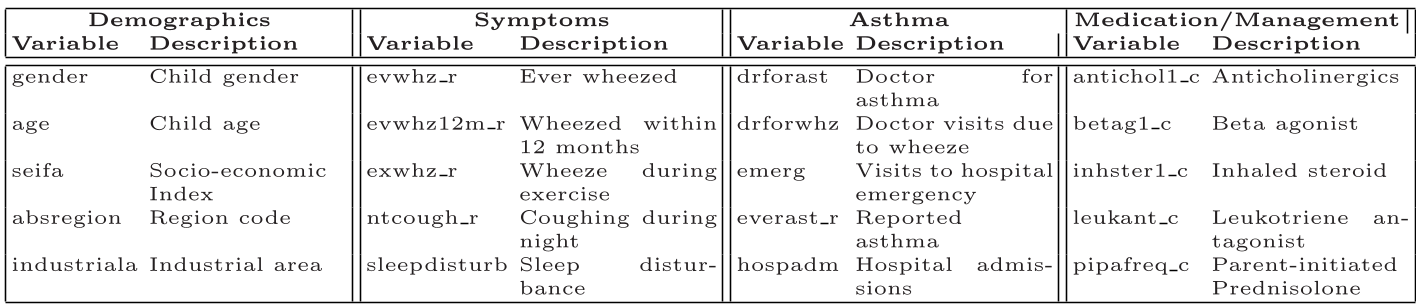 Table 1: The optimized 20 variables used for mining.
Critical Analysis & Conclusion
Takeaway
The study proves that KDD is not just about "prediction" but "interpretation." By revealing that night coughing and sleep disturbance are essentially the same marker in this dataset, researchers can simplify future diagnostic questionnaires to improve data reliability.
Limitations & Future Work
The contradiction regarding gender and industrial pollution indicates either a unique regional characteristic of the Barwon area or a potential bias in the sampling period (March-Sept). Future research should integrate Long Short-Term Memory (LSTM) networks to account for the seasonal nature of asthma triggers and expand to multi-regional datasets to verify if the "Inner City" noise factor holds true globally.
Ultimately, this work serves as a bridge between computer science and the medical profession, showing that when we "see" the data structure, we can better treat the patient.