
Decoding the Digital Doctor: High-Accuracy Medical Persona Classification in Social Media
18549_Medical Persona Classification in Social Media.
This paper introduces the task of Medical Persona Classification, using multi-label text classification to identify whether a social media post (blog or tweet) originates from a patient, caretaker, consultant, or researcher. The authors propose a hybrid approach combining extensive manual feature engineering with deep learning architectures like CNN and CNN-LSTM using pre-trained word embeddings.
TL;DR
When we read a health-related tweet, knowing who wrote it is as important as what they wrote. This research provides a computational framework to distinguish between patients, doctors, and researchers in the noisy world of social media. By leveraging CNN-LSTM architectures and multi-label transformation techniques, the authors achieve significant performance gains over traditional feature engineering, proving that deep learning can capture the "hidden cues" of medical identity.
Motivation: Why Persona Matters
In the era of digital health, pharmaceutical companies and researchers are drowned in data. However, a post about a drug's side effect carries different weight if it comes from a Patient (reporting a real-world reaction) versus a Consultant (discussing clinical possibilities).
The challenge? Social media is a "wild west" of typos, slang, and non-standard abbreviations. Previous attempts relied on manual heuristics that failed to scale or capture the nuance of different writing styles across platforms like Twitter and medical blogs.
Methodology: The Architecture of Identity
The authors treat this as a supervised multi-label text classification problem. Because a single post could involve a conversation between a patient and a doctor, the model must be prepared to assign more than one label.
1. Feature Engineering vs. Neural Representations
The team first built a robust baseline using 89 hand-crafted features including:
- Semantic Features: Mentions of diseases, drugs, and chemicals (extracted via MetaMap).
- POS Tags: Distribution of grammatical structures (e.g., consultants use 1.6x more adjectives than journalists).
- List Lookups: Domain-specific vocabularies for professional titles or medical conditions.
2. Deep Learning Models
To move beyond manual effort, they introduced two primary neural architectures:
- CNN (for Tweets): Uses convolutional filters to capture local n-gram patterns within the 140-character limit.
- CNN-LSTM (for Blogs): Captures local sentence-level features via CNN and feeds them into an LSTM to preserve the long-range "narrative arc" of a blog post.
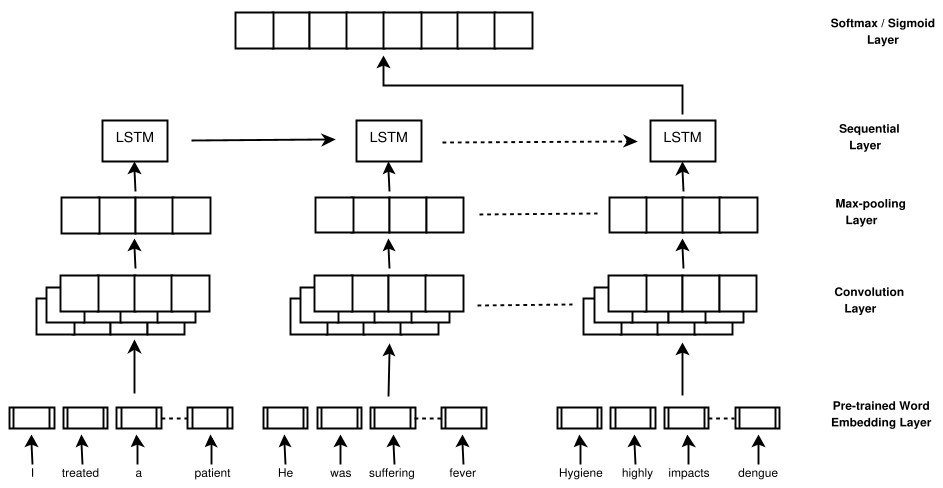 Figure 1: The CNN-LSTM pipeline designed to extract features from word sequences and preserve persona information across sentences.
Experiments and Insights
The researchers tested their models on thousands of annotated blogs and tweets. They discovered a surprising nuance: Medical coverage in embeddings isn't everything.
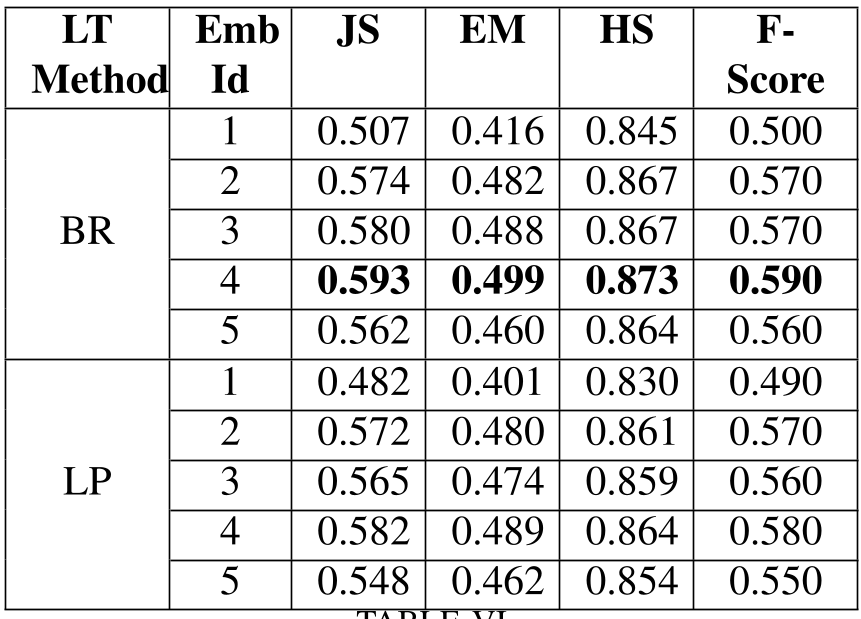 Figure 2: Performance of various approaches on the blog dataset. Note that Averaged Word2Vec with GloVe embeddings (ID 4) performed best.
Key Findings:
- The Power of GloVe: Embeddings trained on massive general web crawls (GloVe) outperformed those trained strictly on medical journals (PubMed). Why? General embeddings capture the informal way patients and caretakers speak, which is often missing from academic medical texts.
- Transformation Strategies: For multi-label management, Label Powerset (LP) generally yielded better F-scores than Binary Relevance (BR), as it accounts for the correlation between different persona labels.
- The Caretaker Dilemma: The "Caretaker" class was the hardest to identify due to its heavy vocabulary overlap with the "Patient" class—highlighting the need for even more nuanced structural analysis.
Conclusion & Future Directions
This work sets a baseline for automated medical social media analysis. The leap from manual features to deep neural representations resulted in a 5-7% F-measure improvement, demonstrating that latent semantic features are better at navigating the noise of social media than rigid medical dictionaries.
Future Outlook: The authors suggest moving toward distant supervision, using heuristically labeled data (like tagged posts from medical portals) to train even larger models without the bottleneck of manual human annotation.
As AI continues to integrate with healthcare, understanding the "Persona" behind the post will be the key to turning social media noise into actionable medical intelligence.