
From Spectator to Actor: How Social Networks Co-create the Value of the Olympic Games
Mega Sporting Events and Technology: The Role of Social Networks in Co-creating Value for the Olympic Games
This paper explores the integration of social networks (Facebook, Twitter) within mega-sporting events, specifically the Olympic Games (1992–2016), through the lens of Value Co-creation. It identifies how digital platforms transform passive spectators into active participants, significantly increasing the social and economic value of the Games through real-time interaction and user-generated content.
TL;DR
This research investigates the paradigm shift in mega-sporting events from 1992 to 2016. By adopting Service-Dominant Logic (SDL), the paper demonstrates that the "value" of the Olympic Games is no longer just produced by organizers but is co-created through the massive, real-time digital interactions on social networks like Facebook and Twitter.
Background: The Shift in the Olympic Paradigm
Historically, the Olympic Games were viewed as a product to be consumed. However, the authors position the modern Games in a world where the distinction between producer and consumer has blurred. Starting from the 1992 Barcelona Games—the first post-Cold War Olympics—the event became a complex "social system" requiring multi-stakeholder participation.
The Core Insight: Service-Dominant Logic (SDL)
The paper argues that in the sports field, value is not "delivered" but "co-created."
- Operant Resources: Fans and athletes are not just targets; they are resources providing knowledge, skills, and emotional labor.
- Horizontal Interaction: Unlike TV (vertical), social media allows a horizontal exchange where a fan’s "Like" or "Tweet" contributes to the event's global brand equity.
Methodology: A Comparative Timeline (1992–2016)
The authors analyzed the evolution of media and technology across Summer Olympics editions.
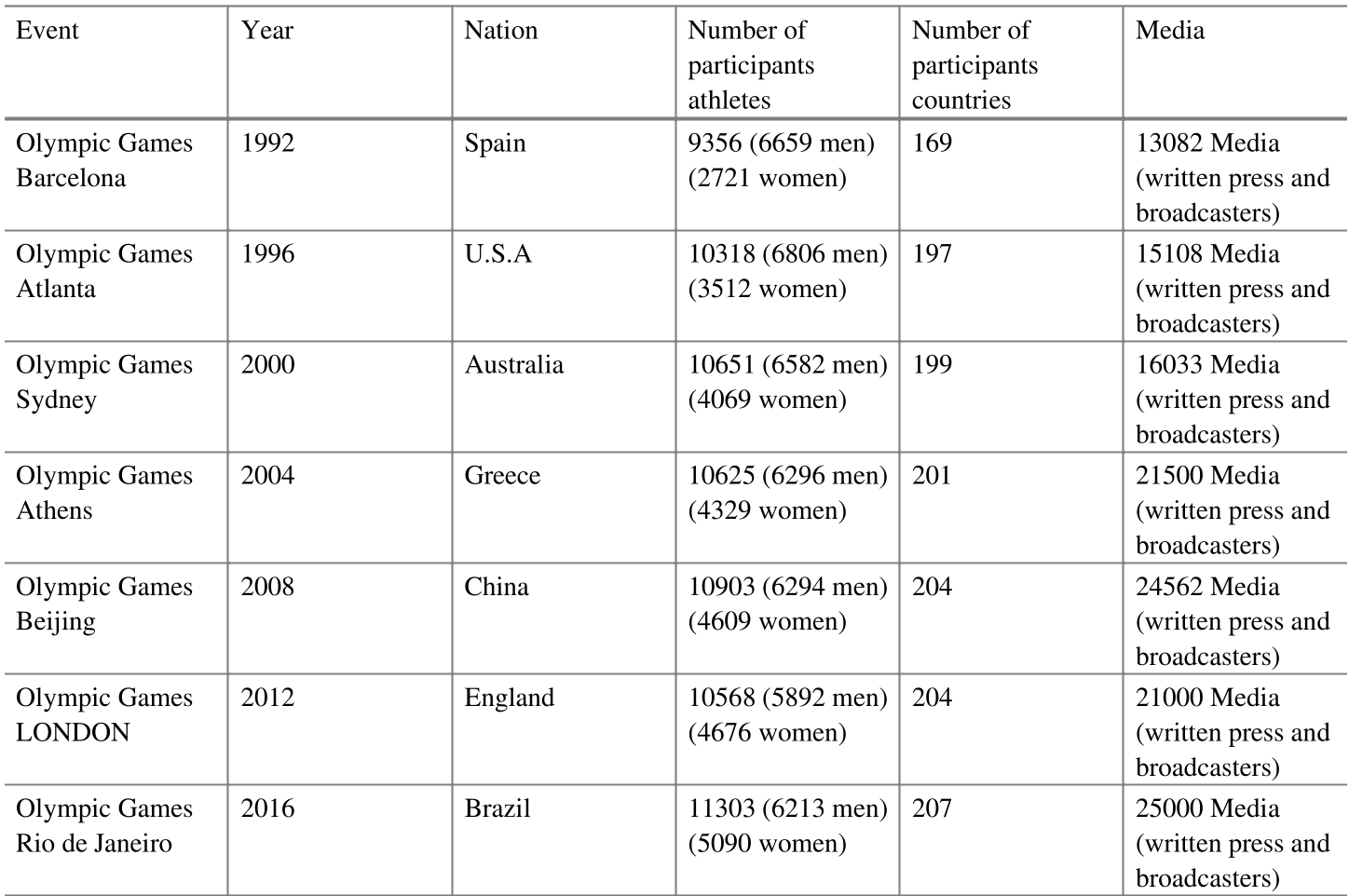 The table above summarizes the growth in media presence and participation, showing a steady climb in complexity and global reach.
Key Technological Milestones:
- Beijing 2008: The "Internet Olympics" inauguration. Despite restrictions, digital access was unlocked for journalists, and 80% of users chose the internet to inquire about results.
- London 2012: The "Social Media Olympics." Over 150 million tweets were recorded, with peaks hitting 116,000 tweets per minute during the Spice Girls' closing performance.
- Rio 2016: The "Interaction Era." Facebook dominated with 227 million posts, while Instagram saw nearly 1 billion interactions, proving the power of visual storytelling in co-creation.
Results and Impact
The results confirm that technology has successfully decentralized the Olympic experience.
- Scale: Interaction volume grew significantly between 2012 and 2016, even accounting for platform growth.
- Social Value: Athletes like Usain Bolt (18M Facebook fans) serve as individual hubs for value creation, bypassing traditional media to engage directly with the public.
Critical Analysis & Conclusion
While the paper successfully establishes social networks as vital tools for co-creation, it raises an important ethical question: Is this "free exploitation"?
The authors suggest that organizers must ensure "mutual growth" where fans receive material or symbolic rewards (perceived value, exclusive content) in exchange for their creative energy.
Limitations & Future Work
The study is primarily exploratory. The authors acknowledge the need for a mathematical analysis model to measure the exact efficiency and economic impact of social media interactions on the "success" metrics of future mega-events.
Final Takeaway
The Olympic Games succeed not just because of the athletes on the track, but because of the millions of "content creators" in the stands and at home. For any modern brand, the transition from "selling a product" to "facilitating a service system" is the key to enduring relevance.