
MELODY: Synchronizing Incentives with the Rhythms of Human Quality
MELODY: A Long-Term Dynamic Quality-Aware Incentive Mechanism for Crowdsourcing
The paper introduces MELODY, a long-term dynamic quality-aware incentive mechanism for crowdsourcing. It combines a greedy reverse auction algorithm for task allocation with a Linear Dynamical Systems (LDS) framework for predicting time-varying worker quality.
Executive Summary
TL;DR: Most crowdsourcing platforms assume a worker's skill is either a fixed number or a random snapshot. MELODY breaks this mold by treating worker quality as a dynamic time-series. By integrating Linear Dynamical Systems (LDS) into a reverse auction framework, it predicts worker trajectories, resulting in a 46.6% boost in requester utility and a significant reduction in estimation errors.
Strategic Positioning: This work bridges the gap between Algorithmic Game Theory and State-Space Modeling, evolving the field from "static task matching" to "long-term human resource optimization."
The Blind Spot of Prior Work
In marketplaces like Amazon Mechanical Turk (AMT), the quality of a worker isn't static. A worker might start slow (learning), peak, and then decline (fatigue).
Current mechanisms suffer from two extremes:
- The Over-fitting Trap: Evaluating workers based only on the current run, which makes the system vulnerable to temporary noise or "accidental" errors.
- The Under-fitting Trap: Treating all historical data as an unordered set, effectively ignoring the fact that a worker's performance today is more correlated with yesterday than with three months ago.
MELODY identifies that worker quality exhibits temporal characteristics—rising, declining, and fluctuating—that require a sequence-aware model.
Methodology: The Core of MELODY
1. The Allocation Engine (Reverse Auction)
MELODY models the interaction as a continuous series of reverse auctions. The platform selects workers who provide the highest "Quality-per-unit-cost" ().
Key Algorithms:
- Greedy Selection: Tasks are sorted by difficulty, and workers are assigned such that the integrated quality meets the task threshold .
- Truthfulness Guardrails: The payment scheme is designed (using a threshold-based price) to ensure that workers maximize their utility only by bidding their true costs.
2. The Dynamic Quality Tracker (LDS-EM)
This is where the "physics" of the model shines. Instead of measuring quality directly, MELODY treats quality () as a latent variable (unobserved state).
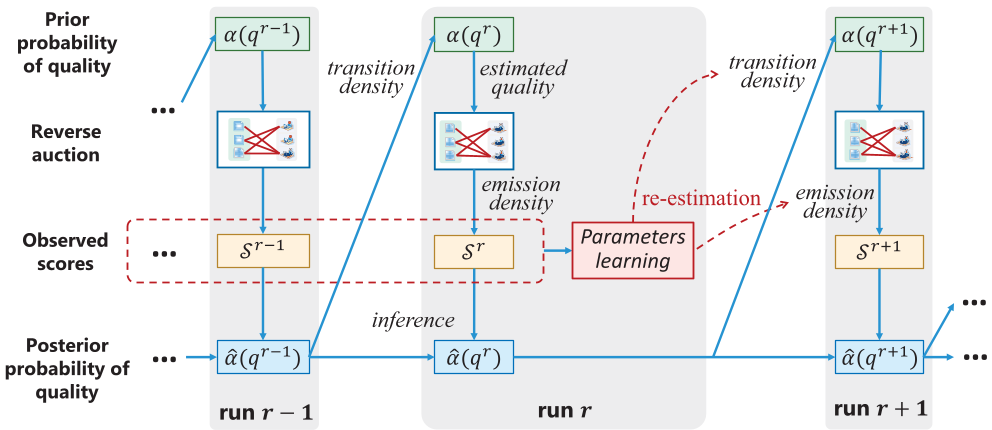
- Transition Density: Predicts how quality evolves from one run to the next ().
- Emission Density: Defines how the latent quality generates the observed scores ().
- Refinement: Using the Expectation-Maximization (EM) algorithm, the platform periodically re-calibrates the transition parameters to ensure the model adapts to how specific workers "evolve."
Experimental Validation: Beyond Static Baselines
The researchers compared MELODY against static models and simple Maximum Likelihood (ML) estimators. The results confirm that ignoring time is costly.
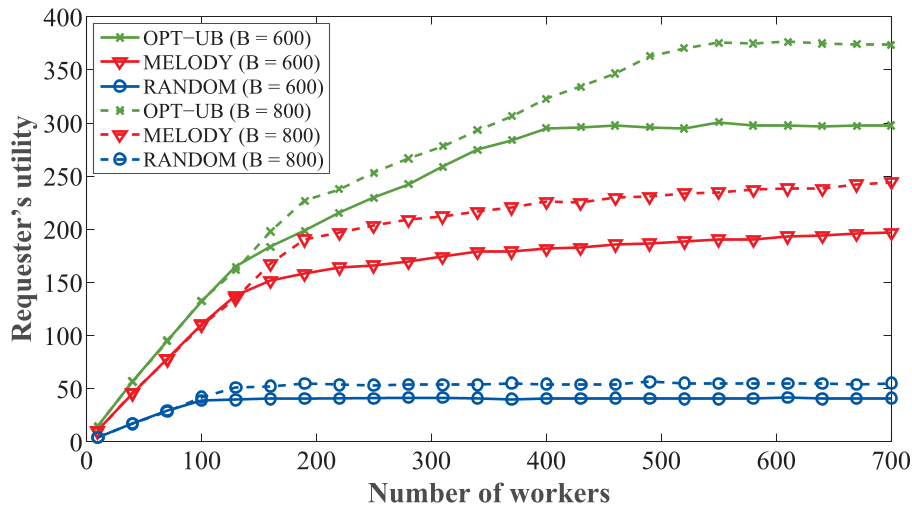
Competitiveness Performance
Under various budget constraints, MELODY consistently tracked close to the theoretical upper bound (OPT-UB), far outperforming random allocation baselines.
Long-term Estimation Accuracy
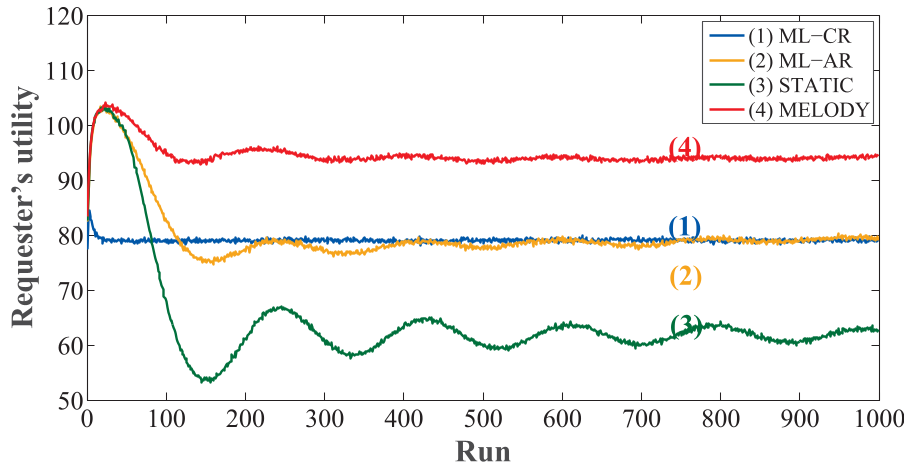
The true power of the LDS framework is visible in the error reduction. While ML-based methods (current run or all runs) fluctuate wildly or lag behind trends, MELODY’s tracking error was 17.6% to 24.2% lower.
Critical Analysis & Conclusion
Takeaway: The "Human-in-the-loop" isn't a static component. MELODY proves that by treating workers as dynamic systems rather than static agents, platforms can extract significantly more value from a limited budget.
Limitations:
- Complexity: Implementing EM algorithms for thousands of workers continuously may introduce significant overhead. The paper suggests an update interval to mitigate this.
- Cold Start: Specifically, new workers' initial parameters must be "guessed," which can lead to early-stage misallocation.
Future Outlook: The integration of Deep State-Space Models could further capture non-linear quality shifts, perhaps modeling the impact of external incentives on worker learning curves.