
SkyBoundary & InfraSky: Strategically Promoting Potential Stars in Social Networks
Member promotion in social networks via skyline
This paper introduces the "Member Promotion" problem in Social Networks (SNs), which identifies non-skyline members that can become "stars" (skyline points) with the lowest edge-addition cost. The authors propose two optimized algorithms, SkyBoundary for unequal-weighted networks and InfraSky for equal-weighted networks, significantly outperforming baseline brute-force methods.
TL;DR
Researchers have developed a way to identify "potential stars" in social networks—members who aren't currently top-tier but can reach the "Skyline" (the Pareto optimal front of influence) with the minimum number of new connections. By utilizing geometric pruning and a new concept called Infra-skyline, the proposed algorithms (SkyBoundary and InfraSky) are orders of magnitude faster than previous brute-force approaches.
Background: Beyond Current Influence
In social networks like Facebook or DBLP, "Stars" (famous scholars, popular actors) are usually identified via Skyline Queries. A member belongs to the skyline if no other member beats them in all measured dimensions (e.g., Authoritativeness/Indegree and Hubness/Outdegree).
However, decision-makers are often more interested in Member Promotion: Who is the most promising candidate to become a star, and what is the cheapest way to get them there?
The Core Challenge: An Exponential Search Space
Promoting a member involves adding edges. But which edges?
- Dynamic Topology: Every new edge changes the network's structure, potentially shifting the metrics of every other node.
- Combinatorial Explosion: The number of possible edge combinations to add to a single node is massive.
- Efficiency: Baseline algorithms like IDP or Brute-force fail to scale beyond a few thousand nodes due to these complexities.
Methodology: The Geometry of Promotion
The authors map social network members into a 2D coordinate system where the x-axis is Authoritativeness and the y-axis is Hubness.
1. Promotion Boundary
Instead of checking every edge, the authors define a Promotion Boundary. This is a polyline connecting current skyline points. Any node below this line is "dominated." To be promoted, a node must shift its coordinates to "cross" this boundary.
 In the figure above, the dotted line represents the promotion boundary. The "x" marks represent virtual promotion points—the most efficient targets for a candidate 'n' to reach.
2. Infra-skyline Pruning
For equal-weighted networks (where every new connection "costs" the same), the authors introduce the Infra-skyline—the skyline of the non-skyline members. They prove mathematically that the "most potential" candidates must belong to the Infra-skyline or its boundary, allowing them to discard the vast majority of nodes immediately.
Algorithms: SkyBoundary & InfraSky
- SkyBoundary: Used for unequal-weighted networks (where some connections are harder to make than others). It uses a priority queue and a cost-based pruning strategy to verify plans in ascending order of cost.
- InfraSky: Used for equal-weighted networks. It calculates promotion costs using L1 (Manhattan) distance to the promotion boundary, making it incredibly fast.
Experimental Results: Scaling to Millions
The performance jump is staggering. On the DBLP dataset:
- Brute-force/IDP: Took ~20 minutes for just 1,000 nodes.
- InfraSky: Handled 1,000,000 nodes in mere seconds.
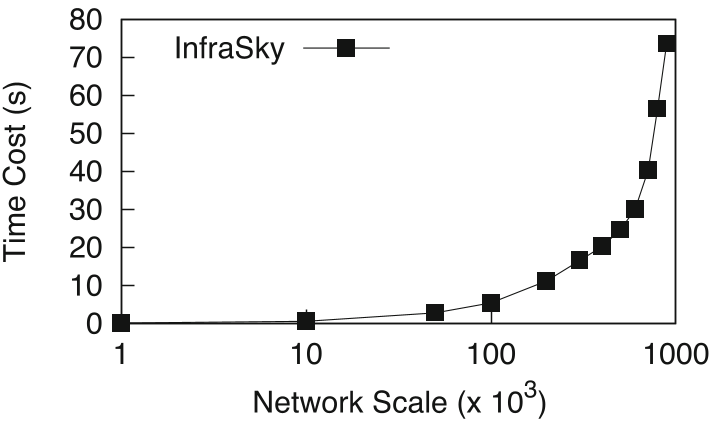 As the scale of the network increases, InfraSky (plotted at the bottom) maintains near-linear performance, while traditional methods spike exponentially.
Real-world Validation: Predicting Turing Award Winners
By running their algorithm on DBLP data from the 1970s, the authors found that many "Potential Stars" identified by the algorithm (like Donald Knuth or Robert Tarjan) were promoted to the skyline and subsequently won the Turing Award shortly after.
Critical Insight & Conclusion
The genius of this work lies in transforming a graph-theoretic search problem into a geometric optimization problem. By treating influence as a coordinate in space, the authors can use the "Promotion Boundary" as a shortcut to bypass millions of useless calculations.
Limitations: Currently, the model only works with "monotonic" metrics (where adding an edge always increases the value). If one were to use "Betweenness Centrality" (which can decrease when new paths are added), the geometry becomes much more complex—a promising frontier for future research.
Takeaway
If you want to find the next "Opinion Leader" or the most promising rising star in a community, don't just look at who is popular now. Look at who is closest to the Infra-skyline—the geometric threshold of breakthrough.