
[CVPR 2026] Memento-Skills: The Rise of the Agent-Designing Agent
Memento-Skills: Let Agents Design Agents
Memento-Skills is a self-evolving LLM agent system that functions as an "agent-designing agent," autonomously constructing and refining task-specific skills. It achieves SOTA performance on GAIA (+13.7%) and HLE (+20.8%) by utilizing a Read-Write Reflective Learning framework that enables continual learning without updating LLM parameters.
TL;DR
Memento-Skills is a breakthrough in continual learning for LLMs that side-steps the need for expensive fine-tuning. Instead of re-training the model, it treats "Skills" (structured markdown, code, and prompts) as a mutable, evolving memory. By implementing a Read-Write Reflective Learning loop, the system allows a frozen LLM to "design" better versions of itself, achieving a relative improvement of up to 116% on expert-level benchmarks.
Motivation: The "Stateless Agent" Problem
Most modern agents are deployed with fixed parameters (). When they fail, they stay failed. The authors argue that while standard LLMs are "frozen," their behavior shouldn't be.
The core bottleneck in current RAG-based agents is that semantic similarity behavioral utility. Just because a past case looks like the current problem doesn't mean the solution is the right tool to execute. Memento-Skills shifts the paradigm from "remembering what happened" to "refining how to act."
Methodology: The Read-Write Evolution Loop
The architecture is governed by the Stateful Reflective Decision Process (SRDP). It approximates policy iteration through two core phases:
- Read (Policy Improvement): A behavior-aligned router (trained via offline RL) selects the most execution-relevant skill from an 8k+ skill library.
- Write (Policy Evaluation & Mutation): If a task fails, a "Failure Attribution" module identifies the responsible skill. A "Skill Rewriter" then patches the code or prompt, followed by a Unit Test Gate to ensure no regressions.
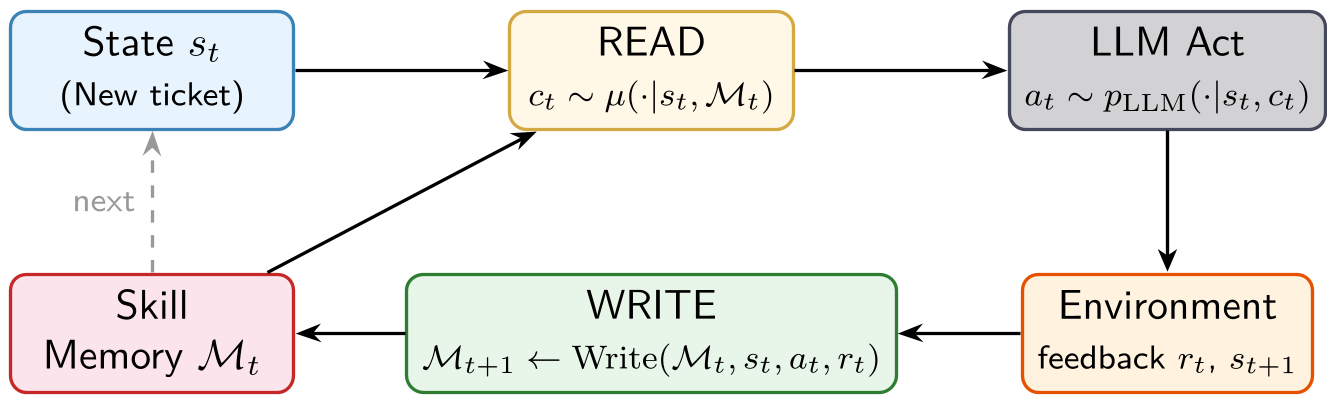 Figure: The Read-Write Reflective Learning loop. The LLM remains frozen; all adaptation occurs in the external skill memory.
The Secret Sauce: Behavior-Aligned Routing
Unlike standard RAG that uses cosine similarity, Memento-Skills uses InfoNCE loss to train its router. By treating retrieval as a "one-step MDP," the router learns to predict which skill will actually lead to a successful "Judge" score, essentially fitting a Q-function over the library.
Experiments: Breaking the Limits of "Humanity's Last Exam"
The system was tested on GAIA (General AI Assistants) and HLE (Humanity’s Last Exam).
- HLE Results: On this expert-level academic benchmark, the self-evolving mechanism allowed the agent to transfer knowledge across subjects (e.g., Biology, Humanities). The success rate climbed from 17.9% to 38.7% on the test set.
- Convergence: The authors show that as the skill library grows and densifies, the "memory coverage radius" () shrinks, leading to a mathematically provable reduction in the performance gap.
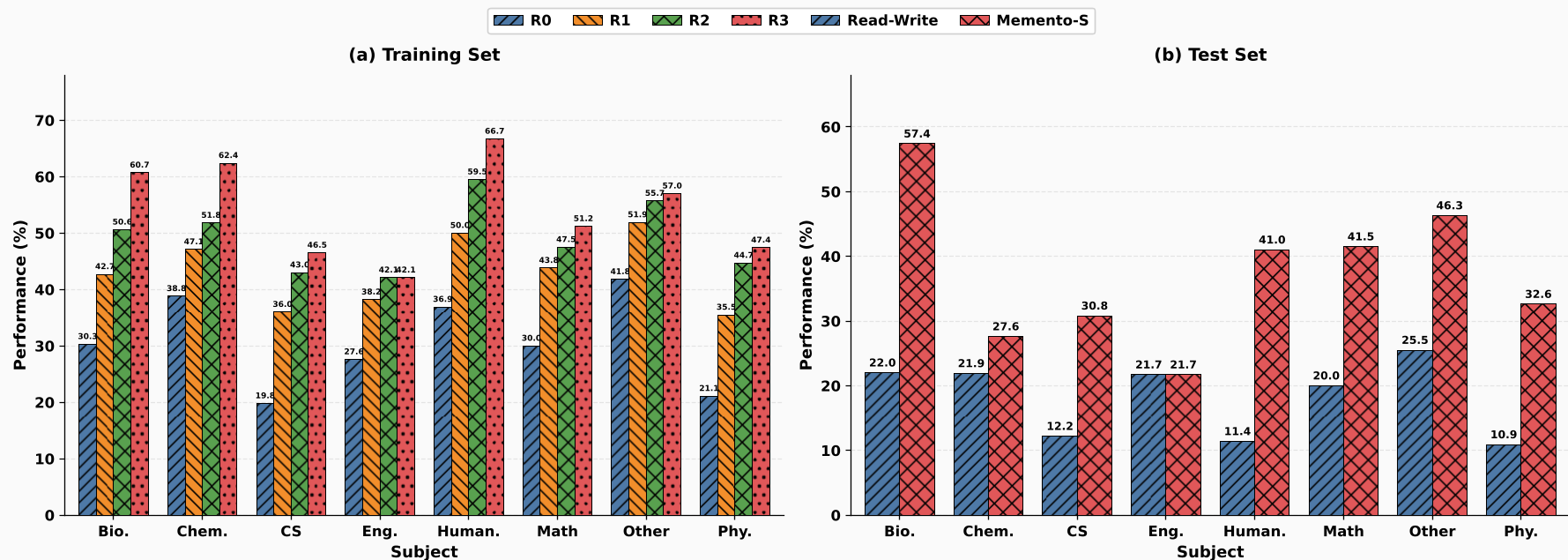 Figure: HLE test set comparison showing Memento-Skills more than doubling the baseline accuracy.
Deep Insight: Skills as Muscle Memory
The most striking visualization in the paper is the t-SNE projection of skill embeddings. Learning on HLE expanded the library from 5 "atomic" seed skills to 235 specialized clusters.
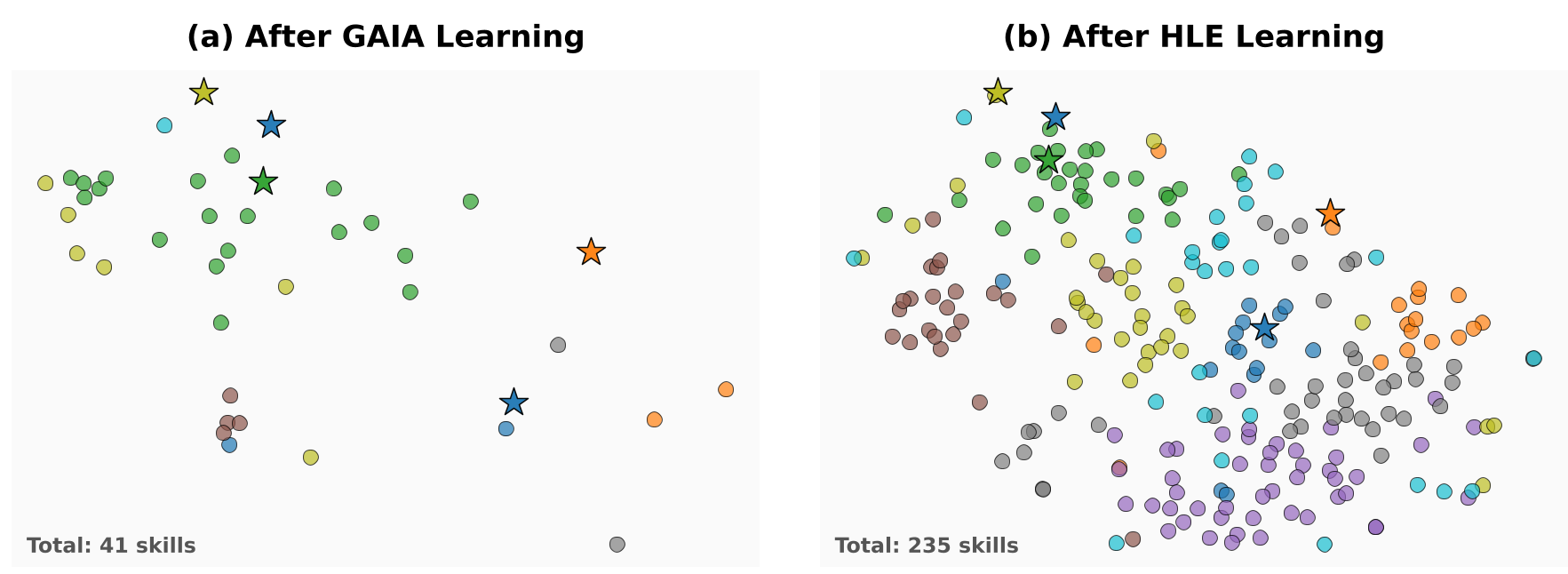 Figure: Evolutionary densification of the skill space. Blue dots represent newly "discovered" skills.
This process mimics biological motor learning: what starts as deliberate, high-level reasoning eventually consolidates into robust, "compiled" routines (skills).
Conclusion & Future Outlook
Memento-Skills proves that intelligence can be externalized. By modularizing an agent's capabilities into a searchable, writable library, we can achieve perpetual self-improvement without a single gradient update to the foundation model.
Limitations: The system currently relies on an LLM-as-a-Judge for rewards, which can be a source of bias. Furthermore, as the library hits millions of skills, the latency of retrieval and the complexity of "skill deduplication" will become significant engineering hurdles.