
Beyond Rationality: How Mood Disorders and Memory Biases Shape Social Success
5114_Analyzing the Effects of Memory Biases and Mood Disorders on Social Performance.
This paper introduces an integrated agent-based model to analyze how memory biases and mood disorders—specifically mania, depression, and bipolarity—affect social performance. Using a "Continuous Prisoner’s Dilemma" framework within a social network, the authors demonstrate that manic agents significantly outperform rational baselines, while depressed agents suffer severe performance deficits.
TL;DR
Researchers have developed a sophisticated Multi-Agent System (MAS) to simulate how mood disorders like mania and depression impact social performance. By moving beyond the "rational agent" myth, the study reveals that manic traits can lead to a 70% increase in social payoffs, while depression leads to a 60% deficit, primarily driven by differences in social engagement and memory retrieval biases.
Background: The Limits of the Rational Agent
For decades, game theory and MAS research relied on the "Perfectly Rational Agent." While later models introduced cognitive biases, they rarely accounted for Mood Disorders, which affect approximately 20% of the population. This paper bridges the gap between clinical psychology and computational modeling by asking: How do mood-driven changes in social drive and memory affect an individual's "win rate" in a society?
The Problem: Why Isolation Doesn't Work
Prior work often modeled agents as isolated entities. However, in the real world:
- Depression correlates with smaller social networks and reduced "drive" (engagement).
- Mania is characterized by hyper-engagement and increased sensitivity to rewards.
- Memory isn't a hard drive; it's biased. We remember "happy" events more easily when we are currently happy (Mood-Congruent Retrieval).
The authors argue that failing to model these factors leads to an incomplete understanding of social dynamics.
Methodology: The Integrated Architecture
The researchers utilized the Continuous Prisoner’s Dilemma (CPD), allowing agents to cooperate on a scale of 0 to 1 rather than a binary choice.
Key Components:
- Reward Sensitivity (): Depressed agents perceive rewards as smaller than they are (), while manic agents amplify them ().
- Mood-Congruent Retrieval: Memory retrieval is probabilistic, using a triangular distribution centered on the current mood. This ensures agents "brood" on failures when sad and "reminisce" on success when happy.
- Social Network Dynamics: Unlike standard models, the network size is a function of the agent type, reflecting the social withdrawal often seen in depression.
 Figure: The conceptual framework of the agent interaction model.
Experiments & Results: The High Cost of Low Drive
The simulation involved 200 agents over 2000 rounds. The results were stark:
- Manic Agents: The "winners" of the simulation, outperforming rational agents by 70%. Their high "drive" leads to more interactions and, despite risks, higher cumulative payoffs.
- Depressed Agents: The worst performers, with a 60% loss relative to rational agents, caused by lower participation and anhedonia (reduced reward sensitivity).
- Bipolar Agents: Interestingly outperformed rational agents by 10%, suggesting that the "highs" of mania provide enough buffer to offset the "lows" of depression in this specific framework.
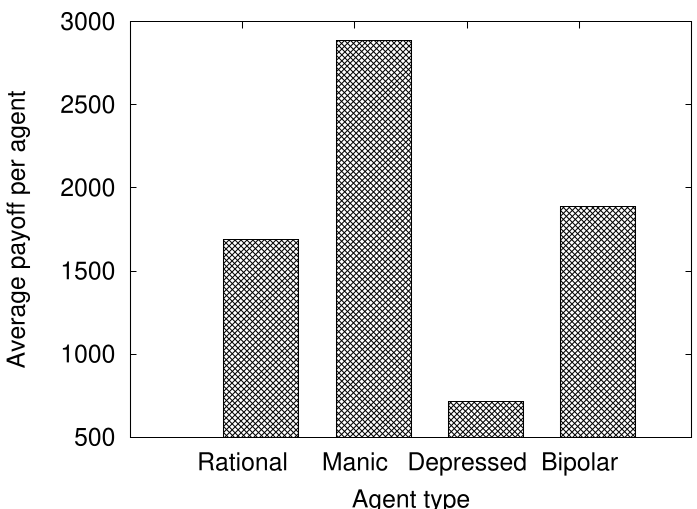 Performance across different agent types (Rational, Manic, Depressed, Bipolar).
The study also found a nearly linear relationship between the degree of mania/depression () and the average payoff, verifying that performance is sensitive to the severity of the disorder.
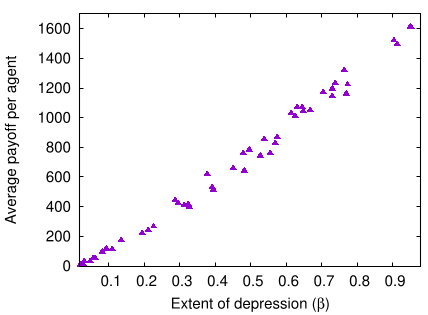 Linear relationship between mood severity (Depression) and Payoff.
Critical Insight & Conclusion
Takeaway
This paper serves as a vital reminder that "performance" in a social system is not just about the logic of the strategy (e.g., Tit-for-Tat), but about the psychological state of the actor. Manic drive, while clinically risky, acts as a "super-cooperator" mechanism in social interactions by maintaining high engagement.
Limitations
The model assumes that "drive" is always beneficial for payoffs, which may not hold true in environments where interactions have high costs or where manic "over-confidence" leads to catastrophic failure (not fully captured in this CPD version).
Future Outlook
This framework could be extended to study Opinion Dynamics or Market Bubbles, where the "manic" exuberance of a subset of agents could trigger systemic shifts that purely rational models would fail to predict.