
AMN: Breaking the Parsing Bottleneck with External Structural Memory
Memory Network for Linguistic Structure Parsing
2020-01-01
Summary
Problem
Method
Results
Takeaways
Abstract
This paper introduces the Associated Memory Network (AMN), an external memory augmentation for linguistic structure parsing tasks like Syntactic Dependency Parsing and Semantic Role Labeling (SRL). By transforming known training instances into a queryable "memory bank," the parser achieves new SOTA performance on benchmarks like PTB, CTB, and CoNLL-2009.
## Executive Summary
Despite the dominance of Transformers and Biaffine architectures, linguistic structure parsing—extracting the syntactic or semantic skeleton of a sentence—has reached a performance plateau. This paper by Li et al. introduces the **Associated Memory Network (AMN)**, a mechanism that allows parsers to "look up" similar examples from a textbook-like memory bank during inference. By moving beyond purely parametric learning, the AMN achieves state-of-the-art results on PTB and CoNLL-2009, proving that explicit memory retrieval is a viable path forward for complex NLP tasks.
## The Core Intuition: Human-like "Analogical" Learning
When a human linguist encounters a difficult sentence, they often recall similar sentences they’ve analyzed before. Traditional neural parsers can't do this; they compress all their "experience" into static weights. The authors argue that this leads to an **information bottleneck**, especially for rare or long-distance dependencies.
AMN shifts the paradigm towards **lazy learning**: instead of just learning a general function, the model retains specific training treebank patterns in an external "RAM" and retrieves them based on structural similarity (e.g., Edit Distance of POS tags).
## Methodology: The "Textbook" Retrieval Architecture
The AMN architecture consists of two main loops:
1. **Memory Addressing (Retrieval)**: For a given input sentence, the model calculates the distance (Edit Distance, Word Moving Distance, etc.) to all sentences in the treebank and selects the top $M$ most similar instances.
2. **Feature Extraction & Fusion**: Using a Transformer encoder, the model aligns the input sentence with the retrieved memory snippets. It extracts "memory features"—actual head positions and labels from the training data—and fuses them with the current sentence’s representation.
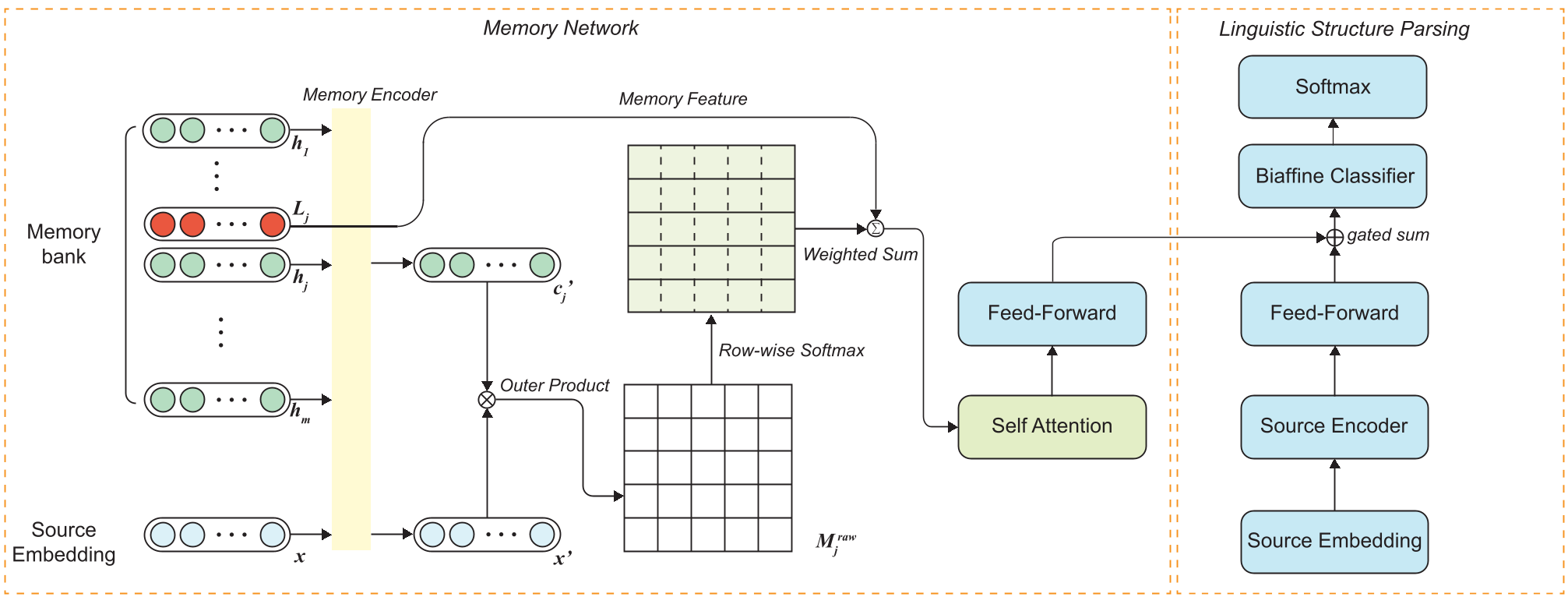
*Fig 1: The overall architecture where the AMN acts as a controller for addressing external storage.*
A unique innovation here is the **Read-Write Memory**. While "Read-Only" memory uses gold training data, "Read-Write" memory allows the model to store its own predictions (silver data) during inference, enabling a form of semi-supervised/online learning that makes the model more robust to domain shifts.
## Experimental Triumphs
The AMN module was tested on two heavy-duty tasks: **Syntactic Dependency Parsing** and **Semantic Role Labeling (SRL)**.
* **Universal Improvement**: On the Universal Dependencies (UD v2.3) benchmark across 12 languages, AMN consistently boosted the BIAF baseline, achieving SOTA in 7 languages.
* **Coping with Complexity**: Error analysis reveals that AMN is particularly effective for **long-distance dependencies**. As sentence length increases, the "memory lookup" provides the structural clues that standard Attention mechanisms often miss.

*Table 1: Competitive performance on English PTB and Chinese CTB benchmarks.*
## Deep Insight: Why Why Randomness and Writing Matter?
The authors discovered two counter-intuitive results in their ablation studies:
1. **Random Distance (RD)**: Surprisingly, even adding a randomly selected sentence to the memory helped. This acts as a regularizer, preventing the model from over-relying on perfect matches and forcing it to learn a more robust "transfer learning" capability.
2. **Read-Write Silver Memory**: Using the model's own predictions as memory during the second stage of training yielded gains nearly orthogonal to traditional semi-supervised methods like tri-training.
## Critical Analysis & Future Outlook
While AMN is powerful, it is computationally expensive. Retrieving from a large-scale treebank for every sentence in a high-throughput production environment is currently prohibitive. However, this work serves as a proof-of-concept for **Retrieval-Augmented Parsing**.
The takeaway for researchers is clear: the road to SOTA might not just be about more parameters or better pre-training, but about building models that can effectively "consult the library" of existing human knowledge.
## Conclusion
By integrating explicit memory into the neural pipeline, Li et al. have provided a blueprint for more interpretable and robust parsing. As we move toward larger and more generalized AI models, the ability to ground decisions in specific, retrieved evidence (AMN's "Textbook paradigm") will likely become a cornerstone of structural linguistic analysis.